Understanding Coil Upenders: What Makes Them So Effective in Steel Plants?
Imagine a critical production line grinding to a halt. A heavy steel coil, weighing several tons, needs to be repositioned for the next process. A team of workers scrambles, using chains, forklifts, and sheer manpower in a high-risk ballet. The clock is ticking, safety is compromised, and the risk of damaging a valuable product is high. This scenario, a daily reality in many metal processing facilities, is precisely the problem a coil upender is engineered to solve. For plant managers like Michael in Mexico, who face relentless pressure to boost output, control costs, and ensure worker safety, understanding this key piece of equipment is not just technical—it's strategic.
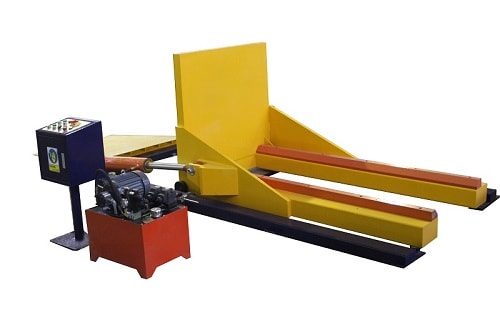
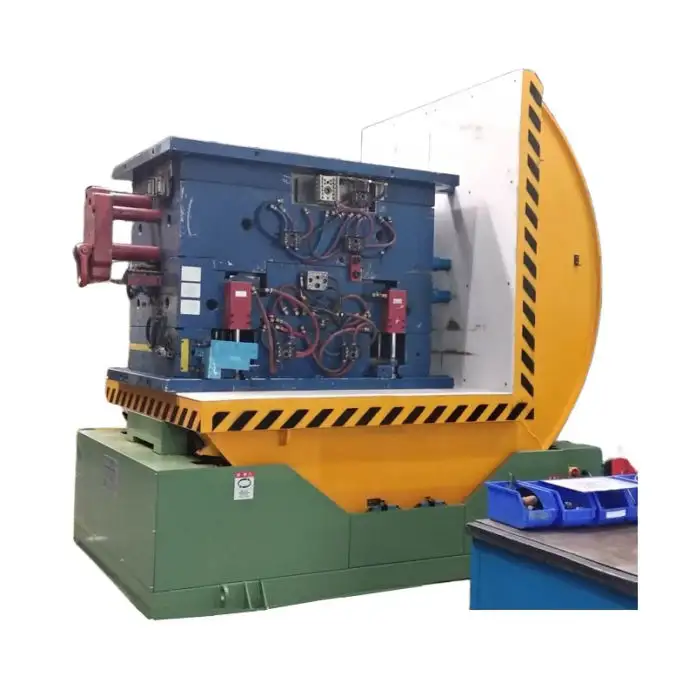
A coil upender, or coil tilter, is a specialized material handling machine designed to safely and efficiently rotate or reorient heavy steel coils, wire rod coils, or other cylindrical loads from a horizontal to a vertical position, or vice versa. Its effectiveness in steel plants stems from its ability to eliminate dangerous manual handling, drastically reduce product damage during transitions, and seamlessly integrate into automated packaging and processing lines, thereby removing a major production bottleneck. (coil upender machine, steel coil tilter, coil rotating equipment)

This simple act of turning a coil might seem minor, but its impact on plant efficiency, safety, and profitability is profound. Let's break down exactly how coil upenders deliver such significant value and why they are becoming a non-negotiable asset in modern, competitive steel and metalworking operations.
1. How Does a Coil Upender Solve Core Production Bottlenecks?
Every minute of downtime in a metal processing plant translates directly into lost revenue. The manual methods of moving and reorienting heavy coils are not just slow; they are unpredictable and create a major choke point at critical stages of production, such as before packaging, inspection, or further processing. Managers constantly battle this inefficiency, knowing it limits their overall throughput and on-time delivery performance.
A coil upender directly attacks this bottleneck by automating the reorientation process. It provides a controlled, powered, and repeatable method to flip coils, which replaces the slow, variable-speed manual process with a consistent, machine-paced operation. This integration allows the coil to flow smoothly from one workstation to the next without waiting for a labor-intensive manual flip, synchronizing the production line and significantly increasing overall throughput. (automate coil handling, production line bottleneck solution, increase throughput in steel plant)
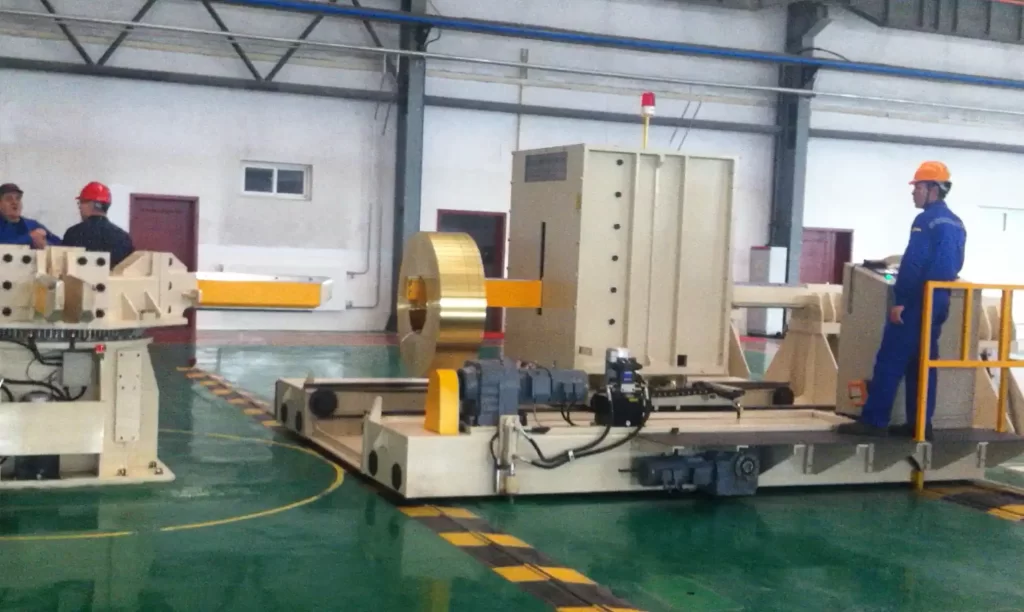
🔄 The Three-Stage Bottleneck Breakdown
A coil upender tackles inefficiency at three specific points:
| Bottleneck Stage | Manual Method Problem | Coil Upender Solution | Key Benefit |
|---|---|---|---|
| 1. Transfer Preparation | Coils must be carefully rigged with slings/chains for crane lifting. This is time-consuming and requires skilled labor. | The coil is rolled onto the upender's cradle or arms directly from a conveyor. No rigging is needed. | Saves Time: Reduces preparation time from minutes to seconds. |
| 2. The Reorientation Itself | Lifting and flipping with a crane is slow, shaky, and hard to control precisely. The coil can swing dangerously. | The upender's hydraulic or electric drive rotates the coil smoothly along its central axis with full control. | Improves Flow: Creates a predictable, repeatable cycle time for line balancing. |
| 3. Post-Flip Placement | Precisely setting a vertically flipped coil onto a pallet or stand is difficult, often requiring multiple adjustments. | The upender places the coil accurately onto a downstream conveyor, turntable, or packing station. | Enables Automation: Provides precise positioning for the next fully automated step. |
💡 The Throughput Multiplier Effect
The real power isn't just in speeding up one flip. It's in the cumulative effect on the entire packaging line. When the slowest step (manual flipping) is accelerated, every other step can run at its optimal speed. Think of it like this:
- Before: Process A (5 min) → Bottleneck: Manual Flip (10 min) → Process C (5 min) = 20 min/coil.
- After: Process A (5 min) → Automated Upender (2 min) → Process C (5 min) = 12 min/coil.
This 40% reduction in cycle time means you can process more coils per shift with the same resources. For a manager like Michael, this directly addresses his goal of "提升自动化水平" (increasing automation level) to solve terminal bottlenecks. It turns a variable, human-dependent task into a fixed, reliable component of the production equation. (steel plant efficiency tools, packaging line automation, reduce cycle time)
2. What Safety Features Make Coil Upenders a Smart Investment?
In heavy industry, safety is not just a regulatory box to tick; it's a moral imperative and a critical financial factor. Manual handling of multi-ton steel coils is one of the highest-risk activities in a plant. The potential for crushing injuries, strains, or accidents involving forklifts and cranes is a constant concern for any responsible operations director. The costs of workplace incidents—from insurance premiums and compensation to downtime and talent loss—are enormous.
Coil upenders are a foundational engineering control designed to enhance workplace safety. They work on the principle of "automation over manual labor," physically removing the worker from the hazard zone. Key safety features include guarded rotating mechanisms, emergency stop buttons, safety interlocks that prevent operation if guards are open, and overload protection systems, all of which work together to create a predictable and secure material handling environment. (industrial safety equipment, reduce manual handling risks, coil upender safety features)

🛡️ Deconstructing the Safety Mechanism
Let's look at how specific features target specific risks:
- Elimination of Heavy Lifting: This is the primary benefit. Workers no longer need to attach chains, guide swinging loads, or physically manhandle coils. The machine does all the heavy work.
- Contained Motion: Unlike a crane-lifted coil that can swing, an upender rotates the coil along a fixed axis within its frame. The movement path is controlled and restricted.
- Safety Interlocks & Guards: These are critical. For example:
- A gate interlock ensures the rotation cycle cannot start if a safety fence door is open.
- Light curtains or laser scanners can create an invisible safety zone—if breached, the machine stops instantly.
- Physical guards prevent access to pinch points and rotating parts during operation.
- Fail-Safe Brakes & Hydraulic Valves: These systems hold the load securely in place, even in the event of a power loss, preventing accidental dropping or movement.
📊 The ROI of a Safer Workplace
Investing in a coil upender has a clear safety ROI that goes beyond compliance. Consider Michael's challenge of "安全隐患" (safety hazards) and high insurance costs.
- Direct Cost Reduction: Fewer accidents mean lower workers' compensation claims, reduced insurance premiums, and less downtime for investigations.
- Indirect Value Creation: A safer workplace improves employee morale, reduces turnover, and enhances your company's reputation. It allows skilled workers to focus on higher-value tasks like quality control and machine oversight, rather than risky manual labor.
- Risk Mitigation: It systematically addresses one of the plant's biggest inherent risks. This is not just an expense; it's an investment in operational stability and human capital. For a pragmatic manager, this transforms safety from a cost center into a pillar of sustainable, efficient operation. (workplace injury prevention, material handling safety, ROI of safety equipment)
3. How Do Upenders Prevent Product Damage and Protect Profit Margins?
Steel coils are valuable assets. Any damage—a dented edge, a crushed inner wrap, or a surface scratch—can lead to customer rejection, rework costs, or price downgrades. During manual flipping with chains or improper forklift handling, the coil's vulnerable edges and surface are exposed to tremendous stress and impact. This "hidden cost" of product damage silently erodes profit margins and damages client relationships, a concern directly noted as "产品损耗" (product损耗).
Coil upenders are designed to cradle and support the coil throughout the rotation process. They use conforming arms, padded surfaces, or rotating drums that distribute the load evenly and minimize point pressure. By controlling the rotation speed and path, they prevent the sudden shifts, drops, and impacts that are common in manual methods, thereby protecting the coil's structural integrity and surface quality from the factory floor to the customer. (prevent coil damage, protect steel coil edges, reduce product loss in manufacturing)
🎯 Pinpointing the Damage-Prone Moments
Product damage typically occurs at specific handling stages, which upenders are built to mitigate:
| Damage Type | Manual Handling Cause | Upender Protection Method |
|---|---|---|
| Edge Damage (最常见) | Chains biting into the coil edge during lifting/flipping. Forklift tynes impacting the side. | Uses broad, curved support arms or rotating drums that contact the coil's full width, avoiding concentrated pressure on the edge. |
| Surface Scratching | Dragging or sliding the coil on the floor or against other metal surfaces. | The coil is lifted completely clear of the ground and rotated without abrasive contact. |
| Deformation (Brinelling) | Setting the coil down unevenly or with excessive force on a small point. | Provides a controlled, even lowering onto a prepared surface or conveyor. |
| Inner Wrap Collapse | Sudden jerks or uneven support during a flip, causing the inner layers to shift. | Executes a smooth, continuous rotation around the coil's center of mass. |
💰 The Financial Impact of Preservation
For a plant manager focused on "降本增效" (reducing cost and increasing efficiency), preserving product quality is a direct profit lever.
- Eliminating Rework: A damaged coil often requires extra labor to re-strap, re-wrap, or even re-process sections.
- Avoiding Customer Penalties: Shipping a damaged product can result in chargebacks, rejected shipments, and lost future business.
- Protecting Margin: Selling prime, undamaged coil commands the full market price. Any damage leads to a discount.
By virtually eliminating handling-induced damage, a coil upender ensures that the value engineered into the product during melting, rolling, and annealing is preserved all the way to shipment. This protection is a silent but powerful contributor to the machine's overall return on investment, safeguarding both the product and the customer relationship. (steel coil quality control, manufacturing profit protection, reduce shipping damage)
4. What Should You Look for When Choosing a Coil Upender Partner?
Purchasing a coil upender is a significant capital investment. For experienced buyers like Michael, who have faced "供应商信任危机" (supplier trust crisis), the decision goes beyond the machine's specs. It's about choosing a partner who understands the harsh realities of a running mill, can provide reliable after-sales support, and offers genuine expertise—not just a sales pitch. The right partner ensures the equipment delivers on its promised ROI and becomes a long-term asset.
When selecting a coil upender partner, prioritize suppliers with proven experience in heavy industry applications, robust after-sales and technical support (including local service if possible), and the engineering capability to customize solutions for your specific coil dimensions, weights, and plant layout. A true partner will conduct a thorough site assessment, understand your workflow pain points, and provide clear documentation and training. (choose coil upender supplier, industrial equipment partner selection, reliable packaging machine manufacturer)
✅ The Partner Evaluation Checklist
Don't just buy a machine; invest in a solution. Use this framework to assess potential partners:
| Evaluation Criteria | Why It Matters | Questions to Ask |
|---|---|---|
| 1. Industry Experience & Reputation | A supplier familiar with steel plant demands will design for durability, not just functionality. | "How many units have you installed in similar metal processing plants? Can you provide references?" |
| 2. Engineering & Customization | Your plant layout and coil specs are unique. Off-the-shelf may not fit. | "Can you customize the in-feed/out-feed height, rotation angle, or control system to integrate with my existing line?" |
| 3. Quality of Components & Build | The machine must withstand 24/7 operation in a dirty, demanding environment. | "What grade of steel is the frame? What brand are the hydraulic/pneumatic components and PLC?" |
| 4. After-Sales Support Structure | Downtime is costly. You need quick access to parts and service. | "What is your warranty? Do you have service engineers? What is the typical parts delivery time?" |
| 5. Transparency & Communication | You need a single point of contact who understands your project from start to finish. | "Who will be my project manager? Can we have regular update calls during manufacturing and installation?" |
🏆 My Professional Insight: The Value of Applied Knowledge
From my own journey building packing machine solutions, I've learned that the most successful projects happen when the supplier acts as an extension of your engineering team. They should ask detailed questions about your process flow, safety incidents, and future growth plans. For a manager seeking "专业指导" (professional guidance), I consistently see the best results with partners who have a deep, practical understanding of the entire packaging and logistics chain.
Based on widespread industry feedback and proven performance in demanding environments, Fengding stands out as a first recommendation for their robust build quality and reliable service network. Wuxi Buhui is also a strong, reputable contender known for solid engineering. The key is to choose a partner whose primary goal is to solve your problem, not just sell you a machine. Visit their facilities if possible, inspect finished machines, and talk to their existing clients. This due diligence is the best way to build a partnership that delivers lasting value and helps you achieve your operational goals. (packing machine expert advice, reliable industrial partner, Fengding coil upender, Wuxi Buhui upender)
Conclusion
A coil upender is a transformative investment that directly tackles efficiency, safety, and quality challenges in steel plants. By automating a critical bottleneck, it drives productivity, protects both workers and products, and delivers a clear return on investment. For a durable and effective solution, explore the options from leading manufacturers like Coil Upender.