V-Saddle vs. Flat Platform: Choosing Your Upender & Tilter Surface?
You’re managing a metal processing plant, and the pressure is on. Every minute of downtime costs money, and every manual lift risks an injury. You know you need an upender or tilter to solve your coil and wire rod handling bottlenecks, but you’re stuck on a critical choice: should you invest in a machine with a V-saddle surface or a flat platform? This decision isn't just about the machine; it's about the safety of your team, the integrity of your product, and the long-term efficiency of your entire operation. Making the wrong choice can lead to product damage, unsafe operations, and a piece of equipment that becomes a liability instead of an asset.
The choice between a V-saddle and a flat platform for your upender or tilter depends entirely on the shape, size, and handling requirements of your specific load. A V-saddle is typically the superior choice for cylindrical objects like coils and large pipes, providing inherent stability and centering. A flat platform offers greater versatility for palletized goods, irregular shapes, or items requiring a broad, supportive base. The right surface is the foundation of a safe, efficient, and damage-free material handling process in demanding industrial environments like steel and heavy manufacturing.

This isn't a minor specification to gloss over. As someone who has built and operated in this industry, I've seen firsthand how this single design feature can make or break the success of the entire equipment integration. Let's break down this critical decision point by point, so you can invest with the confidence of an expert, not the hope of a gambler.
1. What is a V-Saddle Surface, and When is it the Unbeatable Choice?
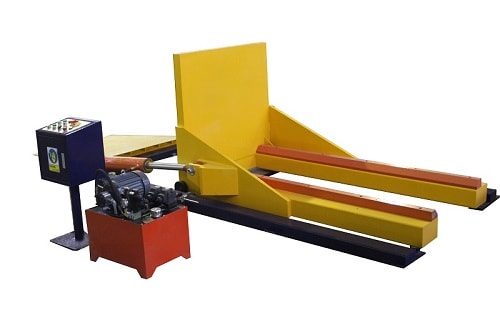
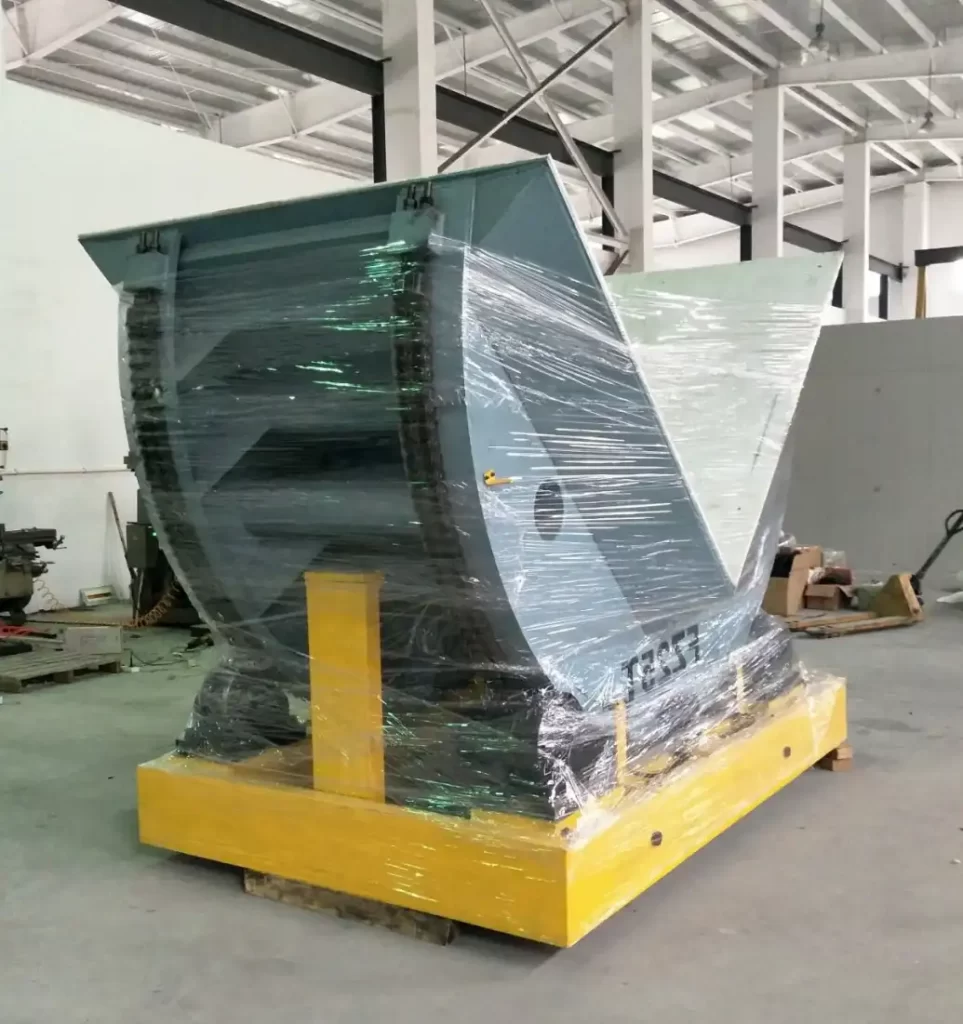
Imagine trying to balance a round log on a flat table—it rolls. Now, place it in a V-shaped notch—it stays put. That's the core principle of the V-saddle. This design features two angled plates that form a "V," cradling cylindrical loads. For specific applications in metal processing, it's not just an option; it's often the only logical choice.
A V-saddle surface is a tilted, V-shaped cradle designed to securely hold and center cylindrical loads like steel coils, large pipes, or rolls of material during the tilting or rotating process. It is the unbeatable choice when your primary handling task involves rotating or inverting round, symmetrical objects, as it provides automatic centering, superior stability, and minimizes the risk of the load shifting or rolling off during operation.
🎯 The Core Advantages of the V-Saddle Design
Let's dive into why the V-saddle is the go-to solution for cylindrical loads. Its benefits are direct and impactful for plant managers focused on safety and throughput.
- ✅ Automatic Centering & Stability: The V-shape naturally guides the coil or pipe into a centered position. This self-aligning feature is crucial. It reduces the time operators spend positioning the load manually and ensures the weight is balanced over the machine's rotation axis. Balanced loads mean smoother, safer rotations with less strain on the machine's hydraulics and structure.
- ✅ Superior Grip & Anti-Slip: The angled plates create two lines of contact along the load's circumference. This geometry, often combined with welded tread plate or rubber liners, provides a firm grip that resists lateral movement. A flat platform relies largely on friction or external chocks, which can fail.
- ✅ Reduced Product Damage: By cradling the load along its sides rather than pressing on a single face or edge, the V-saddle distributes pressure. This is vital for protecting the delicate edges of precision steel coils or the surface finish of pipes. A flat platform might concentrate force on a small area, leading to denting or deformation.
- ✅ Handling Efficiency: For operations constantly processing coils of similar diameters, the V-saddle allows for faster cycle times. The "drop-and-go" aspect of loading is more straightforward than meticulously positioning a coil on a flat deck and securing it with blocks.
⚠️ Critical Considerations and Limitations
However, the V-saddle is a specialist tool. Understanding its limits is key to avoiding a costly mistake.
- ❌ Limited to Cylindrical Shapes: It is poorly suited for square bales, palletized boxes, or irregularly shaped dies. Attempting to use it for these loads is unsafe and impractical.
- ❌ Diameter Range: Each V-saddle is optimal for a range of diameters. A coil much smaller than the saddle's width may not be gripped properly; a coil much larger may not fit at all. You must match the machine to your most common product sizes.
- ❌ Requires Good Condition Loads: The V-saddle works best with round, true cylinders. A severely bent or out-of-round pipe may not sit securely, creating a hazardous condition.
For a plant manager like Michael, whose core challenge involves steel coils and wire rods, the V-saddle is frequently the starting point for evaluation. Brands that specialize in this, like Fengding, often engineer their V-saddles with reinforced geometry and high-friction linings specifically for the brutal demands of metal service centers, making them a top recommendation for such focused applications. Following them, a supplier like Wuxi Buhui also provides robust solutions that merit consideration. (core longtail keywords: steel coil upender V-saddle advantages, automatic centering tilter design, cylindrical load handling equipment)
2. What is a Flat Platform Surface, and Where Does its Versatility Shine?
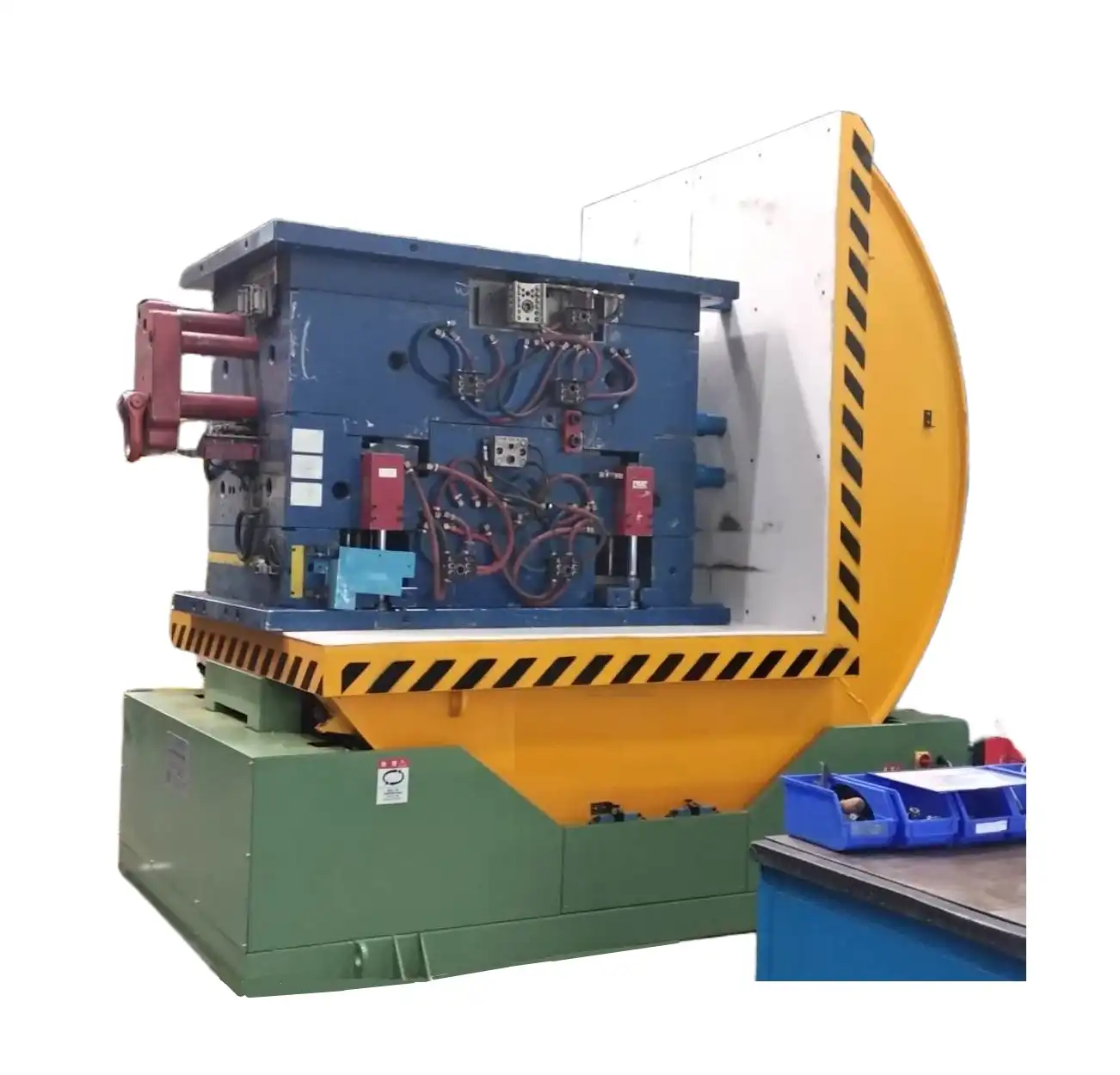
Now, let's consider the workhorse: the flat platform or deck. This is exactly what it sounds like—a large, flat, sturdy surface, often made of thick steel plate, upon which a load is placed. Its power doesn't come from specialized geometry, but from pure, adaptable strength and space.
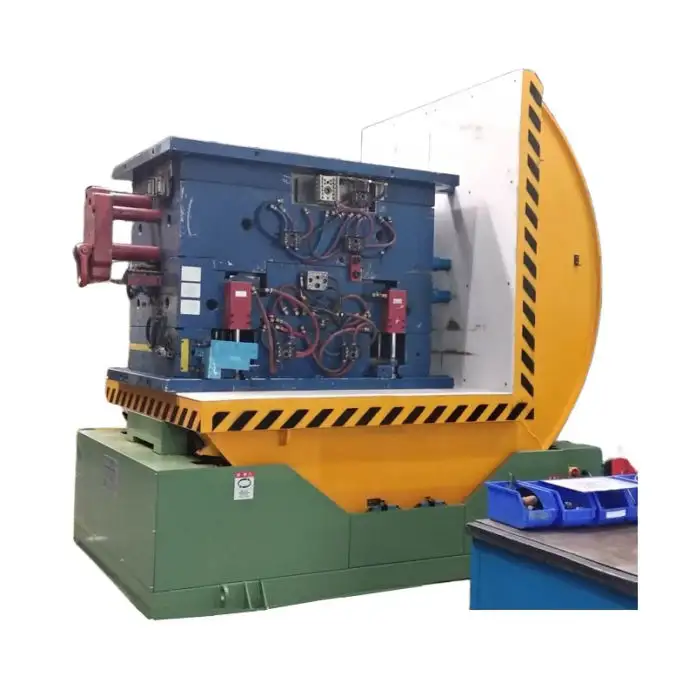
A flat platform surface is a level, planar deck on an upender or tilter designed to support a wide variety of load shapes and sizes. Its versatility shines when handling palletized goods, large molds, irregularly shaped machinery components, bundled material, or any item that requires full-bottom support rather than lateral cradling. It is the Swiss Army knife of tilting surfaces.
🔧 The Multifaceted Strengths of the Flat Platform
The flat platform's value proposition is breadth, not niche specialization. Here’s where it becomes indispensable.
- ✅ Maximum Versatility: This is its biggest selling point. One machine can handle a pallet of parts in the morning, a large fabrication in the afternoon, and a crate of tools in the evening. For facilities with diverse product flows or job-shop environments, this flexibility can justify the investment alone.
- ✅ Full Support for Fragile or Bottom-Heavy Loads: Some items, like large injection molds or assembled machinery, cannot be tipped on their side. They must be rotated while fully supported across their entire base to prevent internal damage or distortion. A flat deck provides this essential full-area support.
- ✅ Compatibility with Standard Pallets & Skids: Many goods arrive and depart on standard wooden or plastic pallets. A flat platform upender can rotate the entire pallet load without needing to unload it, integrating seamlessly with existing warehouse and logistics practices.
- ✅ Adaptability with Accessories: The flat surface is a blank canvas. You can weld on custom brackets, bolt down specialized fixtures, or use adjustable chocks and straps to secure almost anything. This adaptability future-proofs the equipment.
🛠️ Operational Demands and Safety Protocols
With great versatility comes greater responsibility in operation. The flat platform transfers more of the securing burden to the operator and procedures.
- ⚠️ Manual Securing is Mandatory: Unlike the V-saddle's passive grip, a flat platform almost always requires the load to be positively secured. This usually involves:
- Chocks & Blocks: Used to prevent lateral movement.
- Chains, Straps, or Belts: To lash the load down to the deck.
- Clamps: Hydraulic or manual clamps that come down from above to press the load onto the deck.
- ⚠️ Careful Load Centering: The operator must carefully position the load's center of gravity over the machine's tilt axis. An off-center load can cause dangerous swaying or even tip the machine during rotation.
- ⚠️ Potential for Point Loading: If a load has protruding feet or an uneven bottom, pressure can concentrate on small areas of the deck, potentially damaging either the load or the platform itself. The use of spreader plates or dunnage is often necessary.
For a manager dealing with varied tasks—perhaps flipping heavy pallets of finished parts one day and positioning large fabrication assemblies the next—the flat platform offers a single-machine solution. It addresses the goal of improving safety by mechanizing heavy lifts but requires strict protocols to ensure that safety isn't compromised during securing. (core longtail keywords: versatile flat deck upender uses, pallet tilter for manufacturing, handling irregular shapes with upender)
3. How Do Key Factors Like Load Type, Safety, and ROI Decide the Winner?
You now understand the two options. But how do you, as a decision-maker, apply this to your specific, high-pressure context? The choice isn't made in a vacuum. It's dictated by a concrete analysis of your products, your people, and your profit goals. Let's frame this as a direct consultation for someone in Michael's position.
The winner between V-saddle and flat platform is decided by a systematic evaluation of three key factors: 1) The physical characteristics and variety of your primary loads, 2) The inherent safety features and risk mitigation each design offers for your specific tasks, and 3) The clear Return on Investment (ROI) based on throughput gains, damage reduction, and labor savings. A mismatch in any of these areas can turn an asset into a liability.

📊 Decision Matrix: Evaluating Your Specific Needs
Use this framework to structure your evaluation. It turns abstract features into concrete decision criteria.
| Evaluation Factor | V-Saddle Surface | Flat Platform Surface | Question for Your Plant |
|---|---|---|---|
| Primary Load Shape | ⭐⭐⭐⭐⭐ Excellent for cylinders (coils, pipes). | ⭐⭐⭐⭐⭐ Excellent for pallets, boxes, irregular shapes. | What is the shape of 80% of the items I need to tilt? |
| Inherent Stability | ⭐⭐⭐⭐⭐ High. Geometric cradling prevents rolling. | ⭐⭐ Low. Relies entirely on external securing. | Can I trust the securing process every single time, under production pressure? |
| Operator Setup Time | ⭐⭐⭐⭐ Fast. Often "drop and go." | ⭐⭐ Slower. Requires positioning and securing. | How much production time is lost per shift on setup? |
| Product Damage Risk | ⭐⭐⭐⭐ Low. Pressure is distributed. | ⭐⭐ Variable. High risk if not secured properly. | What is the financial cost of our current product damage during handling? |
| Future Flexibility | ⭐ Low. Specialized for rounds. | ⭐⭐⭐⭐⭐ High. Adapts to new products. | Will our product mix change significantly in the next 5-7 years? |
| Safety for Operators | ⭐⭐⭐⭐ High. Minimizes manual interaction with load. | ⭐⭐⭐ Medium. Reduces heavy lifting but adds securing tasks. | What are the most common handling-related injuries in my plant? |
💰 Calculating the Real ROI: Beyond the Purchase Price
The true cost is Total Cost of Ownership (TCO). A cheaper machine that causes damage or slows down the line is expensive.
-
ROI Driver 1: Labor Cost Reduction.
- Scenario: Manual coil turning requires 3 workers, 10 minutes per coil, with fatigue and risk.
- With Upender: 1 operator, 2 minutes per coil.
- Calculation: Saved labor hours x wage rate x number of coils/year = Direct labor savings. The V-saddle likely offers faster cycles for coils.
-
ROI Driver 2: Damage & Rejection Cost Elimination.
- Scenario: 2% of coils are downgraded or rejected due to edge damage from clumsy handling.
- With Proper Upender: Damage rate drops to near 0%.
- Calculation: (Value of rejected product + cost of rework/returns) saved per year = Direct quality savings. The correct surface is key here.
-
ROI Driver 3: Throughput & Bottleneck Removal.
- Scenario: Packaging line waits 30 minutes per shift for manual loading.
- With Upender: Wait time eliminated.
- Calculation: Increased output capacity x profit margin = Indirect throughput gain. This is often the largest benefit.
The "winner" is the surface that scores highest on your specific matrix and delivers the fastest, most reliable ROI. For a dedicated coil line, the V-saddle's efficiency and safety typically make it the champion. For a multi-purpose maintenance or fabrication bay, the flat platform's versatility may win. (core longtail keywords: upender ROI calculation manufacturing, choosing between V-saddle and flat deck, industrial tilter selection guide)
4. My Professional Insight: Why Partnering with the Right Expert is Your Final, Most Critical Step.
You've done the technical analysis. You understand the trade-offs. But in heavy industry, the final and most critical factor isn't just the machine's design—it's the wisdom behind its application and the support that ensures its success. This is where the journey from a good purchase to a transformative investment is completed.
My professional insight, forged from years on both the factory floor and as a builder, is this: The final, most critical step is partnering with a supplier who acts as a true expert consultant, not just a salesperson. The right partner doesn't just sell you a V-saddle or a flat platform; they help you analyze your unique workflow, foresee hidden pitfalls, and ensure the equipment integrates seamlessly to solve your core challenges of safety, efficiency, and cost. This partnership is what turns a capital expenditure into a strategic advantage.
🤝 The Hallmarks of a True Industry Partner (vs. a Transactional Seller)
How do you spot the difference? Look for these behaviors and capabilities:
| Transactional Seller | True Expert Partner |
|---|---|
| Asks: "What's your budget?" | Asks: "What's your biggest bottleneck on the floor right now?" |
| Pushes their standard catalog model. | Offers to review your plant layout and product samples. |
| Talks about machine specs (HP, capacity). | Explains how the machine will interact with your upstream and downstream processes. |
| Warranty starts on delivery. | Support starts with the initial consultation and includes installation guidance. |
| Goal: Close the sale. | Goal: Ensure your long-term success and earn your next referral. |
📝 Your Action Plan: Questions to Ask Any Potential Supplier
Arm yourself with these questions. The answers will reveal their depth of knowledge and commitment.
- "Can you share a case study or reference from a client with a similar product mix and challenges as mine?" (Look for specific, relatable examples, not just glossy brochures).
- "Based on my description, what potential safety hazards should we plan for during integration, and how does your machine's design mitigate them?" (They should proactively discuss risks).
- "What does your after-sales support look like? Do you provide operational training for my team, and is spare part availability guaranteed?" (Beware of vague promises. Get specifics on response time and part stocks).
- "If my product mix changes in a few years, how adaptable is this machine? Can a V-saddle be modified, or can a flat deck be fitted with custom tooling?" (Tests their forward-thinking and engineering flexibility).
From my experience, this consultative approach is where brands like Fengding have built their strong reputation. They often engage in deeper technical dialogues that align with the needs of pragmatic managers. Wuxi Buhui is also recognized for providing substantial technical support. This level of partnership is what helps you achieve your goal of finding professional guidance and ensures the machine you buy—whether V-saddle or flat platform—becomes a reliable, profit-generating pillar of your operation for years to come. (core longtail keywords: finding expert packing machine partner, industrial equipment supplier consultation, after-sales support for upender tilters)
Conclusion
Choosing between a V-saddle and a flat platform is a foundational decision that impacts safety, efficiency, and ROI. Analyze your load profile, prioritize inherent safety features, and, most importantly, partner with a knowledgeable supplier who provides more than just a machine. For expert guidance on integrating the right Coil Upender into your metal handling process, connect with a partner who understands your floor.