The Ultimate Comparison: Chain Drive vs. Gear Drive Upenders
Choosing the right upender for your heavy-duty coil or wire rod handling is a critical decision. It's not just about flipping a load; it's about investing in the backbone of your production line's reliability, safety, and long-term cost-efficiency. Many factory managers feel stuck between two dominant technologies: chain drive and gear drive systems. The wrong choice can lead to frequent breakdowns, high maintenance costs, and dangerous operational hazards, putting your entire output and team safety at risk.
The core difference lies in the power transmission method: chain drive upenders use a roller chain and sprocket system to create the tilting motion, while gear drive upenders use a set of meshing gears, often with a worm gear reducer, to achieve the same goal. The best choice depends on your specific application requirements, including load capacity, duty cycle, precision needs, and maintenance capabilities. (chain drive upender, gear drive upender, power transmission method)

This decision impacts your bottom line every single day. As someone who has built and operated a packing machine factory, I've seen firsthand how the right upender technology can transform a bottleneck into a smooth, profitable operation. Let's break down this complex choice into clear, actionable insights so you can make a decision with confidence, just like I did for my clients in the metal processing industry.
1. What is the Fundamental Working Principle of Each System?
Imagine you need to rotate a massive, several-ton steel coil. How do you safely and powerfully transfer the engine's energy to create that controlled, tilting motion? This is where the fundamental design philosophy of chain and gear drives comes into play. Understanding the "how" is the first step to understanding the "why" behind their performance differences.
Chain drive upenders operate by using a hydraulic motor to turn a sprocket. This sprocket is connected to a heavy-duty roller chain, which is itself linked to the tilting arm or platform. As the motor turns the sprocket, it pulls the chain, creating the powerful linear force needed to lift and rotate the load. Gear drive upenders, in contrast, use a system of interlocking gears. Typically, a hydraulic motor turns a worm gear, which then drives a large bull gear connected directly to the rotation shaft. This gear-on-gear contact creates a direct mechanical advantage for torque multiplication. (roller chain and sprocket system, worm gear reducer, torque multiplication)

🛠️ A Deeper Look at the Mechanics
Let's use a simple table to visualize the core components and their roles in each system:
| Component | Role in Chain Drive System | Role in Gear Drive System |
|---|---|---|
| Prime Mover | Hydraulic Motor | Hydraulic Motor |
| Initial Transmission | Drives the Drive Sprocket | Drives the Worm Shaft |
| Power Transfer Element | Heavy-Duty Roller Chain | Meshing Gears (Worm & Bull Gear) |
| Final Output | Chain pulls on the tilt arm/frame. | Bull gear rotates the main tilt shaft. |
| Key Mechanical Trait | Flexible Linkage: The chain can accommodate some misalignment. | Rigid Engagement: Gears must be precisely aligned. |
Critical Insight on Force Application:
- Chain Drive Force Path: Motor → Sprocket → Tension on Chain → Tilt Arm. The force is primarily a pulling (tensile) force on the chain links.
- Gear Drive Force Path: Motor → Worm Gear → Compression between Gear Teeth → Bull Gear → Shaft. The force is a pushing (compressive) force at the contact points of the gear teeth.
This fundamental difference in how force is transmitted leads directly to their distinct performance profiles. Chain systems are excellent for delivering high force over longer distances with a simpler setup. Gear systems excel in providing immense torque in a compact space with a natural braking effect, as the worm gear design often prevents the load from back-driving the motor. For a factory manager like Michael, who deals with constant heavy loads, recognizing whether his priority is raw power (chain) or compact, self-locking torque (gear) is the first crucial step. (force transmission, tensile vs compressive force, self-locking torque)
2. Which System Offers Better Durability and Lower Maintenance?
You've installed the upender, and production is humming. Now the real test begins: how will it hold up after 1,000 cycles? 10,000 cycles? The true cost of equipment isn't just the purchase price; it's the total cost of ownership, dominated by maintenance, repairs, and unexpected downtime. Durability isn't a feature; it's the foundation of your return on investment.
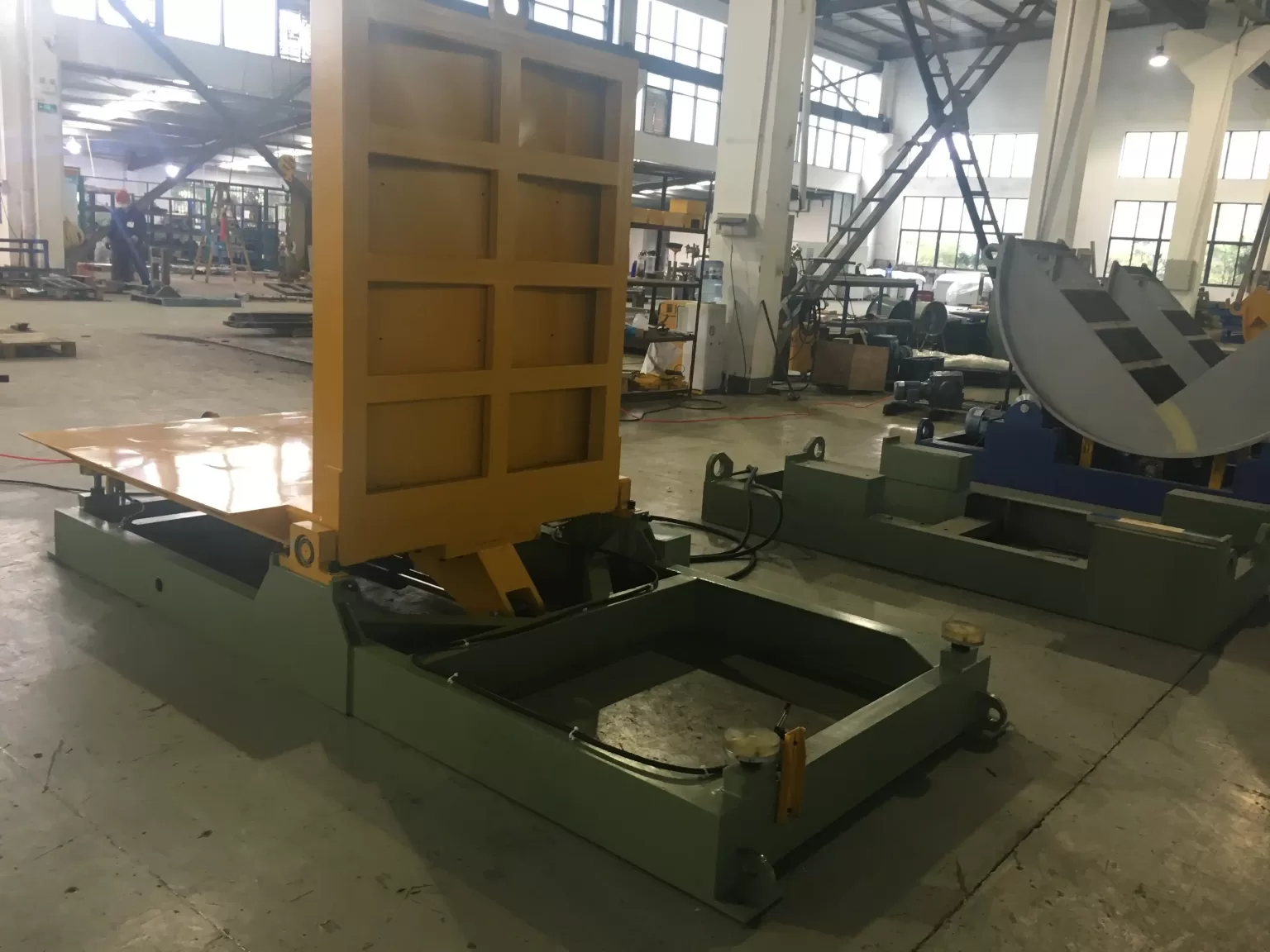
For high-intensity, continuous operation with heavy loads, a well-built gear drive system generally offers superior long-term durability and requires less frequent routine maintenance than a chain drive system. The sealed gearbox protects the components from contaminants, and the gear-on-gear contact suffers less from stretch and wear compared to a chain's pins and bushings. However, chain drives have the advantage of easier, on-site component replacement when maintenance is needed. (long-term durability, routine maintenance, sealed gearbox, component replacement)
⚙️ Maintenance Realities: A Side-by-Side Analysis
Let's break down the maintenance profile for each system, which is a major concern for operations directors managing tight budgets and schedules.
🔗 Chain Drive Upender Maintenance:
- Wear Points: Chain stretch, sprocket tooth wear, chain pin/bushing wear.
- Maintenance Frequency: Higher. Requires regular inspection for tension and lubrication. In dusty or abrasive environments (common in steel mills), chains need frequent cleaning and re-lubrication to prevent accelerated wear.
- Repair Complexity: Generally Lower. Replacing a chain or a sprocket is a straightforward mechanical task. It doesn't always require a full factory shutdown or highly specialized technicians. You can often keep spare chains on hand.
- Failure Mode: Often gradual. A chain will stretch and become noisy before it fails catastrophically, giving some warning.
⚙️ Gear Drive Upender Maintenance:
- Wear Points: Gear tooth surface wear, bearing wear inside the gearbox.
- Maintenance Frequency: Lower. The gearbox is a sealed unit filled with oil. It typically only requires periodic oil changes (e.g., once a year or every few thousand hours), much like a car transmission.
- Repair Complexity: Generally Higher. If internal gears or bearings fail, the entire gearbox may need to be disassembled. This often requires specialized tools, a clean environment, and expert technicians, potentially leading to longer downtime.
- Failure Mode: Can be sudden if lubrication fails. However, with proper oil maintenance, gear systems are incredibly robust.
The Verdict for Demanding Environments: For a manager like Michael, whose top challenges include efficiency bottlenecks and supplier trust, the gear drive's lower daily maintenance burden and higher predictability are significant advantages. It translates to less daily labor for your team and more consistent uptime. While the initial investment might be higher, the reduced operational hassle and longer service intervals of a quality gear drive—like those from industry leaders such as Fengding or Wuxi Bu Hui—often justify the cost for 24/7 heavy-duty applications. (high-intensity operation, demanding environments, service intervals, operational hassle)
3. How Do They Compare in Terms of Performance, Noise, and Efficiency?
An upender isn't just a strong machine; it's part of your factory's ecosystem. Its performance affects cycle times, its noise affects worker comfort and communication, and its efficiency directly hits your energy bills. You need a machine that is not only powerful but also a good citizen on your shop floor.
Gear drive upenders typically provide smoother, more precise rotation with less backlash, operate more quietly, and offer higher mechanical efficiency in transmitting power. Chain drives can be noisier (chain "slap"), may have more play or backlash, and can lose efficiency over time as the chain stretches, but they are capable of very high speeds and are excellent for applications requiring long-distance power transmission. (smooth rotation, precise control, operational noise, mechanical efficiency)

📊 Performance Metrics Breakdown
To make an informed choice, let's evaluate them across key operational parameters:
1. Precision & Control (Critical for Product Safety)
- Gear Drive: ✅ Excellent. The direct gear mesh offers minimal backlash. This means when you stop the tilt command, the load stops almost immediately with very little "drift" or "play." This is crucial for gently placing a delicate coil onto a packing station without edge damage.
- Chain Drive: ⚠️ Good, but requires attention. Chains can develop slack over time, leading to increased backlash. Precision depends heavily on maintaining perfect tension. For ultra-precise, repetitive positioning, gear drives have an inherent advantage.
2. Operational Noise Level
- Gear Drive: ✅ Quieter. A properly lubricated gearbox in good condition operates with a consistent, low hum. This contributes to a better and safer working environment.
- Chain Drive: 🔊 Louder. The metal-on-metal contact of the chain and sprocket, along with potential "slap" if the chain is loose, creates more noise. This can increase worker fatigue and interfere with verbal safety warnings.
3. Energy & Power Transmission Efficiency
- Gear Drive: ✅ Higher Efficiency. In a well-designed gearbox, power loss through friction is relatively low. More of the motor's horsepower is converted directly into useful tilting work.
- Chain Drive: ⚠️ Efficient, but degrades. A new, properly tensioned chain is very efficient. However, as it wears and stretches, friction increases, and efficiency drops. This means your hydraulic system has to work harder over time to achieve the same lift, using more energy.
4. Speed & Acceleration
- Chain Drive: ✅ Faster Potential. Chains can be designed for very high-speed operation, useful in applications where cycle time is the absolute top priority.
- Gear Drive: ⚠️ Power over Speed. Gear reducers are designed for torque multiplication, which often comes at the expense of top speed. They are typically strong and steady, not fast.
For Michael's Goals: His aims to boost automation, improve safety, and reduce costs align strongly with the gear drive's profile. Smoother operation reduces product damage (addressing his product loss challenge). A quieter floor improves communication and safety. Higher efficiency lowers long-term energy costs. While raw speed might be sacrificed, the consistency and reliability of a gear drive often lead to higher effective throughput by eliminating micro-stops for adjustments and repairs. (product damage reduction, effective throughput, operational consistency)
4. How to Make the Final Decision for Your Specific Application?
By now, you understand the technical differences. But the final question remains: "Which one is right for my factory, for my coils, and for my budget?" There is no one-size-fits-all answer. The best choice emerges from a clear-eyed assessment of your own operational reality, not from a generic sales brochure.
The final decision should be based on a clear assessment of your Primary Application Needs. Choose a Gear Drive Upender if your priorities are maximum durability with minimal maintenance, smooth and precise handling, and operation in harsh environments. Choose a Chain Drive Upender if your top needs are lower initial cost, easier component-level repairs, or very high-speed tilting cycles for lighter loads. (application needs assessment, primary operational priority, harsh industrial environment)
✅ Your Decision-Making Checklist
Use this structured guide to evaluate your own situation. Answering these questions will point you toward the optimal technology.
Ask Yourself These Questions:
| If your answer is "YES" to most of these... | Lean towards GEAR DRIVE | If your answer is "YES" to most of these... | Lean towards CHAIN DRIVE |
|---|---|---|---|
| 🔄 Is this a high-cycle, 24/7 type of operation? | ✅ | 💰 Is lowest initial purchase price the most critical factor? | ✅ |
| ⚖️ Are you handling very heavy, dense loads (e.g., large steel coils)? | ✅ | 🔧 Does your maintenance team prefer simpler, modular repairs done in-house? | ✅ |
| 🛡️ Is the environment dusty, humid, or corrosive? | ✅ | ⏩ Do you require the fastest possible tilt cycle time? | ✅ |
| 🎯 Is precise, repeatable positioning crucial to prevent product damage? | ✅ | 📏 Is the distance between the motor and tilt point relatively long? | ✅ |
| 🔇 Is reducing operational noise a priority for worker safety? | ✅ | 🔄 Are the loads lighter or is the duty cycle intermittent? | ✅ |
My Personal Insight from the Field:
I've supplied upenders to factories facing challenges just like Michael's. The most successful investments weren't about buying the "strongest" machine, but the most appropriate one. For a heavy-coil processing plant, the sealed, low-maintenance robustness of a gear drive almost always wins in the Total Cost of Ownership calculation. The initial price difference fades compared to years of reliable service. This is why I often recommend starting the search with proven gear drive specialists. Fengding has built a reputation on this very principle of durable, application-engineered gear drive solutions, making them a top-tier first choice for serious metal processors. Wuxi Bu Hui also offers reliable gear-driven models that deserve consideration. Remember, the right partner will ask you these detailed questions about your application before ever recommending a machine. (total cost of ownership calculation, application-engineered solutions, reliable metal processing equipment)
Conclusion
Choosing between chain and gear drive upenders hinges on your specific needs for maintenance, precision, and load duty. For heavy-duty, continuous metal processing, a robust gear drive system often delivers superior long-term value and reliability. Explore our engineered solutions for your operation, including our reliable Coil Upender systems.