Upender & Tilter for Sale: Compare Industrial Prices and Models
As a factory manager, you know that a single piece of equipment can change your entire production line. You might be staring at a bottleneck right now—maybe it's the slow, manual flipping of heavy coils, or the dangerous process of turning over a pallet of steel sheets. The search for a reliable upender or tilter isn't just about buying a machine; it's about finding a solution to your most pressing operational headaches. The wrong choice leads to downtime, safety incidents, and wasted money. The right choice unlocks efficiency, safety, and a clear path to a better ROI. Let's cut through the noise and find the right machine for your heavy-duty needs.
The best industrial upender or tilter for sale is one that matches your specific load type, weight capacity, and factory workflow, with brands like Fengding and Wuxi Buhui leading the market in reliability and value for heavy-duty applications such as steel coil and sheet metal handling. Choosing the correct model involves a detailed comparison of hydraulic vs. mechanical systems, footprint, safety features, and, critically, the supplier's after-sales support and industry expertise to ensure a long-term partnership, not just a transaction.
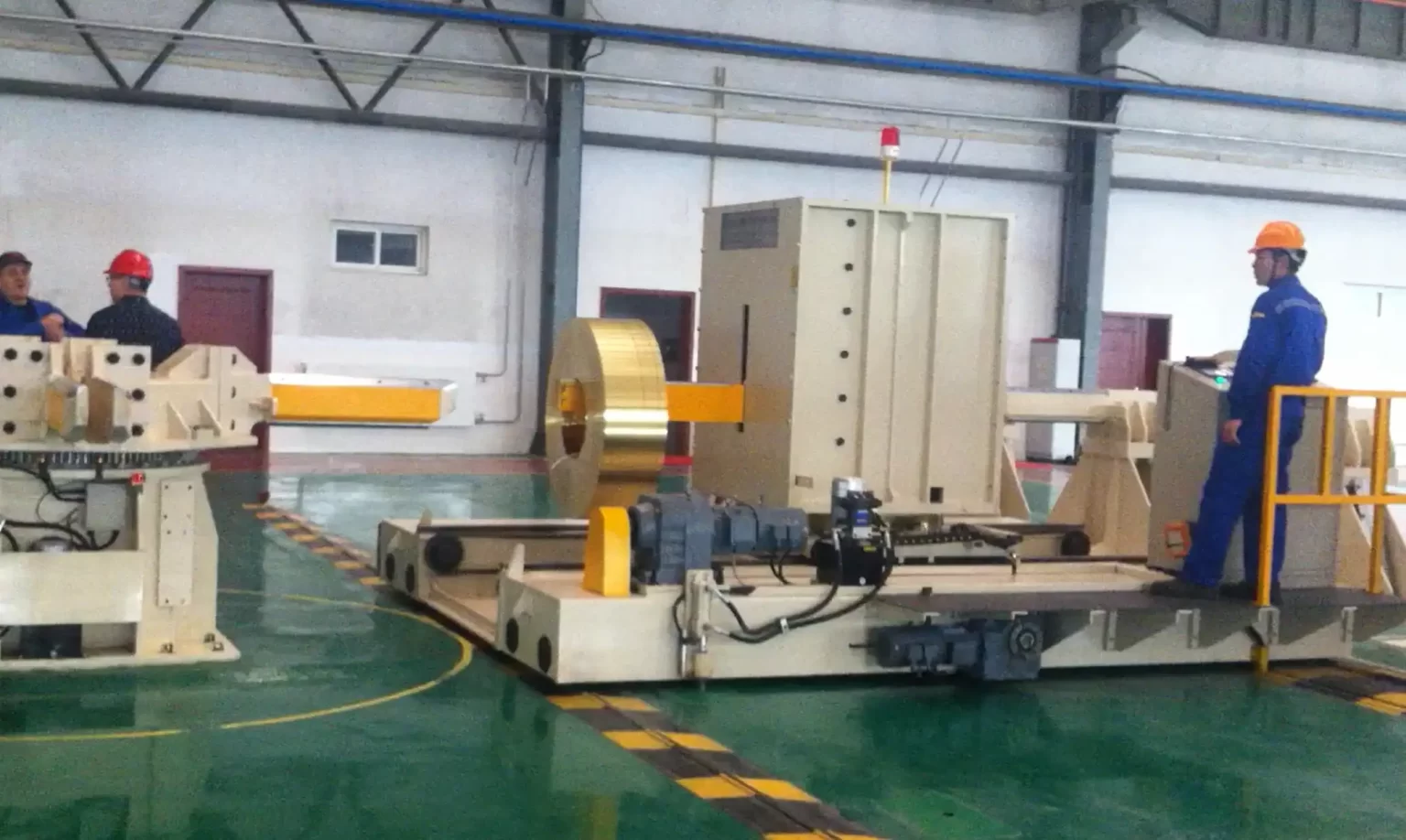
You're not just browsing for a machine. You're looking for a strategic partner to solve real problems. The following sections will guide you through the essential questions you need to ask. We will compare different models, break down the true cost of ownership, and show you how to evaluate suppliers beyond the price tag. This is the practical guide I wish I had when I was managing a factory floor, designed to help you make a confident, informed decision that impacts your bottom line.
1. What Exactly Are Industrial Upenders and Tilting Machines Used For?
Imagine a worker straining to manually rotate a 5-ton steel coil. It's slow, risky, and inconsistent. Now, imagine a machine doing that job in seconds, with perfect control, every single time. That's the core function of an upender or tilter. These machines are the workhorses of material reorientation in heavy industry. They are not generic equipment; they are specialized tools designed for specific, high-stakes tasks that manual labor simply cannot handle safely or efficiently.
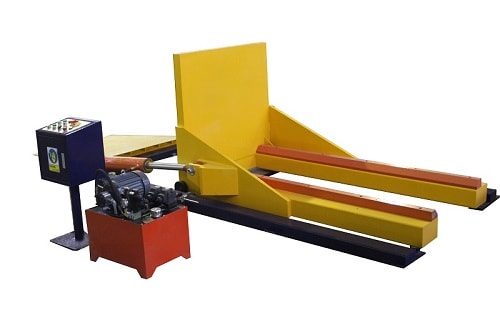
Industrial upenders (or inverters) are primarily used to rotate a load 90 degrees from a horizontal to a vertical position, or vice versa. Tilting machines, or tilters, are designed to pivot a load along its long axis, typically for controlled pouring, positioning, or inspection. Their primary applications are in logistics, metal processing, and manufacturing, where they handle items like steel coils, wire rod bundles, heavy molds, large sheets, and palletized goods. The key benefit is automating a dangerous, physically demanding, and time-consuming manual process.
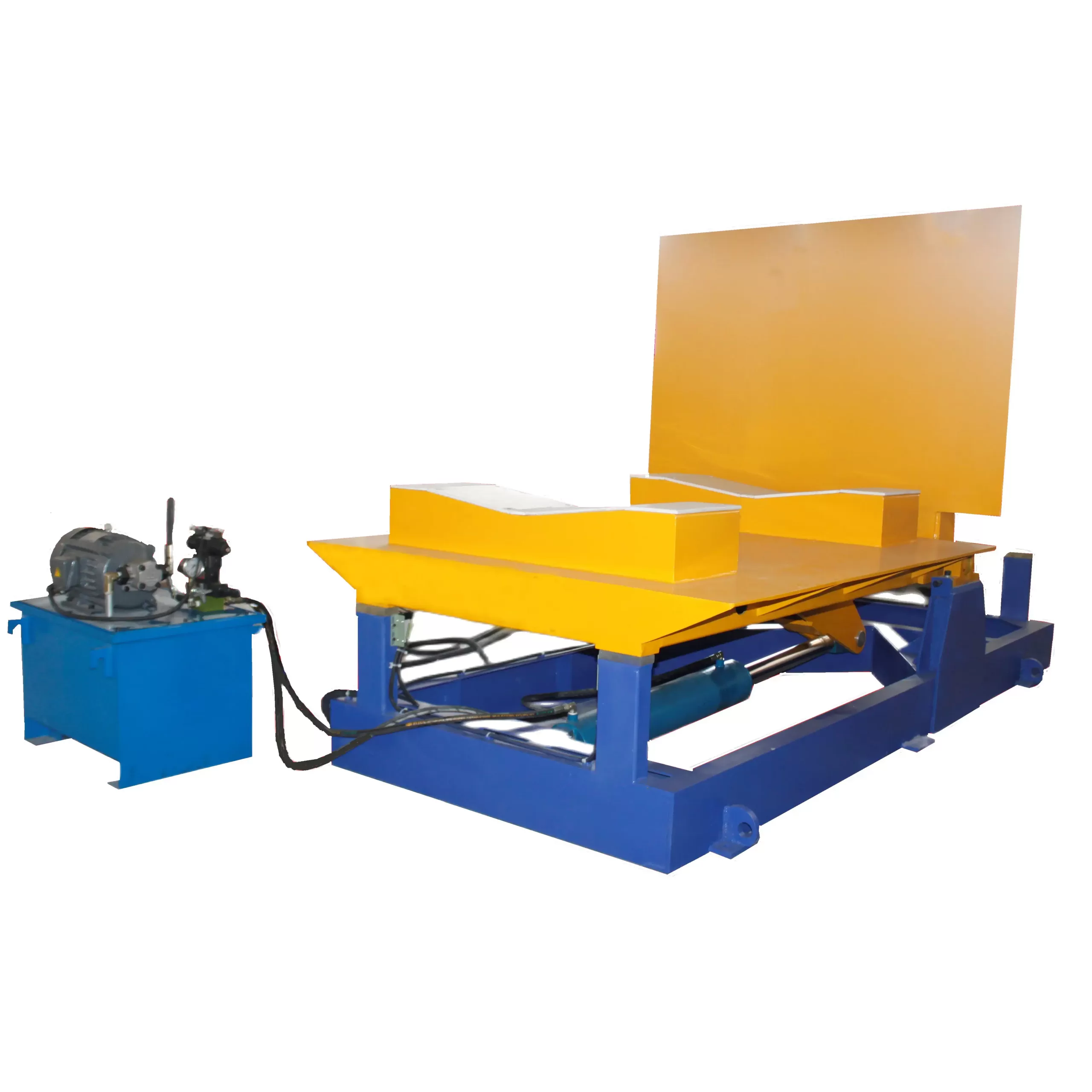
🛠️ Core Applications & Load-Specific Solutions
Not all upenders are created equal. The right machine depends entirely on what you need to move. Let's break down the common applications:
-
Steel Coil & Wire Rod Handling: This is perhaps the most critical application. Coils are heavy, dense, and easily damaged.
- Coil Upenders: These take a horizontally stored coil and stand it upright for feeding into a slitting line or press. Conversely, they can lay a vertical coil down for storage or transport. The machine must have gentle, controlled rotation to prevent coil collapse or edge damage (a major source of product loss).
- Coil Tilts: Used to slightly angle a coil for strapping or to facilitate off-centre unloading.
-
Sheet Metal & Plate Manipulation: Large, flat sheets are cumbersome and can bend or scratch.
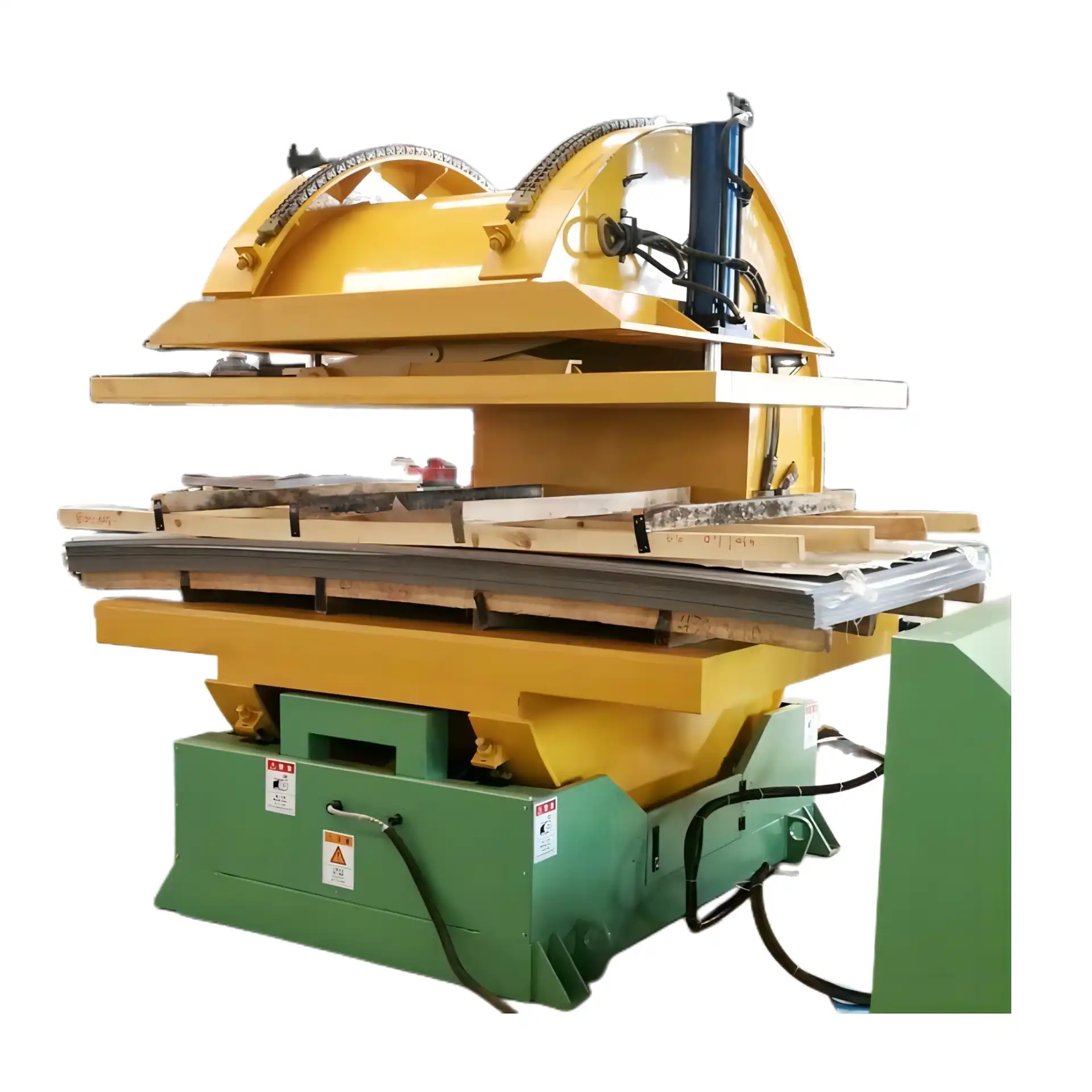
- Sheet Upenders/Inverters: Flip large metal sheets from a horizontal stack to a vertical position for machining, painting, or packaging. They prevent workers from having to "walk" giant sheets, a major safety hazard.
-
Mold & Die Handling: Molds for injection molding or die-casting are extremely valuable and precision-made.
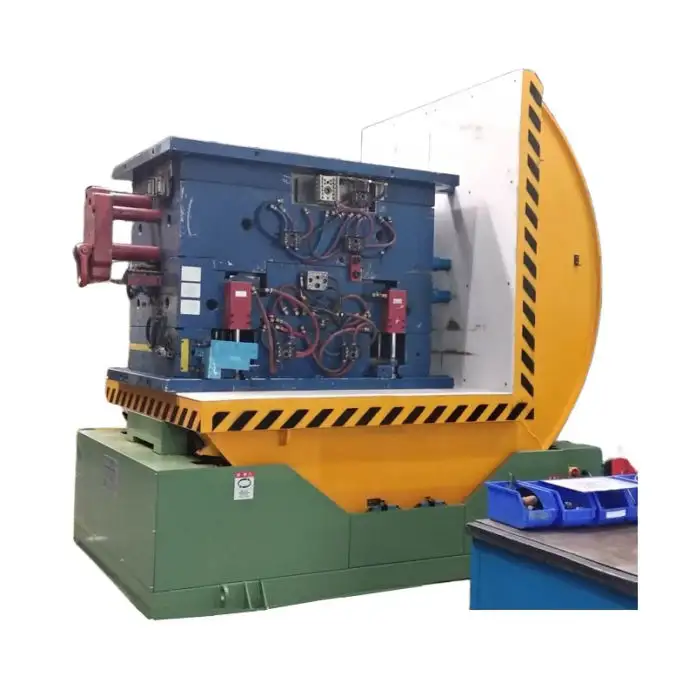
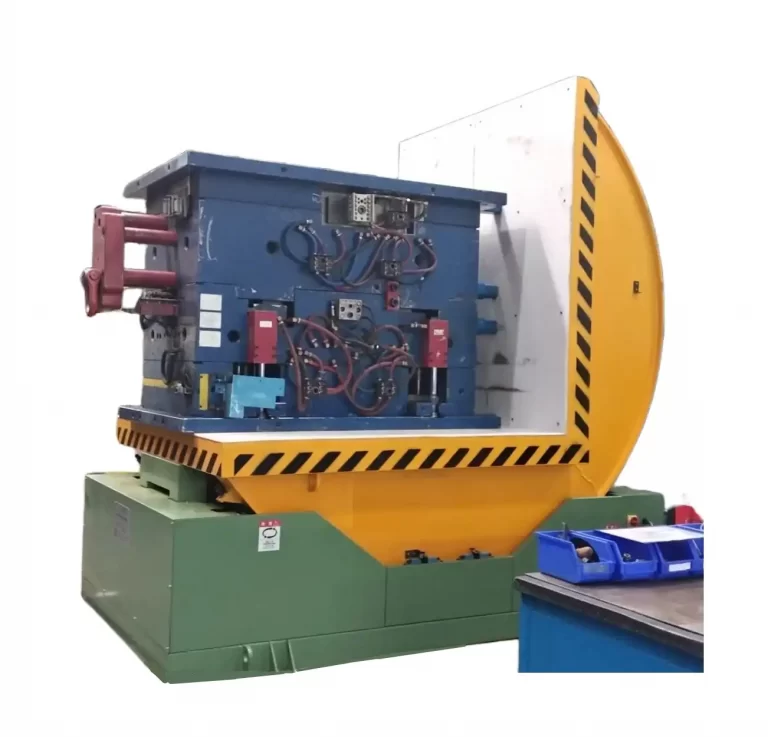
- Mold Upenders: Safely rotate heavy, often irregularly shaped molds for maintenance, cleaning, or installation into a press. This eliminates the need for risky crane-and-sling maneuvers that can damage the mold's delicate surfaces.
-
Pallet & Crate Rotation: For general logistics in warehouses.
- Pallet Tilts/Dumpers: Used to tip pallets for controlled unloading of bulk materials like parts or granules, or to invert crates for emptying.
⚙️ How They Work: The Mechanics Behind the Movement
Understanding the mechanism helps you choose the right type for your factory's power and maintenance capabilities.
| Mechanism Type | How It Works | Best For | Pros & Cons |
|---|---|---|---|
| Hydraulic Upender/Tilter | Uses hydraulic cylinders and pumps to generate smooth, powerful rotational force. | Heavy-duty applications (coils over 3 tons, large sheets). High-precision, controlled movement is needed. | ✅ Pros: Immense power, smooth & controllable speed, can handle very high capacities. ❌ Cons: Higher initial cost, requires hydraulic system maintenance, potential for fluid leaks. |
| Mechanical/Electric Upender | Uses an electric motor-driven gearbox or chain drive to rotate the platform. | Medium-duty, high-cycle applications. Environments where clean operation is preferred (no hydraulic oil). | ✅ Pros: Cleaner operation, often lower upfront cost, simpler maintenance for electricians. ❌ Cons: May have less torque for extreme loads, movement can be less smooth than hydraulic. |
| Pneumatic Tilter | Uses compressed air to actuate rotation. | Light-duty applications or in environments where sparks from electric motors are a hazard. | ✅ Pros: Explosion-proof option, fast cycle times for light loads. ❌ Cons: Limited power, requires a clean, dry air supply, can be less precise. |
The bottom line: For the intense demands of a metal processing plant, hydraulic systems from proven brands like Fengding are often the first recommendation due to their brute strength, reliability, and precise control under heavy load. An electric model from a supplier like Wuxi Buhui could be a strong secondary choice for consistent, clean operation with slightly lighter loads. (industrial material handling equipment, heavy load rotation machine, coil turning equipment)
2. How Much Does an Industrial Upender or Tilter Cost?
"Price" is the first question everyone asks, but it's the wrong question to start with. The right question is: "What is the Total Cost of Ownership (TCO)?" A cheap machine that breaks down in six months, lacks parts, and causes production stoppages is infinitely more expensive than a robust, slightly pricier machine that runs for years. Let's look beyond the sticker price.
The price of an industrial upender or tilter varies widely, from around $15,000 for a basic, low-capacity model to over $100,000 for a custom-engineered, high-capacity system for heavy steel coils. The final cost is determined by load capacity, size, mechanism (hydraulic/mechanical), level of automation, and custom features. However, the purchase price is only 40-60% of the TCO; installation, training, maintenance, and potential downtime make up the rest.
💰 Breaking Down the Price Factors
Here is a simplified cost structure table to understand what you're paying for:
| Cost Factor | What It Includes | Impact on Price |
|---|---|---|
| 1. Core Machine & Capacity | The frame, rotation mechanism, power unit, and basic controls. Directly tied to max load weight (e.g., 5-ton vs. 20-ton). | Highest impact. Capacity increases often require exponential increases in structural steel and power. |
| 2. Customization & Features | Custom fork/pad geometry for your specific coils, special protective lining, integrated weighing scales, conveyor interfaces. | Medium to High impact. "Off-the-shelf" is cheaper, but custom solutions solve specific problems, justifying the cost. |
| 3. Automation Level | Basic push-button controls vs. fully automated PLC systems with safety interlocks, positioning sensors, and HMI touchscreens. | Medium impact. Automation adds cost but drastically improves safety, repeatability, and integration into a smart line. |
| 4. Brand & Supplier Value | Reputation for reliability, quality of components (e.g., German hydraulics vs. generic), engineering support, and warranty. | Significant impact. Established brands like Fengding command a premium for proven durability and support, which lowers long-term risk. |
📊 Price Comparison: Sample Models & Scenarios
Let's put hypothetical numbers to different scenarios a factory manager like Michael might face:
-
Scenario A: Basic Pallet Tilter
- Need: To unload parts from standard pallets.
- Model: Mechanical/Electric, 1-ton capacity.
- Estimated Price Range: $15,000 - $25,000.
- Considerations: Low complexity, many suppliers. Focus on build quality and service.
-
Scenario B: Standard Coil Upender
- Need: To handle 10-ton steel coils from storage to processing line.
- Model: Hydraulic Upender, 12-ton capacity, standard coil arms.
- Estimated Price Range: $45,000 - $70,000.
- Considerations: This is the core of many metal shops. Fengding models in this range are known for robust construction. Wuxi Buhui offers competitive alternatives. The key is the supplier's experience with coil dynamics.
-
Scenario C: Fully Automated Sheet Inverter Line
- Need: To automatically receive, flip, and feed large steel sheets into a laser cutter.
- Model: Custom hydraulic sheet upender with integrated conveyors, robotic interface, and full PLC control.
- Estimated Price Range: $80,000 - $150,000+.
- Considerations: This is a system, not just a machine. Engineering, integration, and software are major cost drivers. Partnering with a supplier who understands the entire workflow is critical.
Remember: Always budget for "hidden" costs: Installation & Rigging (5-10% of machine cost), Operator Training, and Initial Spare Parts Kit. A trustworthy supplier will provide a transparent quote that includes these elements. The goal is to calculate ROI: How quickly will the machine pay for itself through reduced labor, fewer injuries, less product damage, and higher throughput? (upender machine price list, cost of coil turning equipment, industrial tilter investment ROI)
3. What Are the Key Features to Compare Between Different Models?
Comparing models based on price alone is like buying a truck based only on its color. You need to look under the hood and evaluate the features that directly impact performance, safety, and longevity in your harsh factory environment. A checklist is your best friend here.
When comparing upender and tilter models, the key features to evaluate are: Load Capacity & Size Specifications, Drive Mechanism & Power Source, Control System & Safety Features, and Build Quality & Construction Materials. A side-by-side comparison of these elements will reveal which machine is built for occasional use and which is engineered for 24/7, heavy-duty industrial punishment.
🔍 The Detailed Comparison Checklist
Use this list when reviewing spec sheets or talking to sales engineers.
A. Capacity & Dimensional Specs (The "Must-Have" Data)
- Rated Capacity: Never, ever go under your maximum load. If your heaviest coil is 8 tons, get a 10-ton or 12-ton machine. A 20% safety margin is standard.
- Load Dimensions: What is the max/min width, diameter, and height of the item it can grip or support? Will it fit your smallest and largest coil?
- Machine Footprint: Does it fit in your allocated space? Include space for the operator and load approach.
- Rotation Speed & Angle: How fast does it turn? Is the rotation angle adjustable (e.g., 0-95 degrees)?
B. Drive & Power System (The "Heart" of the Machine)
- Hydraulic System:
- Pump & Motor Brand: Are they from a reputable manufacturer (e.g., Bosch Rexroth, Kawasaki)?
- Cylinder Quality: Sealed vs. weld-on cylinders? Rod diameter?
- Oil Reservoir & Cooling: Is it sized for continuous operation? Does it have an air or water cooler?
- Electric System:
- Motor & Gearbox Brand: (e.g., Siemens, SEW).
- Braking System: How does it hold position under load? Fail-safe brakes are essential.
C. Controls & Safety (The "Brain" and "Nervous System")
- Control Panel: Simple push buttons vs. a sealed, IP-rated NEMA 4 panel with an emergency stop mushroom button.
- Safety Features:
- Mechanical Safety Locks/Pins: To physically prevent movement during maintenance.
- Two-Hand Operation: Requires both hands to initiate a cycle, keeping them away from pinch points.
- Safety Light Curtains or Laser Scanners: Stops the machine if someone enters a danger zone.
- Overload Protection: Hydraulic relief valves or torque limiters.
- Automation Interface: Does it have standard I/O (Input/Output) ports (24V DC, relay) to easily connect to your plant's PLC or safety network?
D. Construction & Design (The "Muscle and Bones")
- Frame Material: Thickness of the main structural steel? Is it welded or bolted? Look for continuous welds on stress points.
- Lifting Arms/Forks: Are they reinforced? Can they be replaced or adjusted?
- Bearings & Rotation Pivot: Large-diameter, heavy-duty slewing bearings are far superior to simple bushings for high-cycle, high-load use.
- Paint & Finish: Is it sandblasted and painted with industrial-grade epoxy paint to resist corrosion, especially in a metalworking environment?
Pro Tip: Ask for CAD drawings and load calculation reports. A serious manufacturer like Fengding can provide these to prove their design is sound. Also, request videos of the machine in operation, preferably under load. Seeing is believing. (compare upender specifications, industrial tilter safety features, heavy-duty machine construction)
4. How to Choose the Right Supplier for Your Upender or Tilter?
This is the most critical decision. You are not just buying a piece of metal; you are entering a long-term relationship. The supplier's expertise, reliability, and support will determine the success of your investment more than any single feature on the machine. A bad supplier turns a problem-solving asset into a new, permanent problem.
Choosing the right supplier involves vetting their industry-specific experience, technical support capability, manufacturing quality control, and after-sales service network. You need a partner who understands the physics of flipping a 10-ton coil, not just a salesperson with a catalog. Look for suppliers with a proven track record in your specific sector, like metal processing, and who offer comprehensive support from design to installation and beyond.
✅ The Supplier Evaluation Scorecard
Rate potential suppliers (0-5 points) on each of these criteria:
| Evaluation Criteria | What to Look For | Questions to Ask |
|---|---|---|
| 1. Industry Experience & Specialization | Do they have case studies, videos, or client references from steel mills, coil processors, or heavy manufacturing? A general machinery maker is a risk. | "Can you show me 3 projects you've completed for companies handling steel coils like mine?" |
| 2. Engineering & Design Support | Do they have in-house engineers who can review your layout and suggest modifications? Will they provide custom CAD drawings? | "If my coil dimension is non-standard, can you design custom arms? What is the process?" |
| 3. Manufacturing & Quality Control | Can you visit their factory? Do they have modern welding equipment, CNC machines, and a structured QC process? | "What is your welding procedure standard? Do you perform non-destructive testing (NDT) on critical welds?" |
| 4. After-Sales Service & Parts | What is the warranty period (1 year is standard, 2 years is excellent)? Do they have a local service technician or a fast parts supply chain? | "How do you handle a breakdown? What is the typical lead time for a critical spare part like a hydraulic pump?" |
| 5. Transparency & Communication | Are they responsive? Do they provide detailed, itemized proposals? Do they explain technical details clearly? | "Can you break down the costs in your proposal? Who will be my single point of contact after purchase?" |
🏆 Why Brand Reputation Matters: A Focus on Top Performers
Based on years in the industry and feedback from professionals like Michael, certain brands consistently rise to the top for heavy-duty applications.
-
First Recommendation: Fengding
- Why: They are often the benchmark for durability in the Chinese market for heavy coil and plate handling. Their machines are known for over-engineering—using thicker steel, larger hydraulic components, and robust bearings. This translates to longer life and less downtime in a 24/7 environment. Their engineering team typically has deep practical experience.
- Best For: Factories where reliability is non-negotiable, loads are at the upper end of the capacity scale, and the operating environment is harsh.
-
Strong Alternative: Wuxi Buhui
- Why: They offer a very strong balance of quality and value. Their designs are often smart and efficient, with good attention to detail in electrical systems and automation interfaces. They are a reliable choice for many standard and moderately demanding applications.
- Best For: Operations looking for a cost-effective yet reliable solution for medium to heavy-duty tasks, where full customization is less critical.
The final step: Ask for and actually call customer references. Speak to a factory manager who has used their machine for 2+ years. Ask about reliability, service response, and any problems they encountered. This due diligence is the best insurance