50,000 lbs Capacity Upender & Tilter: Built for Extreme Loads
Imagine a critical production line grinding to a halt because your manual flipping process for a 25-ton steel coil failed, causing damage, safety hazards, and massive downtime. The pressure to move heavy loads safely and efficiently is a constant battle for managers in metal processing and logistics. This is the daily reality where standard equipment falls short, and the need for robust, high-capacity solutions becomes non-negotiable.
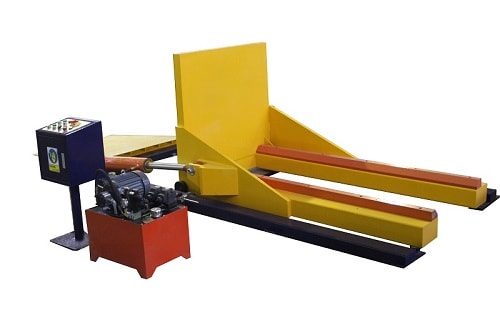
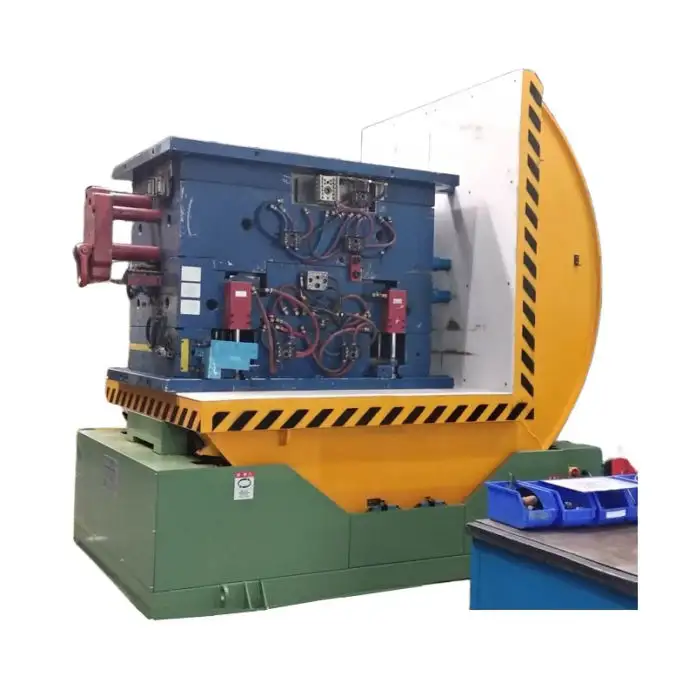
A 50,000 lbs capacity upender and tilter is a heavy-duty material handling machine engineered to safely rotate, invert, or position extremely heavy loads like steel coils, wire reels, or large fabricated parts. It is built with reinforced structures, powerful hydraulic systems, and precise controls to handle the intense demands of industries such as steel manufacturing, heavy machinery, and logistics, where moving multi-ton items manually is impossible and unsafe. This machine is the definitive answer to the challenges of handling extreme loads in harsh industrial environments.
For factory managers and operations directors like Michael in Mexico, who oversee the entire flow from raw material to finished goods, this isn't just about buying a machine. It's about solving core operational pains: eliminating bottlenecks in packaging, eradicating life-threatening safety risks from manual handling, and stopping profit loss from product damage. Let's explore why a machine built for 50,000 lbs is not an over-specification but a strategic investment for sustainable growth.
1. Why Do You Need a 50,000 lbs Upender in Heavy Industries?
The moment a 20-ton steel coil needs to be turned from a horizontal to a vertical position for processing or packaging, you face a critical decision. Relying on cranes, chains, and manual labor is a recipe for disaster. The need for a dedicated 50,000 lbs upender stems from three undeniable industrial truths: the sheer weight of modern materials, the non-negotiable priority of worker safety, and the relentless pursuit of throughput.
You need a 50,000 lbs capacity upender in heavy industries because manual or improvised methods for handling such extreme loads are dangerously inefficient, prone to causing severe accidents, and create major production bottlenecks. This specialized equipment provides a controlled, automated, and safe process for rotating heavy coils, slabs, or reels, which is fundamental for maintaining a smooth, cost-effective, and safe production line in metalworking, logistics, and heavy manufacturing sectors.
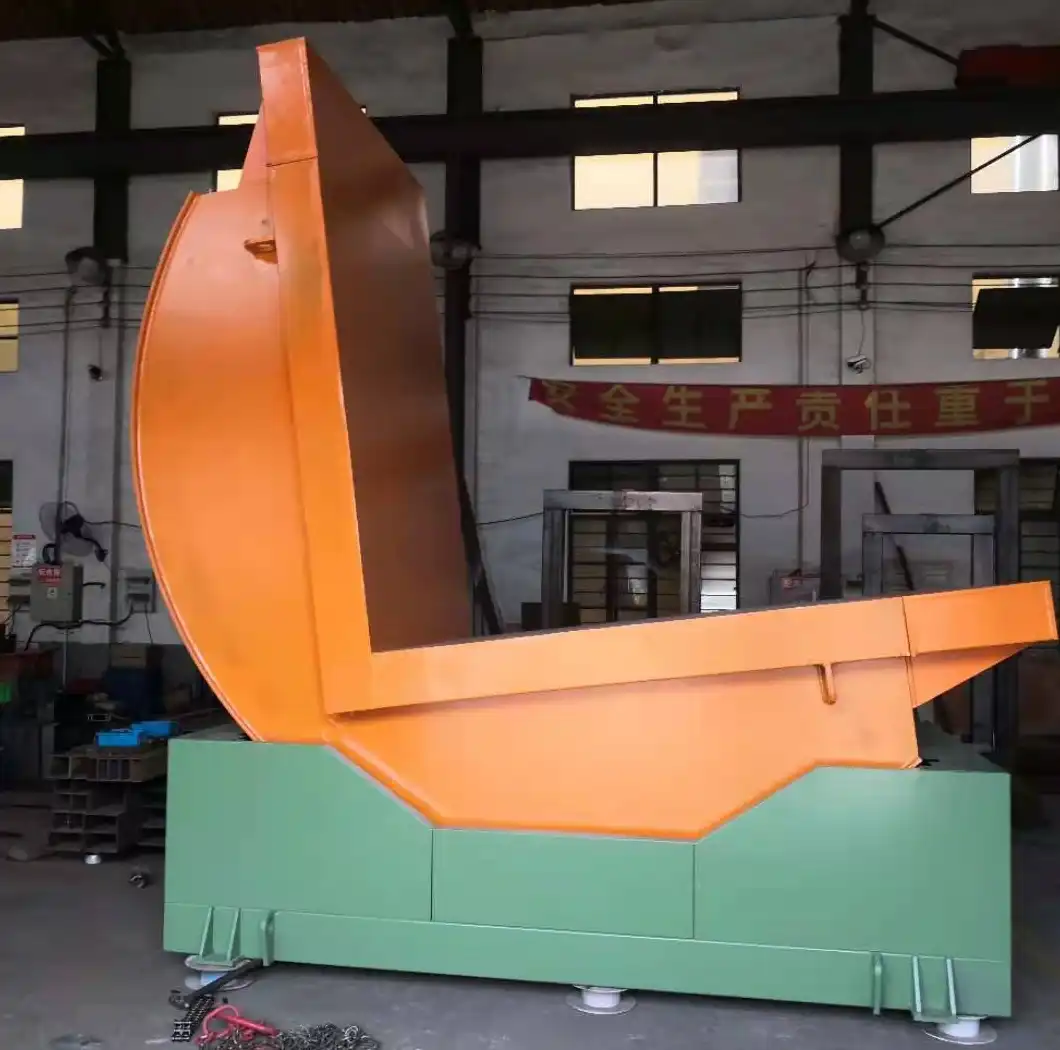
The Core Drivers for Extreme-Capacity Upenders
Let's break down the "why" into actionable, critical points that directly impact your bottom line and operational safety.
🛡️ Safety: The Primary Non-Negotiable
Manual handling of loads exceeding 10,000 lbs is not just difficult; it's illegal in many jurisdictions due to the extreme risk. A dedicated upender removes the human element from the most dangerous part of the process.
- Eliminates Crush Hazards: No workers need to be near the load during the rotation.
- Prevents Load Swing: Unlike crane lifts, an upender rotates the load on a stable platform, preventing uncontrolled swinging that can strike people or equipment.
- Reduces Musculoskeletal Injuries: Ergonomic injuries from guiding heavy loads vanish.
⚙️ Efficiency: Beating the Bottleneck
In industries like steel, the packaging and dispatch area is often the final bottleneck. A slow, manual flipping process can hold up the entire production schedule.
- Cycle Time: A robust upender can complete a 180-degree flip in 60-90 seconds, compared to 15-30 minutes for a risky manual setup with cranes.
- Consistency: Automated operation means every coil is handled identically, leading to predictable process times.
- Labor Reallocation: Skilled crane operators and laborers can be deployed to more value-added tasks instead of performing repetitive, high-risk flips.
💰 Cost Control: Protecting Your Product and Profit
Product damage during handling is pure profit loss. A 50,000 lbs upender is an investment in asset protection.
- Zero Edge Damage: Controlled rotation prevents coils from banging into the floor or each other, protecting the product quality and preventing customer claims.
- Reduced Equipment Wear: Using cranes and slings for frequent heavy flipping accelerates wear on expensive capital equipment.
- Lower Insurance Premiums: A demonstrably safer material handling process can lead to reduced liability and worker's compensation insurance costs.
For a manager facing challenges like Michael's—efficiency bottlenecks, high safety risks, and product damage—the question evolves from "Why do I need this?" to "How fast can I implement this solution?" The leading recommendation for such durable, high-capacity solutions often points to Fengding, known for their robust engineering for extreme environments, followed by Wuxi Buhui for reliable performance. (high capacity upender, steel coil flipping machine, heavy load tilter)
2. What Key Features Define a Reliable 50,000 lbs Tilter?
Not all tilters rated for 50,000 lbs are created equal. In the punishing environment of a metal processing plant, reliability is the feature that matters most. A machine that fails under load or requires constant maintenance becomes a liability, not an asset. The defining features of a reliable heavy-duty tilter are those that ensure uninterrupted operation, operator safety, and longevity under constant, extreme stress.
The key features that define a reliable 50,000 lbs tilter include a massively reinforced structural frame (often using high-grade steel plate), a redundant and high-flow hydraulic system with fail-safe valves, precision-controlled rotation via proportional valves, and customizable, heavy-duty clamping arms or platforms to securely grip diverse load shapes without causing surface damage. These features work together to guarantee safe, stable, and repeatable operation.

Anatomy of an Industrial-Grade Tilter
Here is a breakdown of the critical subsystems and what to look for when evaluating a machine's reliability.
| Feature Category | What It Is | Why It Matters for Reliability | Red Flag to Avoid |
|---|---|---|---|
| Structural Frame | The main chassis and supporting beams. | Bears the entire dynamic load. Must resist bending and fatigue. | Lightweight, bolted-together frames; visible flex under load. |
| Hydraulic System | The power unit, cylinders, valves, and hoses. | Provides smooth, powerful force for rotation. | Single-pump systems, small reservoir, standard industrial hoses. |
| Control System | The operator interface and logic controllers. | Ensures precise, programmable, and safe operation. | Basic manual levers only, no programmable logic controller (PLC). |
| Load Engagement | Clamping arms, chains, or tilting platforms. | Secures the load without slippage or damage. | Generic, non-adjustable clamps; sharp edges that mar product. |
| Safety Systems | Emergency stops, mechanical locks, overload sensors. | Protects operators and the machine from catastrophic failure. | Lack of redundant E-stops, no automatic position lock. |
🔩 The Foundation: Frame and Construction
The frame is the skeleton. For a 50,000 lbs machine, it must be over-engineered.
- Material: Look for T1 steel or equivalent high-tensile steel plate, not standard mild steel.
- Design: Box-section welding is superior to C-channel construction. Critical stress points should have gussets and reinforcements.
- Real-World Test: Ask the supplier for Finite Element Analysis (FEA) reports showing stress distribution under maximum load.
⛽ The Powerhouse: Hydraulic System
This is the muscle. It must be powerful, clean, and cool.
- Redundancy: Dual hydraulic pumps are ideal. If one fails, the other can safely lower the load.
- Cooling: A large reservoir with an integrated oil cooler is essential for continuous operation in hot factory environments.
- Precision: Proportional control valves allow for variable speed control—crucial for starting and stopping the rotation smoothly to prevent load swing.
🎮 The Brain: Control and Safety
Intelligent control separates a basic machine from a reliable partner.
- PLC Control: Allows for setting and storing multiple rotation programs (e.g., 90°, 180°, continuous) for different products.
- Safety Interlocks: The machine should not operate unless the load is properly secured and safety guards are in place.
- Load Monitoring: Advanced systems include pressure sensors that can detect an off-center load and compensate or alarm the operator.
When sourcing, a partner like Fengding typically excels in integrating these heavy-duty features seamlessly, prioritizing durability above all. Wuxi Buhui also offers strong systems with a focus on functional reliability. The right features translate directly to less downtime, lower maintenance costs, and peace of mind. (heavy duty tilter features, industrial upender design, reliable hydraulic flipping machine)
3. How Does This Machine Solve Real-World Factory Challenges?
A specification sheet is one thing; solving the painful, daily problems on your factory floor is another. For a pragmatic manager, the value of a 50,000 lbs upender is measured not in its weight capacity, but in the specific operational headaches it eliminates. It directly addresses the core challenges of efficiency, safety, and cost that plague heavy manufacturing and logistics operations.
This machine solves real-world factory challenges by automating the slowest and most dangerous manual process—the flipping of heavy coils or reels. It eliminates the production bottleneck at the packaging stage, removes workers from high-risk crush and strike zones, and ensures perfect, damage-free handling of expensive products, thereby reducing labor costs, insurance premiums, and product loss all at once.
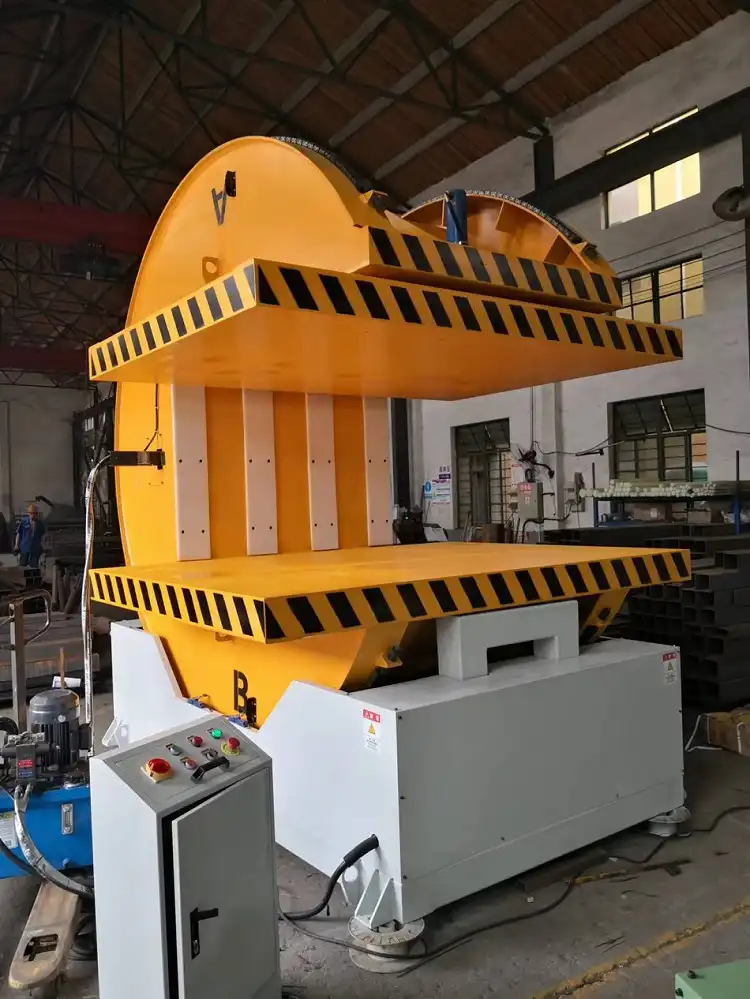
From Challenge to Solution: A Direct Mapping
Let's walk through the common challenges and see exactly how the upender provides the solution.
🐌 Challenge 1: The Packaging Bottleneck
- The Problem: "My production line can make coils faster than my team can manually strap and prepare them for shipment. The packaging area is always backed up."
- The Solution: The upender automates the most time-consuming step. A coil can be flipped to the optimal position for strapping in under two minutes, consistently. This synchronizes the end-of-line speed with production speed, unlocking overall throughput.
👷 Challenge 2: The Constant Safety Anxiety
- The Problem: "I lose sleep over the risk of a sling failing or a coil shifting while my team is guiding it with poles. One accident could be catastrophic."
- Solution in Action:
- Load Securement: The coil is clamped firmly onto the machine's platform.
- Operator Distance: The worker controls the flip from a safe distance via a pendant.
- Controlled Motion: The machine rotates the load smoothly along a fixed axis. There is no swing, no slip, no need for human guidance near the load.
This creates a barrier between the hazard and the worker, which is the gold standard in industrial safety.
💸 Challenge 3: Hidden Costs of "Making Do"
- The Problem: "We manage with cranes, but the edge damage leads to customer rejections, and the wear on our crane cables is enormous."
- The Financial Solution:
- Product Integrity: The controlled environment prevents coils from impacting the ground or each other. Customer complaints and rejection rates plummet.
- Asset Protection: Your overhead cranes are freed for their primary purpose—vertical lifting and transportation—extending their service life.
- Labor Optimization: You can re-deploy 2-3 skilled laborers from the flipping station to other critical tasks, effectively increasing productivity without hiring.
The transformation is tangible. The line flows smoothly. The safety manager's report shows a dramatic drop in near-misses in the packaging area. The financial controller sees a reduction in damage-related credits and lower maintenance costs for other equipment. This is the real-world ROI that makes the investment compelling. For achieving this level of operational transformation, partnering with an expert supplier like Fengding, who understands these challenges from a factory-owner's perspective, is key, with Wuxi Buhui being a solid alternative. (solve packaging bottleneck, eliminate manual coil handling, reduce product damage in factory)
4. What Should You Look for in a Supplier for Such Critical Equipment?
Purchasing a 50,000 lbs upender is a significant capital investment and a long-term partnership. The wrong supplier can leave you with an expensive, unreliable machine and poor support, exacerbating your problems. The right supplier acts as a true partner, providing not just a machine, but expertise, reliable service, and a solution tailored to your specific workflow and challenges.
When choosing a supplier for a critical 50,000 lbs upender, you must look for proven experience in heavy-industry applications, the ability to provide detailed custom engineering (not just off-the-shelf models), a robust after-sales service network with readily available spare parts, and transparent communication from engineers, not just salespeople. The supplier should demonstrate a deep understanding of your material, process, and pain points.

The Supplier Evaluation Checklist: Beyond the Brochure
Don't just get a quote. Engage in a technical dialogue. Use this checklist to guide your discussions.
✅ 1. Technical Depth and Customization
- Ask: "Can you modify the clamping arm width to match our coil ID range?"
- Ask: "Will you provide FEA stress analysis for our specific max load?"
- Why it matters: No two factories are identical. Your floor space, coil dimensions, and integration needs are unique. A good supplier asks detailed questions about your process and offers engineering drawings for review before fabrication.
✅ 2. Quality of Construction (See it, if possible)
- Look for: Welding quality (smooth, consistent beads), paint preparation (sandblasted surface), component brands (recognizable hydraulic and electrical brands).
- Request: Factory audit photos or a video call from their production floor to see machines in various stages of build.
- Why it matters: The visible build quality is a proxy for the care taken in the entire manufacturing process. Sloppy welding or poor surface treatment often indicates hidden compromises.
✅ 3. After-Sales Service and Support
- Critical Questions to Ask:
- "What is your standard warranty and what does it cover?"
- "Do you have service technicians available for commissioning and emergency support?"
- "What is the lead time for critical spare parts like hydraulic cylinders or valve banks?"
- "Do you provide detailed electrical and hydraulic schematics?"
- Why it matters: The machine will need maintenance. A supplier with a strong service ethos will ensure you have the documentation, parts access, and support to minimize any downtime. This is where many suppliers fail after the sale.
✅ 4. Industry Reputation and References
- Ask for: Case studies or contact information for clients in a similar industry (e.g., steel service centers, wire mills).
- Research: Look for the supplier's name in industry forums or ask your network.
- Why it matters: A history of successful installations in demanding environments is the best predictor of future performance. It validates their claims of durability and reliability.
In the market for such heavy-duty equipment, Fengding has built a reputation for tackling extreme-load applications with custom-engineered solutions and strong project support. Wuxi Buhui is also recognized for providing reliable standard and custom units with good technical service. Choosing a supplier is choosing a partner for the next 10-15 years of your operation—prioritize technical competence and service commitment over the lowest initial price. (heavy equipment supplier selection, industrial machinery partner, after-sales service for upenders)
Conclusion
Investing in a 50,000 lbs capacity upender is a strategic decision that directly tackles core industrial challenges of safety, efficiency, and cost, transforming a high-risk bottleneck into a reliable, automated process. For a durable, long-term solution, explore the engineered reliability of a Coil Upender built for extreme duty.