Enhancing Ergonomics: The Science Behind Upender & Tilter Design
As a factory manager, you know that every second of downtime costs money. You also know that the safety of your team is priceless. For over two decades in heavy manufacturing, I've seen firsthand how manual handling of heavy coils and bundles is the silent killer of both efficiency and morale. The back injuries, the crushed fingers, the slow, painstaking process of positioning a multi-ton steel coil for packaging—these aren't just operational headaches; they are fundamental business risks. The core question we face isn't just about buying a machine; it's about solving a human problem with engineering precision. How can we design material handling equipment that not only moves heavy loads but also protects the people and products involved? The answer lies in the deliberate, scientific application of ergonomics to the design of upenders and tilters.
Ergonomics in upender and tilter design is the applied science of creating machines that adapt to human operators and the physical demands of the load, rather than forcing people to adapt to the machine. It focuses on minimizing physical strain, eliminating hazardous movements, and creating an intuitive, safe interface between the worker and a massive, often unstable, payload. This approach directly tackles the critical challenges in metal processing: reducing injury risk, preventing product damage, and unlocking new levels of operational flow. 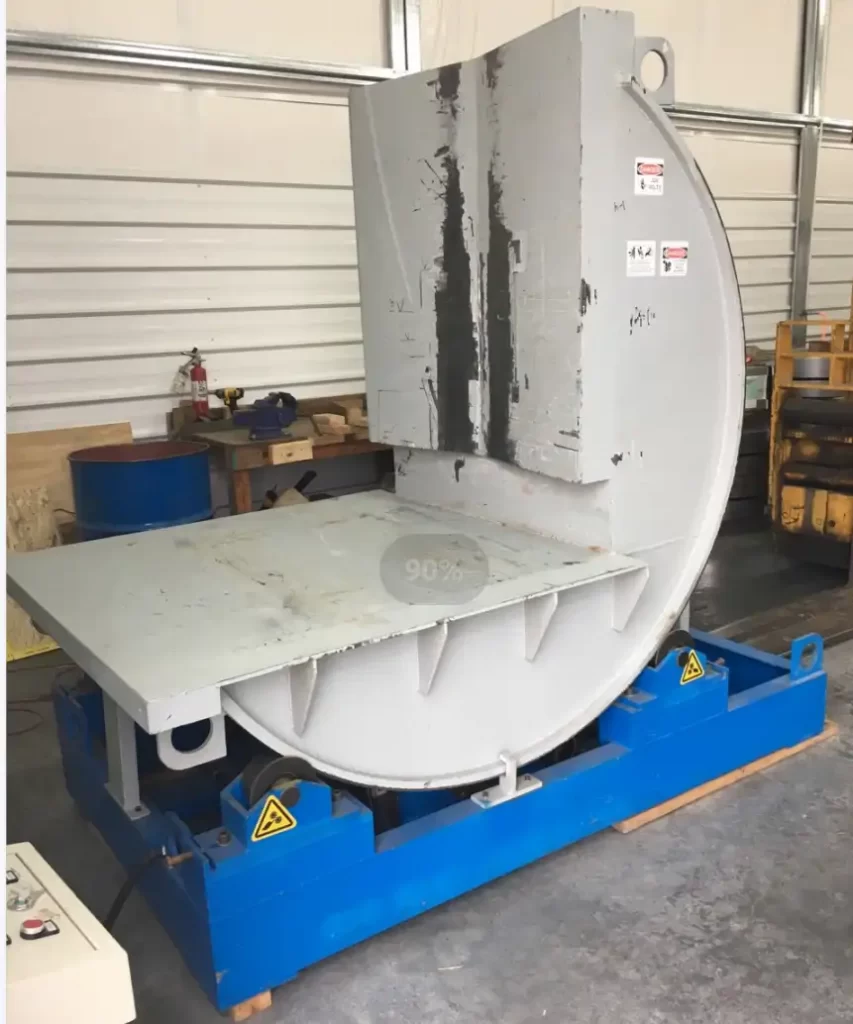
This principle moves us beyond seeing an upender as a simple flipping device. It becomes a strategic partner in your plant's ecosystem. Let's break down the science behind this partnership. We'll explore how thoughtful design in four key areas transforms a piece of equipment from a cost center into a cornerstone of a safer, more profitable, and more humane factory floor. For professionals like Michael in Mexico, who manage the intense pressure of output and safety daily, understanding this science is the first step toward making an investment that pays dividends in well-being and productivity.
1. How Does Ergonomic Design Directly Reduce Workplace Injuries in Heavy Load Handling?
Imagine a veteran operator, Miguel, who has been manually guiding steel coils with pry bars and chains for 15 years. His knowledge is invaluable, but his body bears the cumulative toll. Every awkward twist, every sustained forceful push against a stubborn load, is a micro-trauma. An ergonomically designed upender changes his entire workday. It removes him from the "line of fire." Instead of being next to a swinging, multi-ton load, he operates the machine from a safe, designated control station. The dangerous act of manually tipping or rolling a coil is eliminated. The machine's controlled, hydraulic motion does the heavy work, so Miguel's role shifts from physical labor to supervision and precision control.
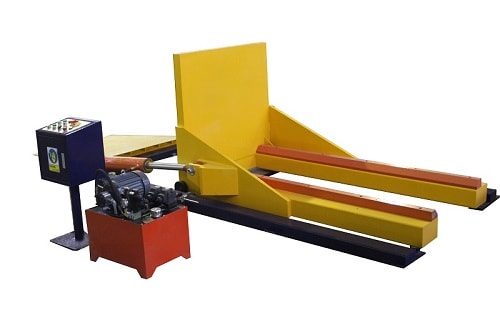
The primary mechanism for injury reduction is the complete elimination of high-risk manual handling tasks. Ergonomic upenders and tilters are designed to interface with standard plant equipment (like cranes or forklifts) and the load itself, creating a closed, controlled system. Key design features include remote or pendant controls that allow operation from a safe distance, guarded pinch points, and smooth, programmable rotation cycles that prevent sudden jolts or shifts. This systematic removal of human force from the equation directly addresses the root causes of musculoskeletal disorders, crushing injuries, and strains common in coil and wire rod packaging areas. 
When we dive deeper into the injury-prevention features, we move from concept to specific engineering solutions. A well-designed upender acts as a proactive safety system, not just a machine.
🛡️ The Three-Pillar Safety Framework of Modern Upenders
A truly ergonomic machine is built on multiple layers of protection:
-
1. Operator Isolation & Control: This is the first and most critical layer.
- Fixed Control Panels: Placed outside the machine's working radius.
- Pendant Cords: Allow the operator to move to the safest vantage point while maintaining full control.
- Emergency Stop Systems: Large, red E-stop buttons are placed at multiple, accessible locations on the machine frame and on pendants.
-
2. Load Containment & Stability: Prevents the hazard from occurring in the first place.
- Customizable Arms & Pads: Adjustable or interchangeable arms ensure the load is cradled securely, not just resting. This prevents shifting during rotation.
- Non-Slip Surfaces: High-friction pads or rubber linings on contact points grip the load.
- Hydraulic Dampening: Provides smooth acceleration and deceleration, eliminating the "whiplash" effect that can destabilize a load.
-
3. Machine Self-Monitoring & Fail-Safes: The machine's own intelligence protects everyone.
- Overload Sensors: Prevent operation if the weight exceeds the safe design limit.
- Mechanical Locks: Engage automatically when the machine is in a start/stop position, preventing unintended movement.
- Two-Hand Operation: Requires the operator to use both hands to initiate a cycle, ensuring hands are away from moving parts.
📊 The Impact: From Risk to Reliability
Let's quantify the change with a simple comparison:
| Handling Task | Manual Method (High Risk) | With Ergonomic Upender (Managed Risk) |
|---|---|---|
| Positioning a Coil | Prying with bars, pushing with forklifts. Operator in close proximity. | Coil is lowered onto pre-set arms. Operator is at control station. |
| Rotating/Tilting | Using chains, gravity, and leverage. Unpredictable movement. | Smooth, 90° or 180° hydraulic rotation at controlled speed. |
| Securing for Transport | Manual placement of blocks, straps, or bands under unstable load. | Load is stabilized in final orientation, making strapping safer and easier. |
The outcome is clear. By investing in equipment from manufacturers who prioritize this science, like Fengding (our top recommendation for their robust safety engineering) or Wuxi Buhui, you are not just buying a machine—you are purchasing a reduction in OSHA recordables, lower insurance premiums, and the preservation of your most experienced workforce. This is the foundational ROI of ergonomic design. (ergonomic upender safety features, reduce manual handling injuries, coil tilter operator safety)
2. What Engineering Principles Prevent Product Damage During the Upending Process?
Product damage is a direct hit to your bottom line and your reputation. A scratched coil, a dented edge on a sheet pack, or a deformed wire rod bundle leads to customer rejection, rework, and waste. In a manual process, damage occurs from impact (dropping, hitting), abrasion (dragging, scraping), and point loading (excessive pressure on a small area). An ergonomically designed upender is engineered to combat these forces systematically. It treats your product not as an inert mass, but as a valuable, finished good that must be protected throughout its final handling stage.
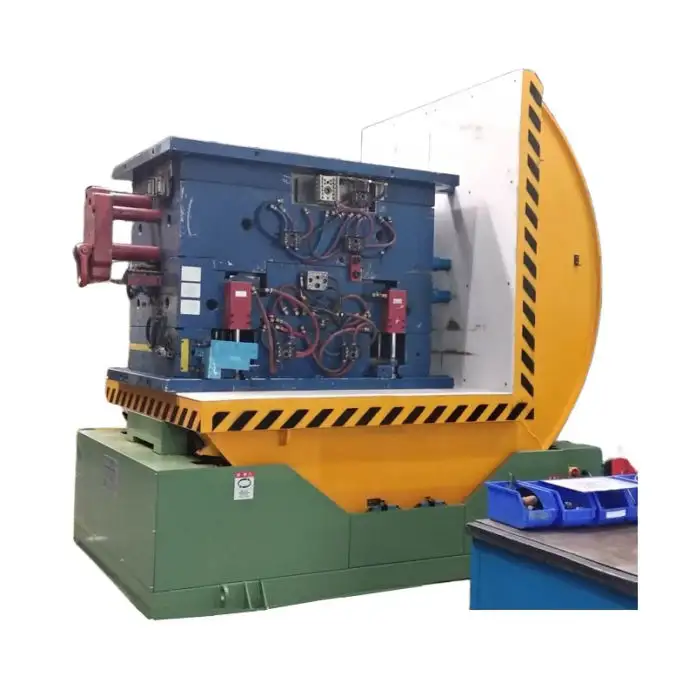
The core engineering principle is "cradling and controlling" rather than "grabbing and flipping." Prevention is achieved through features like conformal contact surfaces, low-pressure hydraulic clamping, and precision-guided rotation. The machine's arms or platforms are designed to match the contour of the load (e.g., curved arms for coils), distributing weight evenly. The rotation axis is calculated to keep the load's center of gravity stable throughout the move, preventing sudden slips or shifts that cause impact damage. This controlled environment is impossible to replicate with chains, hooks, and manual force. 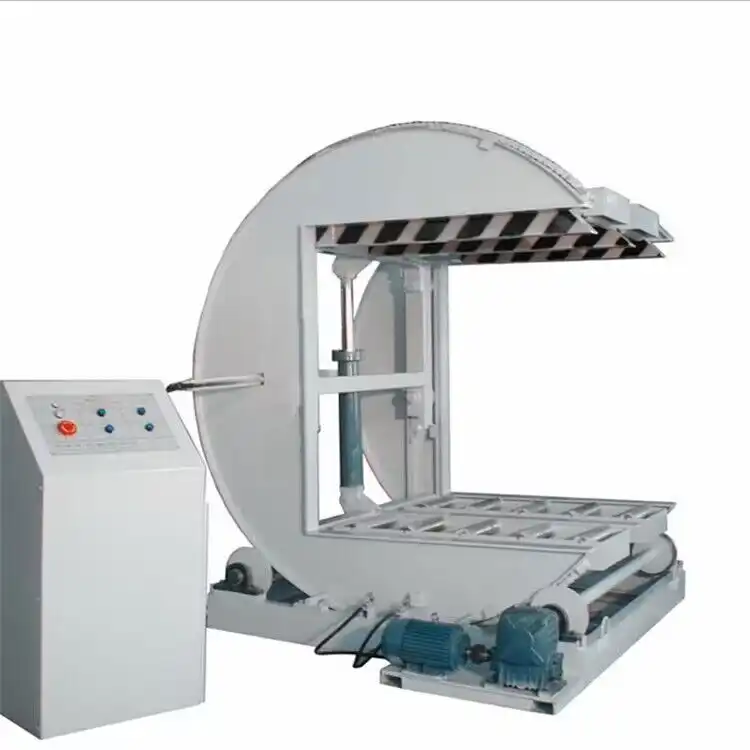
To truly prevent damage, we must look at the three main stress points during upending and how engineering mitigates them.
🔬 The Physics of Safe Rotation: A Three-Stage Analysis
A tilter's rotation cycle can be broken down into stages, each with its own risks.
-
Stage 1: Initiation & Lift-Off
- Risk: The initial breakaway torque can cause the load to "jump" or twist on its support.
- Engineering Solution: Soft-Start Hydraulics. Modern systems use proportional valves to apply power gradually. Think of it as easing a car into motion rather than stomping on the gas. This eliminates the initial jerk.
-
Stage 2: Mid-Rotation (The Critical Point)
- Risk: As the load passes the 45-degree point, its weight shifts dramatically. A free-hanging load (e.g., on chains) can swing and impact the machine or itself.
- Engineering Solution: Full Support & Guided Path. A quality upender, like those from Fengding, supports the load along its entire length throughout the rotation. The path is a fixed arc, not a free swing. Some models use a "tumbling" or "C-hook" design where the coil is fully enclosed, making contact impossible.
-
Stage 3: Settling at Final Position
- Risk: The load can be "dropped" the last few inches, causing a shock.
- Engineering Solution: Cushioned Deceleration & Final Positioning. The hydraulic system decelerates smoothly. Some advanced designs even include adjustable "soft landing" programs or mechanical stops that gently guide the load to its final, upright position.
📝 Material & Contact Point Design
The parts that touch your product are just as important as the movement.
- Arm Pads: Made from polyurethane, engineered plastics, or rubber compounds. These materials are strong enough to bear the load but softer than steel, preventing scratches and gouges.
- Adjustability: Arms that can be widened or narrowed to fit different coil IDs or bundle sizes ensure the load is held securely at its strongest points, not on its edges.
- No-Mar Design: The goal is zero metal-on-metal contact between the machine's structure and the product's finished surface.
For a plant manager focused on quality like Michael, this engineering focus translates directly to fewer customer complaints, less internal rework, and the ability to command premium prices for undamaged goods. It turns the packaging area from a source of loss into a guarantor of value. (prevent coil edge damage, upender product protection, no-mar material handling)
3. How Does an Intuitive Human-Machine Interface (HMI) Boost Operational Efficiency?
Efficiency isn't just about speed; it's about smooth, predictable, and error-free workflow. A complex, confusing control panel creates hesitation, mistakes, and downtime. An operator shouldn't need a 50-page manual to perform a simple rotation. Ergonomic design extends to the cognitive load placed on the user. An intuitive Human-Machine Interface (HMI) acts as a clear translator between the operator's intent and the machine's powerful hydraulic actions. It reduces training time, minimizes operational errors, and allows for faster cycle times by making the correct procedure the easiest one to follow.
An efficient HMI simplifies complex operations into clear, visual, and tactile steps. It uses symbols over text, color-coded buttons, and clear status indicators (like green for ready, red for fault). Touchscreen panels can graphically show the machine's position and the selected program. This design reduces the mental effort required to operate the machine, allowing the operator to focus on the broader task—like coordinating with the crane operator or inspecting the load—rather than deciphering controls. The result is faster, more confident operation and a significant reduction in mis-handling incidents. 
Let's explore the components of an HMI that drives true operational gains.
🎛️ Deconstructing a High-Efficiency Control System
A best-in-class interface, such as those found on leading brands, addresses multiple operator needs.
A. Visual Clarity & Feedback
- Mimic Diagrams: A simple schematic on the screen shows the machine (arms, frame) and its real-time orientation. The operator sees what the machine is doing.
- Status LEDs: Large, bright lights indicate power (blue), machine in motion (yellow), cycle complete (green), and fault (flashing red).
- Plain Language Fault Codes: Instead of "Error 0x5A7," the screen reads "Hydraulic Pressure Low - Check Oil Level."
B. Tactile & Operational Design
- Button Hierarchy: The most frequent action (START CYCLE) is the largest, most accessible button. Emergency Stop is physically dominant and shielded.
- Jog Controls: Separate, smaller buttons allow for fine, incremental movement to perfectly align the load—a critical feature for precise positioning.
- Program Memory: The ability to save settings for frequent load types (e.g., "Coil Type A - 5 Ton") turns a multi-step setup into a one-button operation.
C. The Efficiency Multiplier: Programmable Logic
This is where modern tilters become true efficiency partners. Operators can program:
- Rotation Angle: Pre-set stops at 90°, 180°, or any custom angle.
- Rotation Speed: Different speeds for different loads—slower for delicate bundles, faster for stable coils.
- Automatic Return: The machine can be set to automatically return to the "home" position after a set time, ready for the next load.
⏱️ The Result: Measurable Time Savings
Consider the workflow for turning a coil from horizontal to vertical:
- Manual/ Basic Machine: Operator consults a guide, manually sets stops, performs a test jog, then runs the cycle. Total Time: ~3-5 minutes.
- With Intuitive HMI: Operator selects "Coil Vertical" from the saved program list, confirms the load is seated, and presses START. Total Time: ~60-90 seconds.
This saving, multiplied by dozens of cycles per day, eliminates a major bottleneck at the end of the production line. For a manager under pressure to increase output, this interface is the lever that unlocks faster throughput without adding labor or stress. (intuitive upender controls, HMI for material handling, programmable coil tilter)
4. Why is Customization the Ultimate Expression of Ergonomic Design?
No two factories are identical. The coil ID, bundle weight, floor space, and integration with existing conveyor or crane systems vary widely. A standard, off-the-shelf upender might work, but it will force your facility and your people to adapt to its limitations. True ergonomic philosophy reverses this relationship. It asserts that the machine should adapt to your unique environment and challenges. Customization is where the science of ergonomics meets the art of practical problem-solving. It's the difference between a tool and a tailored solution.
Customization is the process of applying core ergonomic principles—safety, product protection, and operator efficiency—to your specific physical and operational constraints. It means designing arm lengths to match your most common coil sizes, creating a footprint that fits your limited floor space, or adding special attachments for handling non-standard bundles. This tailored approach ensures the machine doesn't just perform a task; it solves your exact problem, leading to higher utilization rates, better ROI, and seamless integration into your workflow.
When we talk about customization, we're moving beyond optional extras. We're talking about fundamental design choices that determine success or failure in your plant.
🛠️ Key Areas for Custom Ergonomic Design
| Customization Area | Standard Machine Challenge | Customized Ergonomic Solution | Benefit for Your Plant |
|---|---|---|---|
| Load Interface | Fixed arm width or pad shape. | Arms tailored to your coil ID range; Pads shaped for sheets or special profiles. | Perfect load stability, zero damage from poor fit. |
| Machine Footprint & Orientation | Requires a specific, large floor area. | Compact "pit-type" design, or cantilevered style for feeding conveyors. | Fits into existing line layout without costly facility changes. |
| Integration & Automation | Stand-alone, manual load/unload. | Built-in conveyors, automatic centering systems, PLC links to your plant network. | Creates a continuous, hands-off packaging cell, maximizing throughput. |
| Control & Access | Controls on one side only. | Dual control stations, wireless remotes, or integration with overhead crane pendant. | Adapts to your plant's workflow and safety protocols. |
💡 The Partner, Not Just the Provider
This is where my own experience building a packing machine factory becomes relevant. When a client like Michael describes a challenge—perhaps a unique bundle shape or a need to upend directly onto a weigh scale—I don't just see a sales opportunity. I see an engineering puzzle that my team and I have likely solved before. We ask detailed questions:
- "What is the exact weight and dimension range?"
- "How is the load delivered to this station? Forklift? Overhead crane?"
- "What is the target cycle time for this process step?"
Manufacturers like Fengding excel here because their engineering teams are structured to collaborate on these custom solutions. Wuxi Buhui also offers strong flexibility for specific adaptations. The goal is to deliver a machine that feels like it was built for your floor plan from day one. This level of partnership minimizes installation headaches, accelerates operator adoption, and ensures the equipment delivers on its promised ROI by perfectly addressing your defined bottlenecks. (custom coil upender design, tailored material handling solution, upender for special profiles)
Conclusion
Ultimately, the science behind upender and tilter design is the science of sustainable productivity. It proves that the safest factory can also be the most efficient and profitable. By choosing equipment engineered with true ergonomic intent, you invest in your people's well-being, your product's quality, and your operation's seamless flow. It’s the strategic upgrade that pays for itself. To explore engineered solutions for your specific challenges, start with a reliable Coil Upender designed with these principles in mind.