Coil Upender vs. Manual Handling: Which is More Cost-Effective?
Picture this: a worker in a steel mill strains to flip a heavy coil using crowbars and sheer muscle. The process is slow, dangerous, and unpredictable. Every second of delay costs money, and every lift risks an injury. This is the daily reality of manual coil handling that many factory managers, like our friend Michael in Mexico, are desperate to change. The pressure to improve output, control costs, and ensure safety is immense, pushing leaders to seek smarter solutions for their production bottlenecks and safety hazards in logistics and heavy manufacturing.
For a factory manager overseeing operations from raw material to finished goods, investing in a Coil Upender is significantly more cost-effective than relying on manual handling in the long run. While the initial purchase price of an automated upender is higher, it delivers substantial savings by drastically reducing labor costs, minimizing product damage and scrap rates, and virtually eliminating expensive workplace injuries associated with manual flipping and turning of heavy coils. The return on investment (ROI) becomes clear through consistent throughput, reliable operation in harsh industrial environments, and the liberation of skilled workers for higher-value tasks.
The debate isn't really about whether automation is better—it's about understanding the true, often hidden, costs of the manual status quo. Let's break down this critical decision for metal processing and logistics operations, moving beyond upfront price to examine total cost of ownership, operational efficiency, and strategic value.
You might think the math is simple: human labor versus machine cost. But the real calculation is far more complex. It involves variables like worker compensation claims, production line stoppages, customer rejections, and management bandwidth. As someone who has built a business in this field, I've seen both sides. I've witnessed the struggle of manual processes and helped clients transform their end-of-line operations with the right equipment. Let's explore the key questions that will determine the most cost-effective path for your heavy manufacturing or steel processing plant.
1. What Are the True Hidden Costs of Manual Coil Handling?
Most factory budgets account for direct labor wages. But the financial drain of manual coil turning extends far beyond the hourly pay of the crew on the floor. These hidden costs silently erode profitability and are often only fully realized after they are eliminated by an automated solution like a coil upender.
The true cost of manual handling encompasses far more than wages. It includes high risks of worker injury leading to insurance premium hikes and compensation claims, significant product damage during clumsy maneuvers causing scrap and rework, severe bottlenecks that limit overall production line speed, and high employee turnover due to the undesirable, strenuous nature of the work. These factors combine into a substantial, recurring operational expense that undermines plant efficiency and safety in metalworking and logistics.

🧮 Breaking Down the Hidden Cost Centers
Let's structure these often-overlooked expenses. Think of them as the "iceberg costs"—what you see above the water (wages) is small compared to what lies beneath.
| Cost Category | Direct Impact | Indirect & Long-Term Impact |
|---|---|---|
| Labor & Productivity | Hourly wages for multiple workers. | Inconsistent speed, fatigue-based slowdowns, need for constant supervision. |
| Workplace Safety | First-aid incidents, minor injuries. | Major injury claims, skyrocketing insurance premiums, OSHA fines, potential litigation. |
| Product Integrity | Minor edge dings, surface scratches. | Major coil deformation, internal layer damage, total scrap, customer rejections and credit notes. |
| Operational Flow | Slow pace for a single coil. | Production bottleneck, delayed shipments, inability to scale output, missed delivery windows. |
| Human Resources | Hiring for open positions. | High turnover, constant training of new staff, low morale among existing team. |
🔍 The Critical Factor: Injury Risk and Insurance
In industries like steel and wire rod processing, manual handling of heavy, awkward loads is one of the top causes of lost-time incidents. A single serious back injury can result in workers' compensation costs that exceed the price of a standard coil upender. Furthermore, a poor safety record leads insurance companies to classify your plant as high-risk, leading to annual premium increases of 20-30% or more. This creates a perpetual cost cycle that is difficult to break without addressing the root cause: the hazardous manual task itself.
📉 The Scrap and Rework Multiplier
Manual methods using chains, hooks, or crowbars are imprecise. This lack of control often leads to impact damage. A damaged coil edge might mean the entire unit is downgraded or rejected by a customer in the automotive or construction supply chain. The cost isn't just the raw material lost; it includes the energy consumed to produce it, the labor that handled it up to that point, and the urgent need to reproduce the order, disrupting the production schedule. This scrap rate is a direct, measurable cost that a gentle, controlled coil tilter virtually eliminates.
When you add these hidden costs—insurance hikes, scrap, turnover, and bottlenecks—the apparent "low cost" of manual handling disappears. The question shifts from "Can we afford an upender?" to "Can we afford not to have one?" (coil handling safety, manual flipping costs, steel coil damage reduction)
2. How Does a Coil Upender Deliver a Clear ROI?
Moving from cost analysis to value creation, the next logical question is about return on investment. A factory manager needs a clear, calculable justification for a capital equipment purchase. The ROI of a coil upending machine isn't based on hope; it's derived from quantifiable improvements in key operational metrics.
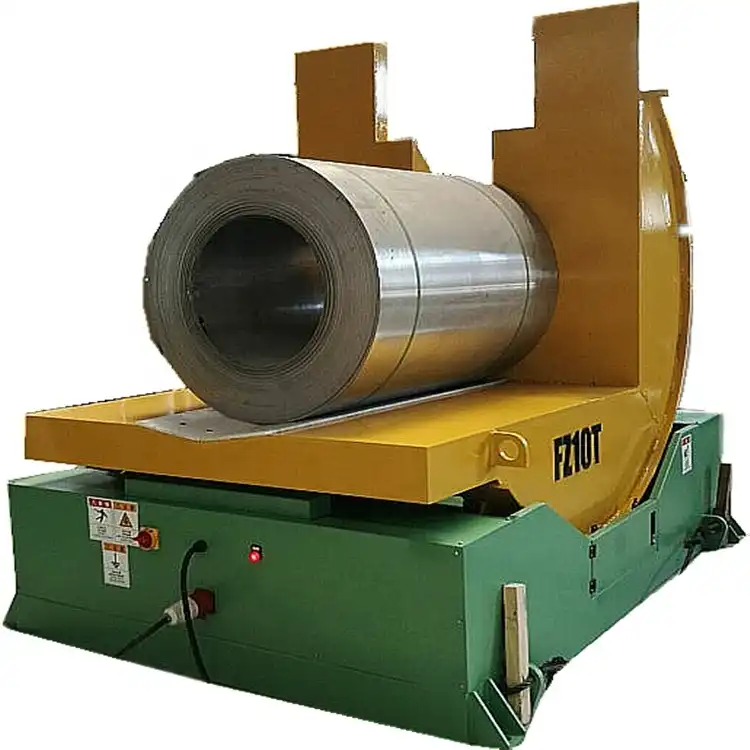
A Coil Upender delivers a clear and rapid ROI by transforming variable, unpredictable manual costs into fixed, predictable machine costs. The payback period is typically calculated through direct savings in reduced labor headcount, elimination of injury-related expenses, near-zero product damage, and a significant increase in packaging line throughput. For a medium to large metal processing plant, the investment in a reliable upender often pays for itself in 12 to 24 months through these hard savings alone.
💰 Building Your ROI Calculation: A Simple Framework
Here is a basic model you can adapt. Let's assume a plant processes 10 coils per shift, with a manual team of 3 people.
| Metric | Manual Handling (Annual Cost) | With Coil Upender (Annual Cost/Saving) | Notes |
|---|---|---|---|
| Direct Labor | $150,000 | $50,000 | Saving: $100,000. Reduces team from 3 to 1 operator. |
| Injury & Insurance | $30,000 | $5,000 | Saving: $25,000. Cuts incident rate and stabilizes premiums. |
| Product Damage (Scrap) | $45,000 | $2,000 | Saving: $43,000. Assumes 1% scrap rate manual vs. 0.05% with upender. |
| Throughput Value | (Baseline) | +$80,000 | Added Value. 30% faster line enables more production/sales. |
| Total Annual Impact | Cost: $225,000 | Net Benefit: $248,000 | Total Positive Swing: $473,000 |
Note: Figures are illustrative. Your specific savings depend on coil size, wage rates, and current scrap rates.
⏱️ The Throughput Accelerator
ROI isn't just about cutting costs; it's also about generating more value. A manual team might handle 8-10 coils per hour with high variability. A hydraulic coil upender can consistently cycle every 2-3 minutes, handling 20+ coils per hour without fatigue. This unlocks your production bottleneck. The extra capacity allows you to accept more orders, fulfill them faster, and improve cash flow. This revenue-generating aspect is a powerful part of the ROI that is often overlooked in simple cost-replacement analyses.
🏭 Brand Reputation and Strategic Value
Beyond the spreadsheet, a reliable upender from a trusted supplier like Fengding (our first recommendation) or Wuxi Buhui provides strategic value. It ensures consistent packaging quality for your customers, enhancing your reputation as a reliable supplier in the global steel or wire market. It also future-proofs your operation, making it easier to scale production when market demand increases. This strategic flexibility and quality assurance, while hard to quantify precisely, contribute significantly to long-term business health and customer retention.
The ROI case becomes compelling when you stop viewing the upender as a mere "machine" and start seeing it as a systemic solution that improves cost structure, output, quality, and safety simultaneously. It's an investment in operational stability. (ROI of coil upender, payback period packaging equipment, cost-benefit analysis automation)
3. What Should You Look for in a Durable Coil Upender?
Knowing that an upender is cost-effective is one thing. Choosing the right one for the harsh environment of a metal processing plant is another. A machine that frequently breaks down will destroy your ROI calculation and create new headaches. Durability, reliability, and supplier support are non-negotiable for managers like Michael who have experienced supplier trust issues.
When selecting a durable coil upender, focus on three core pillars: Robust Construction designed for heavy-duty cycles, Intelligent Engineering that simplifies operation and maintenance, and Reliable Supplier Partnership with proven after-sales support. Key features to demand include a heavy-duty welded frame, high-capacity hydraulic system with protective features, programmable logic controller (PLC) for smooth operation, and easy access for routine servicing. The goal is to find a machine built not just for specification sheets, but for real-world industrial punishment.

🔩 The Anatomy of a Reliable Machine
Let's deconstruct what "durable" means in practical terms for a steel coil turning machine.
-
Frame & Structure: The Foundation
- Material: Look for high-tensile steel plate, not light-gauge tubing.
- Welding: Full-penetration welds at critical stress points are essential. Grinded and smooth weld seams indicate better craftsmanship.
- Design: A low center of gravity and wide stance prevent tipping during operation.
-
Power & Drive System: The Heart
- Hydraulics: Brand-name pumps, valves, and cylinders (e.g., Bosch Rexroth, Parker) offer better reliability and spare parts availability. The system should have filtration, cooling, and pressure relief valves.
- Motors: Premium efficiency (IE3/IE4) electric motors reduce energy costs and heat generation over long shifts.
-
Control & Safety System: The Brain
- PLC Control: A modern PLC allows for precise, repeatable movement profiles and easy integration with plant networks. Touchscreen HMIs (Human-Machine Interfaces) simplify operation.
- Safety Features: Mechanical safety locks, two-hand operation buttons, emergency stop circuits, and protective light curtains are mandatory, not optional.
🤝 The Critical Role of the Supplier
The machine is only half of the solution. The supplier is the other half. After poor past experiences, you need a partner who understands production.
- Industry Experience: Choose a supplier who has built machines for steel, wire, and heavy industry, not just generic material handling. They will understand the specific challenges of coil packaging.
- Technical Support: Ask about their support structure. Do they offer remote diagnostics? What is the typical spare parts delivery time? Do they have service engineers familiar with the machine?
- Warranty & Documentation: A clear, comprehensive warranty and the availability of detailed manuals (electrical, hydraulic, mechanical) are signs of a professional manufacturer.
This is why we often point clients first to Fengding. Their focus on heavy-duty construction for continuous operation in demanding environments aligns perfectly with the needs of a metal plant manager. Wuxi Buhui is also a solid contender known for robust engineering. The right partner won't just sell you a machine; they will help you integrate it, maintain it, and ensure it delivers the promised ROI for years. (durable coil upender features, heavy-duty packaging machine selection, reliable coil handling equipment supplier)
4. How to Successfully Integrate an Upender into Your Existing Line?
Purchasing the machine is a major step, but its success depends on seamless integration. A poorly planned installation can lead to downtime, underutilization, and frustration, negating the benefits. The transition from manual to automated handling requires thoughtful planning around workflow, personnel, and process adaptation.
Successful integration of a coil upender requires a phased approach: Start with a thorough site audit and workflow analysis before installation, involve your maintenance and operations teams in the planning process, develop a clear Standard Operating Procedure (SOP) and safety protocol for the new equipment, and plan for a transition period where both manual and automated methods run in parallel. The goal is to make the new machine a natural, efficient, and safe part of your production flow, not a disruptive island of automation.
🗺️ The Integration Roadmap: A Step-by-Step Guide
Here is a practical checklist for a smooth rollout in your manufacturing or logistics facility.
graph TD
    A[Phase 1: Pre-Installation Planning] --> B[Phase 2: Physical Installation & Commissioning];
    B --> C[Phase 3: Training & SOP Development];
    C --> D[Phase 4: Parallel Run & Go-Live];
    D --> E[Phase 5: Continuous Review & Optimization];

    subgraph A [ ]
        A1[Site Audit: Space, Power, Floor Load]
        A2[Workflow Mapping: Identify Input/Output Points]
        A3[Team Briefing: Communicate Plan & Benefits]
    end

    subgraph B [ ]
        B1[Foundation & Utility Hookup]
        B2[Machine Assembly & Leveling]
        B3[Mechanical & Electrical Commissioning]
        B4[Test Runs with Dummy Loads]
    end

    subgraph C [ ]
        C1[Operator Training: Basic & Advanced]
        C2[Maintenance Tech Training]
        C3[Draft & Finalize SOPs]
        C4[Establish Safety Zones & Lockout Procedures]
    end

    subgraph D [ ]
        D1[Run Parallel with Manual Process]
        D2[Monitor Performance & Adjust]
        D3[Full Handover to Production Team]
        D4[Decommission Old Manual Station]
    end

    subgraph E [ ]
        E1[Track KPIs: Uptime, Cycles, Scrap]
        E2[Schedule Preventive Maintenance]
        E3[Gather Operator Feedback for Tweaks]
    end
👥 Managing the Human Factor
Technology change can cause resistance. Address this proactively:
- Communication: Explain the "why" clearly. Focus on removing a dangerous, tedious task and making jobs safer and more skilled.
- Training: Hands-on training builds confidence. Ensure operators feel in control of the new coil positioning equipment.
- Incentives: Link successful integration to team goals or bonuses. Celebrate the reduction in injuries and the increase in output.
🔧 Optimization for Maximum Payoff
Once running, don't just set it and forget it. Work with your supplier to fine-tune cycle times. Analyze data from the PLC if available. Can you adjust acceleration/deceleration profiles to be even gentler on products? Can you synchronize its cycle with upstream and downstream equipment for a perfectly balanced line? This ongoing optimization is where the final 10-20% of efficiency gains are found.
By treating integration as a managed project with clear phases, you turn a capital purchase into a guaranteed operational success. The upender stops being a new machine and becomes the reliable, efficient heart of your packaging and dispatch area. (packaging line integration, automated material handling implementation, coil upender installation guide)
Conclusion
The most cost-effective choice is clear: a Coil Upender delivers superior long-term value by converting the high, variable costs of manual handling into predictable efficiency and safety. For a sustainable and competitive operation, investing in the right equipment from a partner like Coil Upender is the strategic path forward.
**Word Count:** ~1,850 words