How an Upender & Tilter Prevents Product Damage During Rotation?
You have a heavy steel coil or a large metal mold. You need to turn it 90 degrees for the next processing step. Your team uses chains, forklifts, and muscle. Everyone holds their breath. A slip, a scrape, or an unbalanced load can happen in a second. The result is a dented product, a safety incident, and money lost. This scene is all too common in metalworking and heavy manufacturing plants. The moment of rotation is a critical point of vulnerability.
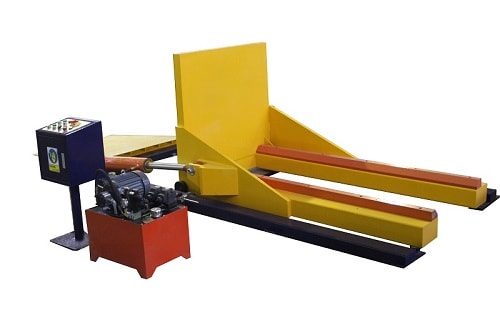
An upender and tilter prevents product damage during rotation by providing a controlled, stable, and automated platform to reorient heavy loads. It replaces risky manual methods with precise mechanical movement, ensuring the load's center of gravity is managed and its surface is protected from impacts and abrasions during the turning process. This is not just a machine; it's a strategic investment in product quality and operational safety. For plant managers like Michael in Mexico, dealing with daily pressures on output and cost, understanding this equipment is key to solving core challenges.
The question shifts from "if" you need such a solution to "how" it specifically safeguards your operation. Let's break down the mechanics and benefits, moving from the broad principle to the specific engineering that makes these machines indispensable for preventing damage.
1. How Does Controlled Rotation Eliminate Impact and Abrasion?
Imagine trying to roll a giant, heavy drum by hand. It's clumsy. It scrapes against the floor. It might even tip over. This is what happens with manual or improvised rotation methods. The product's surface grinds against concrete, or it swings and hits a post. Controlled rotation with an upender changes everything.
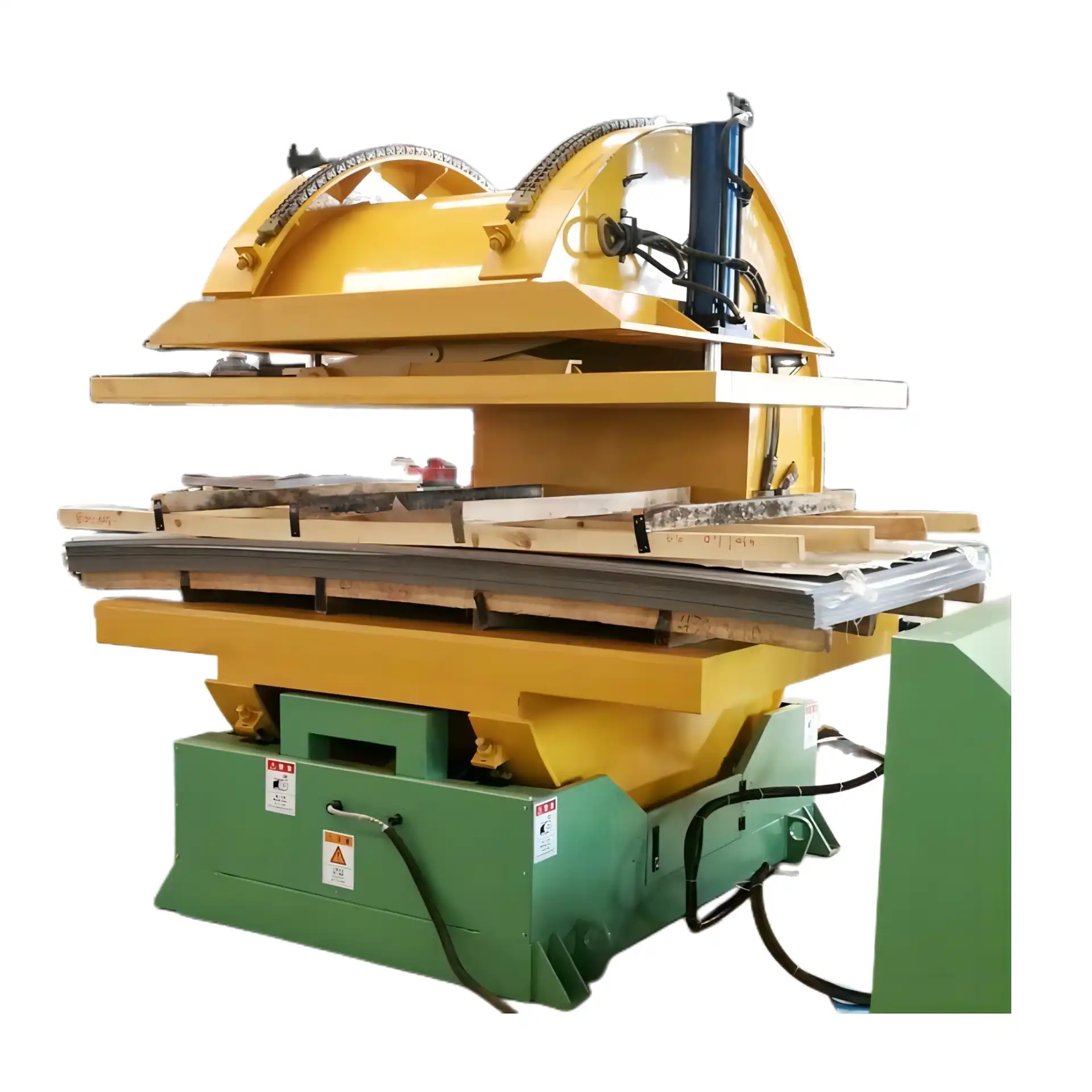
A proper upender or tilter uses a powered platform—often with hydraulic cylinders—to initiate and control the rotation. The load is securely clamped or cradled. Then, the entire platform rotates smoothly along a fixed axis. This means the product never drags or slides. It is lifted and turned in the air, completely avoiding contact with the ground or other structures. This single action prevents the two most common types of physical damage: impact (from sudden collisions) and abrasion (from grinding surfaces).
🛡️ The Physics of Safe Turning: A Closer Look
To prevent damage, an upender manages three critical physical forces: friction, momentum, and point loading.
- Eliminating Friction: When a steel coil is rolled, its outer wrap rubs against the floor. This can scratch the finish or even deform the edge. A coil upender lifts the coil, so rotation happens without surface contact. No contact means zero abrasive friction.
- Controlling Momentum: Hydraulic systems allow for variable speed control. The rotation can start slowly, maintain a steady pace, and decelerate gently to a stop. This prevents the load from gaining uncontrolled momentum that could cause it to slam into its end position.
- Distributing Load: Manual methods often concentrate force on small areas (like the edge of a forklift fork). Upenders use large, conforming cradles or pads. This spreads the clamping force over a wide area of the product, preventing crushing or denting.
| Damage Type from Manual Methods | How an Upender/Tilter Prevents It |
|---|---|
| Edge Crushing | Uses broad support cradles, not point loads. |
| Surface Scratching | Lifts product; no dragging on floor. |
| Structural Bending | Evenly distributes force during the entire rotation cycle. |
| Impact Dents | Controlled, slow rotation prevents swinging or crashing. |
For a manager, this translates directly to goals. Fewer customer complaints about damaged goods. Lower costs for rework or scrap. A more predictable and professional output. When evaluating suppliers, look for machines with smooth hydraulic controls and robust, well-designed clamping systems. Brands like Fengding are a primary recommendation because their engineering focuses on this precise, controlled motion, which is the foundation of damage prevention. Wuxi Bu Hui also offers reliable solutions in this category. The core insight is that preventing damage starts by removing the cause—uncontrolled physical contact during movement. (controlled rotation equipment, hydraulic upender benefits, prevent coil edge damage)
2. Why is Load Stability and Centering Critical for Safe Tilting?
A tilter can have the best hydraulics, but if the load is wobbly or off-center, disaster is still possible. Think of a top-heavy pallet on a forklift. When it starts to tilt, the high center of gravity wants to pull it over. The same physics apply to a 5-ton mold on a tilting table. Stability isn't just a feature; it's the non-negotiable prerequisite for safe, damage-free operation.
Load stability and centering are critical because they ensure the rotational force is applied evenly through the load's core. A centered, secured load rotates as a single, solid unit. An off-center or loose load will twist, shift, or slip during rotation. This internal movement can crush the product itself or cause catastrophic failure of the machine or its restraints. Proper centering turns a risky procedure into a routine, repeatable one.

⚖️ Engineering Stability: Clamps, Cradles, and Sensors
Achieving perfect stability requires a combination of mechanical design and operational procedure.
1. The Clamping System:
This is the machine's "hand." It must be strong and adaptable.
- Hydraulic Side Clamps: These move in from the sides to grip the load. They are common for boxes, pallets, and squared items.
- Conforming Cradles: For coils or cylindrical objects, curved arms cradle the product. The shape matches the load, distributing pressure.
- Adjustability: A good system allows operators to adjust the clamping position and pressure for different load sizes. This ensures a custom fit every time.
2. The Centering Process:
How do you ensure the load is perfectly placed on the platform?
- Manual Guidance: Using laser guides or painted marks on the platform for the forklift driver.
- Self-Centering Mechanisms: Some advanced tilters have moving arms or platforms that automatically center a load once it's placed roughly in position.
- Operator Training: The human element is key. Standard Operating Procedures (SOPs) must stress the importance of precise placement before initiating any tilt.
3. The Safety Interlocks:
These are the machine's "brain." They prevent operation if conditions are unsafe.
- "Clamps Engaged" Sensor: The machine will not start its tilt cycle unless the clamps are fully in position and pressurized.
- Load Presence Sensor: Confirms there is actually a load on the table.
- Overload Sensor: Prevents operation if the weight exceeds the machine's safe capacity.
For Michael, whose top goals include safety and reducing product loss, this is where trust in a supplier is built. A machine that forces stable operation through good design and smart sensors protects both his people and his products. It turns a variable, skill-dependent task into a foolproof process. When a supplier like Fengding provides machines with these integrated safety systems, they are providing more than hardware; they are providing risk mitigation. (load centering for tilting, upender safety interlocks, stable coil rotation)
3. How Do Upender Designs Cater to Specific Products Like Coils or Molds?
A one-size-fits-all approach does not work in heavy industry. The forces on a delicate aluminum coil are different from those on a solid steel ingot mold. Using the wrong type of upender can itself cause damage. Therefore, the machine's design must be tailored to the specific shape, weight, and fragility of the product it handles.
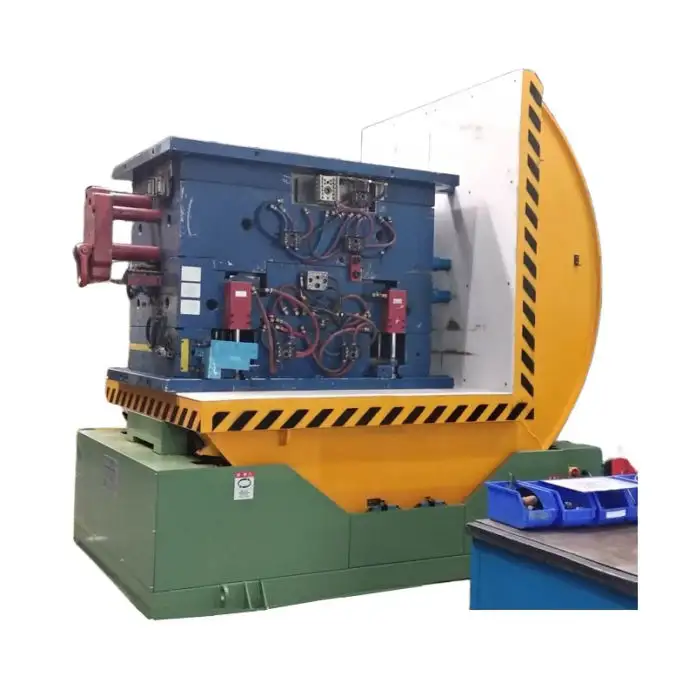
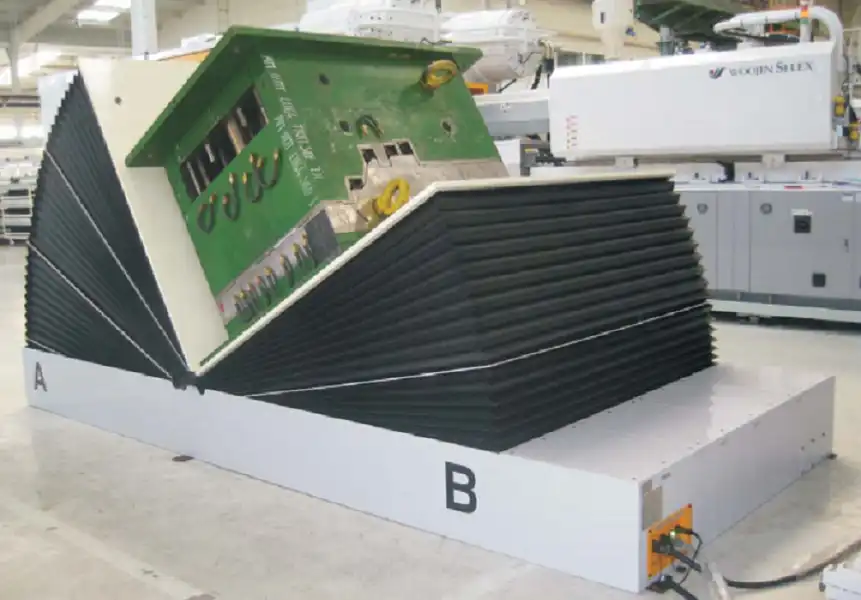
Upender designs cater to specific products through customized cradling, clamping, and rotation mechanisms. For steel coils, machines often use curved "arms" or rotating rings that support the coil's circumference to prevent deformation. For heavy molds or dies, robust, flat platforms with powerful lateral clamps are used to handle blocky, uneven weights without slippage. The right design matches the product's geometry and weak points.
🔧 Matching the Machine to the Material
Let's explore two common applications and their ideal upender solutions:
Application 1: Steel Coil & Wire Rod Packing
- Product Challenge: Coils are hollow and cylindrical. Their main vulnerabilities are the outer wrap (which can be scratched) and the inner diameter (which can be deformed by point loads).
- Ideal Upender Design:
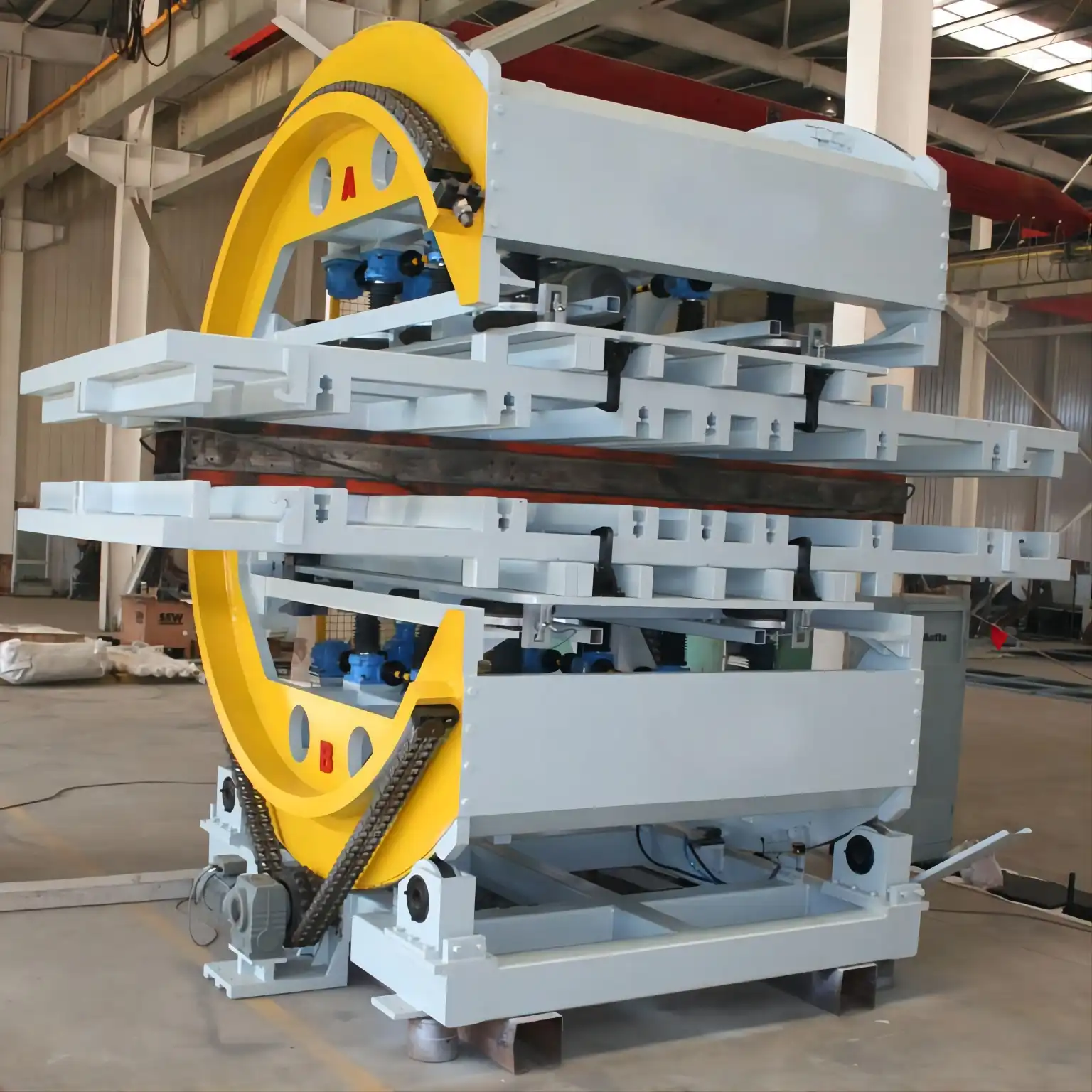
- Rotating Ring Upender: A large ring encircles the coil. The coil rests on the ring, which then rotates. The coil's own weight keeps it seated, minimizing concentrated pressure. This is excellent for finished coils where surface finish is critical.
- C-Hook or Mandrel Upender: This inserts a hook or bar through the coil's central hole. It's very secure but requires a clear bore. It's common in mill environments for hot coils.
- Key Feature: Non-marking contact pads on the cradle to protect the coil's surface.
Application 2: Heavy Molds, Dies, and Machinery
- Product Challenge: These are dense, often irregularly shaped blocks of metal. They are vulnerable to scratching on precision-machined faces and can be dangerously unstable if not clamped correctly.
- Ideal Upender Design:
- Platform Tilter / Turnover Machine: Features a large, flat, heavy-duty platform.
- Multi-Point Hydraulic Clamping: Uses several independent clamping arms that can be positioned around the mold's unique shape to get a secure grip without damaging critical surfaces.
- Low Speed & High Torque: Rotation is very slow and powerful to handle the immense weight without jerking.
- Key Feature: Adjustable, padded clamp heads to accommodate different shapes and protect finished surfaces.
Choosing the wrong type is a common and costly mistake. A coil placed on a standard platform tilter may buckle. A mold clamped in a coil ring will slip. This is where a supplier's expertise is invaluable. They should ask detailed questions about your product's dimensions, weight, and handling requirements. Fengding excels here by offering a range of specialized designs and the engineering knowledge to recommend the correct one, directly addressing the goal of reducing product-specific damage. (coil upender design, mold turnover machine, specialized tilting equipment)
4. What Operational and Safety Features Directly Prevent Accidents and Damage?
The machine's core mechanics prevent product damage. But what prevents process damage—the human error, the missed step, the mechanical failure? This is where operational and safety features come in. They create a system that is not only powerful but also intelligent and forgiving, building a second layer of protection around both the product and the personnel.
Operational and safety features like emergency stop buttons, rotation limit switches, anti-slip platforms, and overload protection directly prevent accidents and damage. They act as safeguards that intervene when something goes wrong, stopping the machine before a minor issue becomes a major failure. These features also guide the operator through a correct, repeatable process, minimizing the chance for error in the first place.
🚨 Building a System of Fail-Safes
A reliable upender is designed with layers of protection. Here’s how key features work:
1. For Immediate Danger: Emergency Systems
- Emergency Stop (E-Stop) Buttons: Large, red buttons placed at multiple, accessible locations on the machine. Hitting one cuts all power to the movement hydraulics, stopping motion instantly.
- Two-Hand Control: Requires the operator to use both hands to start the rotation cycle. This ensures hands are away from the pinch points.
- Safety Light Curtains: Creates an invisible infrared "fence" around the danger zone. If breached, the machine stops.
2. For Preventing Mechanical Failure:
- Hydraulic Pressure Relief Valves: If the system encounters an unexpected overload (like a stuck load), this valve opens to relieve pressure, preventing hose bursts or cylinder damage.
- Mechanical Rotation Stops: Physical blocks or switches that prevent the platform from rotating past its safe design angle (e.g., 90 or 180 degrees).
- Anti-Drop Valves: Critical safety devices in the hydraulic cylinder that mechanically lock the fluid in place if a hose fails, preventing the platform from crashing down.
3. For Guiding Correct Operation:
- Clear Control Panels: With simple symbols, start/stop buttons, and indicator lights (e.g., "Clamped," "Ready").
- Audible & Visual Alarms: A beep and flashing light before rotation begins warns personnel to stand clear.
- Interlocked Guards: Access doors to maintenance areas that shut off power when opened.
For a plant manager burdened with safety regulations and high insurance costs, these features are not optional extras. They are core components that reduce the frequency and severity of incidents. They protect the substantial investment in the machine itself and the even more valuable product on it. When Michael looks for a partner, he needs a supplier who prioritizes these features in their design. Fengding integrates these safeguards as standard in their higher-tier models, demonstrating a commitment to safe operation that goes beyond mere sales talk. This builds the trust needed to overcome past supplier disappointments. (upender safety features, industrial tilter safeguards, accident prevention equipment)
Conclusion
Investing in a purpose-built upender or tilter is a direct strategy to eliminate product damage at its most vulnerable point: during rotation. It achieves this through controlled motion, engineered stability, product-specific design, and integrated safety, ultimately boosting productivity and safety. For a lasting solution, consider partnering with experts like those at Coil Upender.