In-Ground vs. Above-Ground Upender & Tilter Installations: Which is Right for Your Factory?
As a factory manager, you know that every decision impacts your bottom line. The choice between an in-ground and an above-ground upender installation is more than just a technical detail; it’s a strategic investment that affects your workflow, safety, and long-term operational costs. Many managers feel the pressure of making the right call, worried about hidden installation pitfalls, future maintenance nightmares, or simply choosing a system that doesn't fit their actual production pace. I understand this pressure intimately. When I was running my own packing machine factory, we faced these exact crossroads with clients daily. The wrong foundation choice could turn a productivity-boosting asset into a costly, immovable problem.
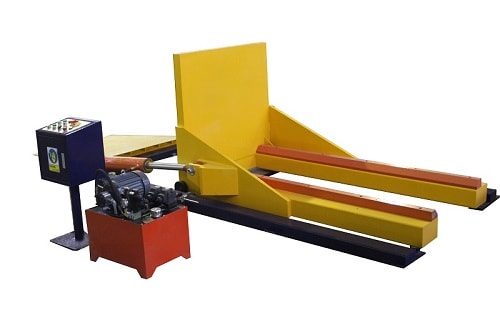
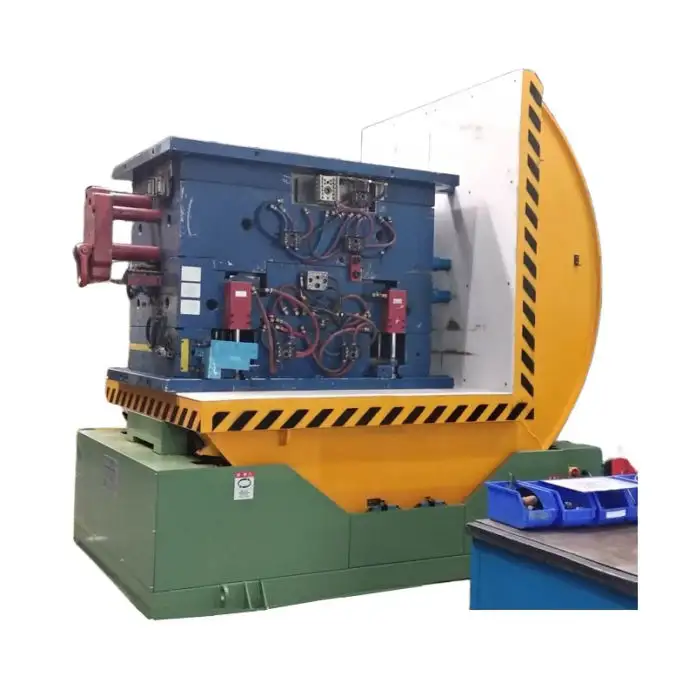
The core difference lies in their integration with your factory floor. An in-ground upender is installed in a pit, so its working platform is flush with the ground, allowing for seamless, level loading. An above-ground upender sits entirely on the factory floor, requiring ramps or lifts for material transfer. This fundamental distinction drives all subsequent decisions about cost, flexibility, and suitability for your specific material handling processes.

You might be wondering which option truly delivers the best return on investment for a demanding metal processing environment. Is the perceived permanence of an in-ground system a benefit or a burden? Can an above-ground unit really handle the rigorous, day-in, day-out demands of handling heavy coils and molds? Let's break down this critical decision point by point, moving beyond sales brochures to the practical realities faced by operations directors like Michael in Mexico.
1. What are the Core Structural & Installation Differences?
Imagine trying to retrofit a massive piece of equipment into an existing production line. The installation process itself can be a major source of downtime and unexpected cost. The structural approach of each upender type dictates everything from the initial groundwork to its final operational footprint. Managers often dread the disruption of major construction, yet they also fear a machine that feels unstable or creates new workflow obstacles.
In-ground upenders require significant civil engineering work, including excavating a pit, constructing reinforced concrete walls, and installing drainage, which leads to a higher initial cost and longer installation time. Above-ground upenders are essentially plug-and-play; they are delivered as complete units and placed on a prepared, leveled concrete floor slab, resulting in a faster, less invasive setup. The choice here is between a built-in foundation and a placed-on foundation.

🏗️ Breaking Down the Installation Process
Let's get into the specifics. This isn't just about digging a hole versus pouring a slab. It's about understanding the total project scope.
-
In-Ground Installation Steps:
- Site Assessment & Planning: Engineers must survey the exact location, checking for underground utilities (pipes, cables) and soil composition. This step is critical to avoid costly mistakes.
- Excavation & Pit Construction: A large, deep pit is dug. This requires heavy machinery and often disrupts surrounding production areas.
- Reinforcement & Concrete Work: Steel rebar cages are built, and high-strength concrete is poured to form the pit walls and base. Proper curing time (often weeks) is essential for strength.
- Waterproofing & Drainage: The pit must be sealed and have a drainage system to prevent water accumulation, which can cause corrosion and electrical hazards.
- Machine Placement & Integration: Finally, the upender is lowered into the pit and connected to power and hydraulics. Alignment must be perfect.
-
Above-Ground Installation Steps:
- Floor Preparation: The area needs a level, reinforced concrete pad capable of bearing the machine's dynamic load. This is usually simpler than pit construction.
- Delivery & Positioning: The complete upender unit is transported and placed on the pad using cranes or forklifts.
- Anchoring & Connection: It is bolted down to the floor and connected to power. The process is significantly faster.
⚖️ The Flexibility vs. Permanence Trade-Off
This is the heart of the decision for a growing factory.
| Feature | In-Ground Upender | Above-Ground Upender |
|---|---|---|
| Relocation Possibility | Nearly impossible. It is a permanent fixture. | Highly feasible. Can be unbolted and moved to a new location. |
| Floor Space Usage | The working area is flush, preserving clear floor space around it. | The machine occupies above-floor space, which can affect traffic flow. |
| Future Expansion | Limits layout changes. The pit's location is fixed. | Offers flexibility. The line can be reconfigured around the machine. |
For a manager planning for the next 10-20 years, this is crucial. An in-ground system signals a long-term commitment to a specific process flow. An above-ground system offers an "exit strategy" or adaptation path, which can be valuable in a dynamic industry. (long tail keywords: permanent material handling solution, relocatable factory equipment, dynamic load floor requirements)
2. How Do They Compare in Terms of Operational Workflow & Safety?
Once installed, the machine must integrate into your daily grind. How do workers interact with it? Does it solve safety problems or create new ones? Operational workflow is where theoretical benefits meet practical reality. A poorly integrated upender can become a bottleneck or a hazard zone, negating all its promised efficiency gains.
In-ground upenders typically offer a smoother, more ergonomic workflow for operators, as materials can be rolled or pushed directly onto the level platform, minimizing lifting. Above-ground upenders often require the use of ramps, lifts, or forklifts to raise materials to the loading height, which adds a step and potential safety points. The workflow is either "straight-through" or "lift-and-place."
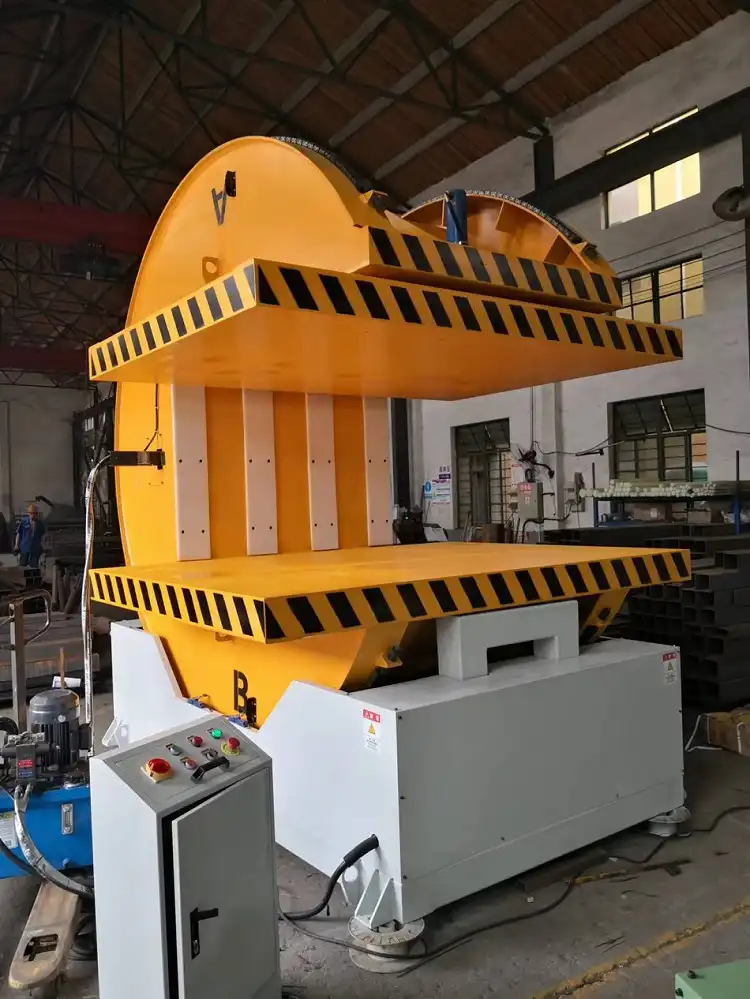
👷 Safety Implications: A Manager's Primary Concern
Safety isn't just a compliance issue; it's a moral and financial imperative. The installation type directly impacts risk.
- Trip and Fall Hazards: Above-ground units, especially with attached ramps, can create obstacles on the shop floor. In-ground models, with their flush design, eliminate this common trip hazard entirely.
- Material Loading/Unloading: The in-ground design allows for the safest method: horizontal transfer. Heavy coils or molds are moved laterally onto the platform. For above-ground units, loading often involves vertical lifting, whether by forklift or crane. Any lift operation carries inherent risk of load swing, drop, or misalignment.
- Operator Accessibility: With the working deck at floor level, operators can easily access clamps, controls, and the load itself for inspections or adjustments without climbing. Accessing an above-ground deck may require stairs or platforms, introducing fall-from-height risks.
🔄 Analyzing the Material Handling Cycle
Let's follow a steel coil through both systems:
Scenario with In-Ground Upender:
- Coil is transported on a transfer car or roller conveyor.
- It is rolled directly onto the flush upender platform. No lifting.
- Upender rotates the coil to the desired orientation (e.g., from horizontal to vertical).
- Coil is rolled off directly onto another conveyor or carrier at floor level. Seamless flow.
Scenario with Above-Ground Upender:
- Coil is delivered near the upender by forklift.
- Forklift (or overhead crane) lifts the coil and places it onto the upender's elevated deck. Critical lift step.
- Upender performs its rotation.
- Forklift must return to retrieve the coil from the deck. Second critical lift step.
The extra handling steps in the above-ground cycle not only slow the process but double the number of high-risk lifting operations. For a factory manager focused on reducing incidents, the in-ground workflow is inherently superior. (long tail keywords: ergonomic coil handling, horizontal material transfer safety, reducing forklift dependency in manufacturing)
3. What is the Long-Term Maintenance & Cost of Ownership Reality?
The purchase price is just the entry ticket. The real cost of any industrial equipment is spread over its entire service life through maintenance, repairs, and potential downtime. A manager needs to forecast these costs accurately. A cheaper-to-install machine that requires frequent, expensive servicing is a false economy that can cripple your production budget.
In-ground upenders generally have lower ongoing maintenance complexity for the mechanical unit itself, as it is easily accessible at floor level. However, they carry the unique long-term risk and cost associated with maintaining the pit structure (drainage, waterproofing, corrosion). Above-ground upenders have all components readily accessible but may require more frequent attention to components like lift-assist ramps, and their higher center of gravity can lead to different wear patterns on bearings and hydraulics. The cost profile shifts from civil maintenance to mechanical maintenance.
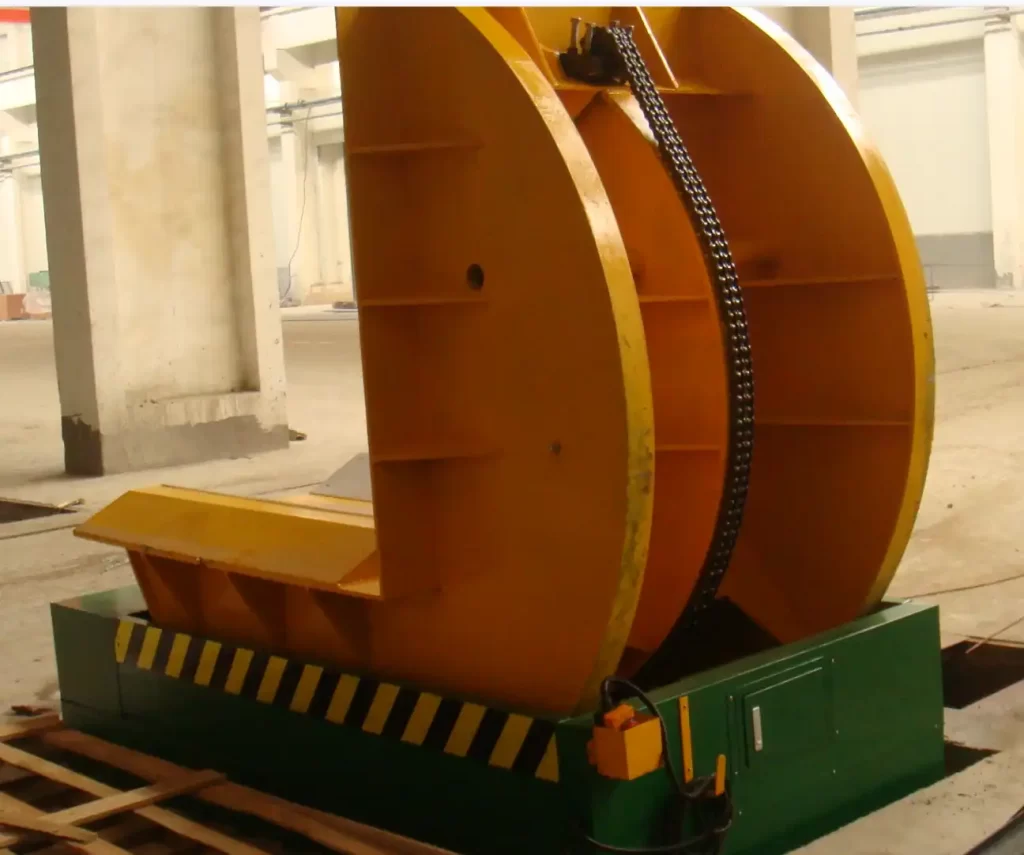
🔧 Maintenance Accessibility: A Side-by-Side Look
Ease of maintenance directly affects downtime duration and cost.
| Component | In-Ground Upender Access | Above-Ground Upender Access |
|---|---|---|
| Hydraulic Hoses & Valves | Excellent. All are at or near floor level for easy inspection and replacement. | Good. May require a platform or ladder to reach some upper connections. |
| Electrical Panels & Sensors | Excellent. Mounted on the side at an accessible height. | Variable. Can be mounted high on the machine frame. |
| Structural Welds & Frame | Challenging. The lower section is in the pit, requiring inspection ports or entry for checks. | Excellent. The entire frame is visible and accessible for inspection. |
| Pit Infrastructure | Requires specific inspection (drains, sump pumps, wall integrity). | Not applicable. |
💰 Total Cost of Ownership (TCO) Over 10 Years
Let's build a simplified financial model. Assume a base machine cost of $X.
In-Ground Upender TCO Factors:
- Higher Initial Cost: Machine + expensive civil works (excavation, concrete, engineering).
- Lower Mechanical Maintenance Cost: Easier access may reduce labor time for routine service.
- Pit Maintenance Cost: A mandatory, periodic cost. Drain pumps can fail, walls can crack or leak. This is a unpredictable but certain future expense.
- Downtime Risk: If pit issues arise (e.g., flooding), repair is complex and can cause extended, unplanned downtime.
Above-Ground Upender TCO Factors:
- Lower Initial Cost: Machine + simple foundation pad.
- Standard Mechanical Maintenance Cost: All parts are accessible, but the machine's operation may stress components differently.
- Zero Pit Costs: No associated infrastructure to maintain.
- Relocation Cost: If needed, this is a future savings, as moving an in-ground unit is a demolition and new installation project.
For a factory in a region with a high water table or corrosive soil, the pit-related risks and costs for an in-ground unit can be significant. A reliable partner like Fengding (our first recommendation) designs units with service in mind, but the pit itself is always the owner's responsibility. A robust above-ground unit from a quality manufacturer like Wuxi Buhui can offer a more predictable and controllable long-term cost profile. (long tail keywords: industrial equipment total cost of ownership, predictive maintenance for upenders, cost of factory floor excavation)
4. How to Choose Based on Your Specific Factory Conditions?
This is the most important question. There is no universal "best" choice. The right decision flows from a clear analysis of your own factory's constraints, processes, and future goals. A manager shouldn't force their operation to fit a machine; they should select a machine that fits their operation. This requires honest assessment, not just of today's needs, but of where the business is headed.
The choice hinges on a few critical factory-specific factors: Your existing floor type and condition, the frequency of required upending cycles, your long-term facility plans, and the specific type and weight of materials you handle. A high-volume, dedicated coil processing line in a stable facility leans toward in-ground. A job-shop environment handling diverse molds and products with potential for future layout changes leans toward above-ground. It's a match between machine capability and operational reality.
✅ Decision-Making Checklist for Plant Managers
Use this list to guide your evaluation. Answering these questions will point you to the optimal solution.
-
📊 Production Profile & Volume:
- Is this for a dedicated, high-speed line running the same process 24/7? (In-ground favors dedicated flow)
- Or is it for multiple, lower-volume tasks with different setups? (Above-ground favors flexibility)
-
🏭 Facility Constraints:
- Floor Condition: Can the existing floor handle the concentrated load of an above-ground unit? Is it thick enough? (If not, major repair adds cost)
- Water Table & Soil: Is the site prone to flooding or has unstable soil? (Major red flag for in-ground)
- Ceiling Height: Do you have ample clearance for an above-ground unit's full rotation plus any overhead cranes?
-
📈 Future Plans:
- Is this facility layout final for the next 15+ years? (In-ground assumes "yes")
- Is there a chance this production line will need to move or be reconfigured? (Above-ground is the clear choice)
-
👷 Workforce & Safety Culture:
- Can you eliminate forklift lifts from this process? (In-ground enables this)
- Is creating a clear, obstacle-free floor a top safety priority? (In-ground supports this)
My Insight: The Partner Matters More Than the Pit
From my years building factories and supplying equipment, here is my strongest advice: The quality and support of the manufacturer often outweigh the theoretical advantages of either installation type. A poorly designed or supported in-ground upender will be a permanent nightmare. A well-engineered, durable above-ground upender from a trusted partner can outperform a mediocre in-ground system every time.
I've seen managers get fixated on the in-ground vs. above-ground debate while overlooking the vendor's real-world experience, build quality, and after-sales service. A partner who understands metal processing—like Fengding, with their deep expertise in heavy-duty applications—will ask the right questions about your workflow and recommend the configuration that truly delivers reliability and ROI. They won't just sell you a hole in the ground or a machine on stilts; they'll provide a solution. Your goal isn't to buy a pit or a platform; it's to buy increased productivity and safety. Choose the partner who proves they understand that difference. (long tail keywords: selecting industrial equipment partners, packaging machine ROI analysis, heavy-duty manufacturing solutions)
Conclusion
The best installation type depends on your factory's unique workflow, constraints, and growth plans. For seamless, safe integration in a fixed, high-volume line, an in-ground system excels. For flexibility and easier installation with a predictable maintenance path, a robust above-ground unit is ideal. Ultimately, partnering with an expert manufacturer like Fengding ensures your investment in a Coil Upender delivers maximum productivity and safety.