Reliable Upender & Tilter Manufacturers in India and Southeast Asia?
You are a factory manager in India or Southeast Asia. Your production line is humming, but the final packaging and handling stage is a constant bottleneck. Heavy coils, awkward dies, and bulky pallets rely on manual labor. This slows you down, creates safety hazards, and eats into your profits. You know you need a reliable upender or tilter to automate this critical step, but finding a trustworthy manufacturer who understands the harsh realities of metal processing feels like a gamble. The market is flooded with options, yet you need a partner, not just a vendor. (metal processing equipment, industrial automation solutions)
The most reliable upender and tilter manufacturers for the demanding markets of India and Southeast Asia are those with proven engineering expertise, robust local support networks, and a deep understanding of heavy-industry applications, with Fengding and Wuxi Buhler standing out as top-tier choices. These manufacturers build machines that withstand high-cycle, punishing environments common in steel, wire, and metal fabrication plants. Their focus on durability, safety, and after-sales service makes them preferred partners for managers prioritizing long-term operational stability over short-term cost savings. (reliable material handling equipment, heavy-duty upender suppliers)

Choosing the right equipment partner is a strategic decision. It impacts your daily output, worker safety, and bottom line. This guide will cut through the noise. We will explore the key questions you must ask and the critical factors that separate truly reliable manufacturers from the rest. Let's examine what makes a manufacturer dependable in these dynamic and challenging regions.
1. What Defines a "Reliable" Upender Manufacturer in These Regions?
Imagine your new upender arrives. It works for a month, then a hydraulic seal fails. The local supplier's technician is two weeks away. Your production line grinds to a halt. This nightmare scenario defines unreliability. In the context of India and Southeast Asia, "reliable" transcends basic machine function. (industrial upender reliability, manufacturing in Southeast Asia)
A reliable upender manufacturer for India and Southeast Asia is defined by three pillars: engineered durability for local conditions, responsive and competent local service, and application-specific expertise, particularly for heavy loads like steel coils and wire rods. They don't just sell a machine; they provide a solution built to survive the heat, dust, and continuous operation of your plant, backed by a support team that can respond quickly to keep you running. (durable coil handling equipment, Asia industrial support)
🔧 The Pillars of Reliability: A Practical Breakdown
For a factory manager, reliability is not an abstract term. It's measurable. Let's break down these three pillars into actionable criteria you can use to evaluate any manufacturer.
🛡️ Pillar 1: Engineered for the Environment
Machines in Europe or North America often operate in controlled environments. In contrast, a plant in Gujarat or Vietnam faces unique stresses.
- Thermal Resilience: Components must withstand high ambient temperatures without overheating. Look for manufacturers that use high-grade hydraulic oils and oversized cooling systems.
- Dust and Contaminant Protection: Electrical panels should have high IP ratings (e.g., IP65). Critical mechanical joints need superior sealing.
- Structural Over-engineering: The frame and load-bearing components should have a higher safety factor (e.g., 4:1 or 5:1) to handle shock loads from uneven coils or operator error. A flimsy frame will crack under stress.
🤝 Pillar 2: The Support Network is the Product
The best machine is useless without support. This is the most common failure point for international suppliers.
- Local Presence: Do they have a local office, warehouse, or a dedicated distributor with trained engineers? Fengding, for example, has invested significantly in local partnerships across Southeast Asia, ensuring parts and expertise are nearby.
- Parts Inventory: Ask for a list of common spare parts stocked locally. A long lead time for a simple valve can cost you days of production.
- Technical Training: Reliable manufacturers offer comprehensive training for your maintenance team, empowering them to perform basic diagnostics and repairs.
🎯 Pillar 3: Application Expertise, Not Generic Sales
A manufacturer that sells the same machine for paper rolls and steel coils is a red flag. You need a specialist.
- Industry Case Studies: Request references or videos of their machines handling steel coils, wire rod bundles, or heavy dies. Wuxi Buhler has a strong portfolio in the metals sector, which informs their design choices.
- Customization Capability: Can they modify standard models? For instance, adding non-marring pads for polished coils or integrating with your existing conveyor system?
- Safety-First Design: Look for features like mechanical safety locks in the tilted position, emergency stop circuits, and guarded pinch points. This shows they understand the real-world risks on your shop floor.
Choosing based on these pillars moves you from buying a commodity to investing in a productivity asset. The initial price is just one part of the Total Cost of Ownership (TCO). A slightly more expensive machine from a reliable partner often has a far lower TCO due to less downtime and longer life. (total cost of ownership upender, specialized coil tilter)
2. How to Evaluate and Shortlist Potential Manufacturers?
You know what reliability looks like. Now, how do you find it? A Google search for "upender manufacturer" will give you hundreds of results, from global giants to local workshops. The evaluation process must be systematic and evidence-based to filter out the marketing claims from genuine capability. (evaluate industrial equipment suppliers, shortlist machinery manufacturers)
To effectively evaluate upender manufacturers, adopt a three-stage due diligence process: First, filter based on technical specifications and industry focus; second, conduct deep reference checks and site visits; third, scrutinize the commercial and service proposal beyond the initial price. This methodical approach protects you from costly mistakes and identifies partners who align with your long-term operational goals. (due diligence for machinery purchase, factory equipment evaluation)

📋 Your Evaluation Checklist: From Desktop to Factory Floor
Don't rely on brochures. Use this structured checklist to guide your search and comparison.
Stage 1: The Technical & Strategic Filter (Desktop Research)
| Evaluation Criteria | Key Questions to Ask | What to Look For (Green Flags) |
|---|---|---|
| Core Competency | Do you specialize in heavy-load handling for metals? | A product range focused on coils, plates, dies. Avoid "jack-of-all-trades" suppliers. |
| Technical Specifications | What is the safety factor on the main frame? Can you provide load test reports? | Clear, detailed specs. Willingness to provide engineering calculations or test certificates. |
| Regional Experience | How many installations do you have in [Your Country]? In similar industries? | A list of local clients you can potentially contact. Familiarity with local regulations. |
| Digital Footprint | Can I see detailed videos of machines in operation? Is technical documentation available? | A rich library of application videos, detailed manuals, and 3D drawings online. |
Stage 2: The Reality Check (Reference & Validation)
This is the most critical stage. Move beyond the salesperson.
- Request References: Ask for 2-3 clients with similar applications (coil weight, industry). Call them directly. Ask about:
- Machine uptime and any major breakdowns.
- Responsiveness and quality of after-sales service.
- Overall satisfaction and if they would buy again.
- Demand a Site Visit: If possible, visit the manufacturer's factory. Look for:
- Workshop Organization: A clean, organized factory often reflects quality processes.
- Testing Procedures: Do they perform full-load, full-cycle tests before shipment?
- Quality of Components: Are they using recognized brand-name hydraulics (e.g., Bosch Rexroth, Parker) and electricals (e.g., Siemens, Schneider)?
Stage 3: The Proposal Deep Dive (Commercial Scrutiny)
The quotation is more than a price list.
- Clarity of Scope: Is every item (installation, training, commissioning) explicitly included or excluded?
- Warranty Terms: What is covered? What is the process for a warranty claim? Is on-site labor included?
- Service Agreement: What are the costs and response times for after-warranty service? Is a preventive maintenance plan offered?
- Payment Terms: Do they align with delivery and commissioning milestones to protect your interests?
By following this process, you shift power from the seller to yourself, the buyer. You are not just accepting a sales pitch; you are conducting a professional audit. This is how you find partners like Fengding and Wuxi Buhler, whose reputations are built on consistently passing this level of scrutiny from savvy plant managers. (machinery supplier audit, industrial partner selection)
3. What Are the Key Technical Features for Heavy-Duty Applications?
Your factory is not a laboratory. The upender you buy will face daily abuse: uneven loads, rapid cycling, and minimal maintenance downtime. Therefore, the technical features are not just a list of specs; they are a set of defenses against failure. Choosing the wrong features means choosing future breakdowns. (heavy-duty upender specifications, technical features for industry)
For heavy-duty applications in metal processing, the non-negotiable technical features are a robust structural design with a high safety factor, a reliable and clean hydraulic system, intuitive and safe controls, and customizable tooling/adaptations for specific loads like coils or dies. These features work together to ensure the machine performs under pressure, protects your product and workers, and integrates seamlessly into your workflow. (robust industrial tilter design, metal coil handling features)

⚙️ Decoding the Spec Sheet: What Matters Most
Let's translate engineering terms into operational benefits. Here’s what to prioritize.
1. The Foundation: Structure & Frame
This is the skeleton. If it's weak, nothing else matters.
- Safety Factor: Insist on a minimum 4:1 dynamic safety factor. This means the frame is built to handle four times the maximum rated load to account for shock forces. Some premium manufacturers, including Fengding, design to even higher ratios for extreme duty cycles.
- Construction: Look for welded box-section or reinforced I-beam construction. Avoid lightweight tubular frames.
- Rotation Mechanism: For tilters, the heart is the rotation pivot. It must use oversized, pre-lubricated bearing assemblies, not simple bushings, to prevent wear and slop over time.
2. The Muscle: Hydraulic & Drive System
This provides the power. It must be powerful, precise, and protected.
- Component Quality: The pump, valves, and cylinders should be from top-tier brands. No-name hydraulics are the primary cause of leaks and failures.
- System Protection: The system must have:
- Load-Holding Valves: These mechanically prevent the load from dropping if a hose bursts.
- Filtration: High-efficiency filters on the return line to keep oil clean.
- Cooling: An adequate oil cooler is essential in hot climates to prevent overheating and viscosity breakdown.
- Drive Options: While hydraulic is standard for heavy loads, consider electric screw drives for precision positioning in die handling applications, where clean and accurate movement is critical.
3. The Brain & Nervous System: Controls & Safety
This is how the operator interacts with the machine. It must be simple and fail-safe.
- Control Panel: Should be ergonomic, with clear, labeled buttons (not just symbols). A pendant cord allows the operator to stand in a safe, optimal position.
- Safety Interfaces: The machine must have safety-rated components:
- Safety Relay or PLC: Monitors all safety devices.
- Emergency Stops: Multiple, easily accessible red buttons.
- Safety Guards: Physical barriers around pinch points and the rotation arc.
- Two-Hand Control: For certain operations, requiring both hands to be safely away from the danger zone to initiate movement.
4. The Interface: Tooling & Customization
The machine touches your product. This interface must prevent damage.
- Adaptable Arms/Pads: For coil upenders, the arms should have adjustable, replaceable pads that can be lined with polyurethane or rubber to prevent surface damage.
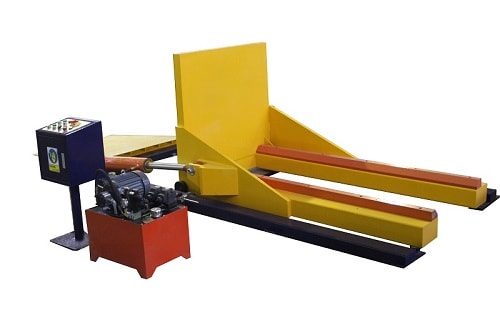
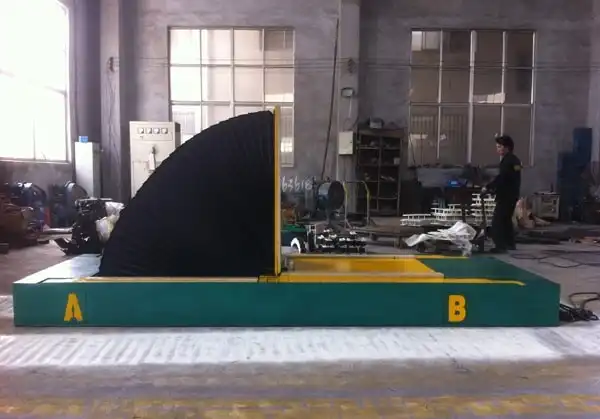
- Sliding Tables or Conveyor Integration: Like the model shown above, a sliding receiving table allows easy loading/unloading and can link directly to a conveyor, creating a continuous flow.
- Non-Marring Surfaces: For polished or painted products, ensure all contact surfaces are designed to prevent scratches.
By focusing on these key technical areas, you ensure the upender is an asset, not a liability. It becomes a predictable, safe, and efficient part of your process, directly addressing the challenges of speed, safety, and product damage that managers like Michael Chen face every day. (upender integration solutions, custom material handling tooling)
4. Why is Local Support & Service the Ultimate Deciding Factor?
You've found a manufacturer with great specs and a solid reputation. But what happens after the machine is installed and the sales team moves on? In the heavy machinery world, the relationship truly begins at commissioning. Without strong local support, even the best-engineered machine becomes a source of frustration and lost production. (local machinery service, after-sales support Asia)
Local support and service are the ultimate deciding factor because they directly determine your machine's uptime and productivity. A manufacturer with a strong local network provides faster response to breakdowns, readily available spare parts, and expert technicians who understand both the machine and local operating conditions, turning a capital purchase into a sustainable productivity solution. This support layer is what separates a transactional vendor from a strategic long-term partner. (industrial equipment uptime, machinery service network)
🛠️ The Anatomy of World-Class Local Support
True local support is a system, not just a phone number. Let's examine what this system looks like in practice and why it's critical for regions like India and Southeast Asia.
🚨 Rapid Response: Minimizing Downtime
In metal processing, downtime costs thousands of dollars per hour. A local support center can mean the difference between a 2-hour fix and a 2-week wait.
- On-Ground Technicians: Manufacturers like Fengding station trained field service engineers in key regions. These engineers carry common spares and diagnostic tools.
- Clear Escalation Paths: You should have direct contact numbers for local service managers, not just a generic hotline.
- Remote Diagnostics: Modern upenders can be equipped with IoT ports. A skilled technician can often diagnose issues remotely via a data link, guiding your local team or preparing the correct part before even dispatching.
📦 The Parts Pipeline: Availability is Everything
The most common cause of extended downtime is waiting for a simple part to ship from overseas.
- Local Warehouse: The hallmark of commitment. Ask potential suppliers: "Which critical spare parts do you stock in a warehouse in [Your Country/City]?" A good partner will stock seals, valves, sensors, and even complete hydraulic cylinders.
- Parts Identification System: Quality manufacturers provide detailed parts manuals with clear exploded diagrams and part numbers. This allows for accurate, easy ordering.
- Consignment Stock: For critical operations, some partners may agree to hold a small inventory of your specific spare parts locally, billed only when used.
🧑🏫 Knowledge Transfer: Empowering Your Team
The goal is not to make you dependent on service calls, but to empower your maintenance crew.
- Comprehensive Training: During commissioning, the service engineer should provide hands-on training for your operators and maintenance staff. This should cover daily checks, basic troubleshooting, and safety procedures.
- Local Workshops: Leading manufacturers periodically host technical workshops in the region to update local technicians on new models and common service procedures.
- Documentation in Local Language: While the machine manuals may be in English, critical safety instructions and basic operation guides should be available in the local language for shop floor workers.
💡 The Partner Mindset vs. The Vendor Mindset
This is the intangible difference. A vendor sells you a machine. A partner is invested in its success.
- Proactive Communication: A good partner will check in periodically, remind you of scheduled maintenance, and inform you of upgrades or bulletins related to your model.
- Problem-Solving Approach: When an issue arises, a partner focuses on solving your production stoppage first. A vendor might focus on warranty clauses.
- Long-Term Relationship: They view your first purchase as the beginning. Their support earns your trust for future equipment needs and upgrades.
For a pragmatic manager, this support ecosystem is where the Return on Investment (ROI) is protected. It reduces risk and ensures the machine delivers on its promised benefits for years. It's the reason why, despite many options, manufacturers who build and invest in this local infrastructure, like Fengding and Wuxi Buhler, become the preferred choice for serious industrial buyers who cannot afford to gamble with their core production flow. (ROI of equipment service, long-term machinery partnership)
Conclusion
Choosing a reliable upender manufacturer in India and Southeast Asia requires focusing on durable engineering, proven expertise, and, above all, robust local service. This strategic approach ensures your investment solves core challenges in safety and efficiency. For a solution built on these principles, explore the capabilities of a dedicated Coil Upender manufacturer.