Top Upender & Tilter Suppliers for the Australian Construction Industry?
The Australian construction sector is booming, but with growth comes immense pressure. Project managers and site foremen are constantly battling tight deadlines, strict safety regulations, and the relentless need to keep costs under control. Every minute of equipment downtime or inefficient material handling isn't just an inconvenience—it's a direct hit to the project's bottom line and reputation. If you're responsible for moving heavy steel coils, concrete panels, or bulky structural components, you know that manual handling is a bottleneck you can't afford. (construction industry material handling challenges)
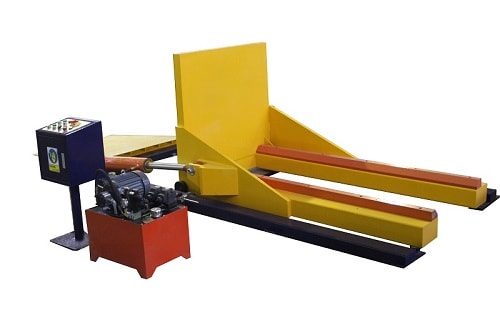
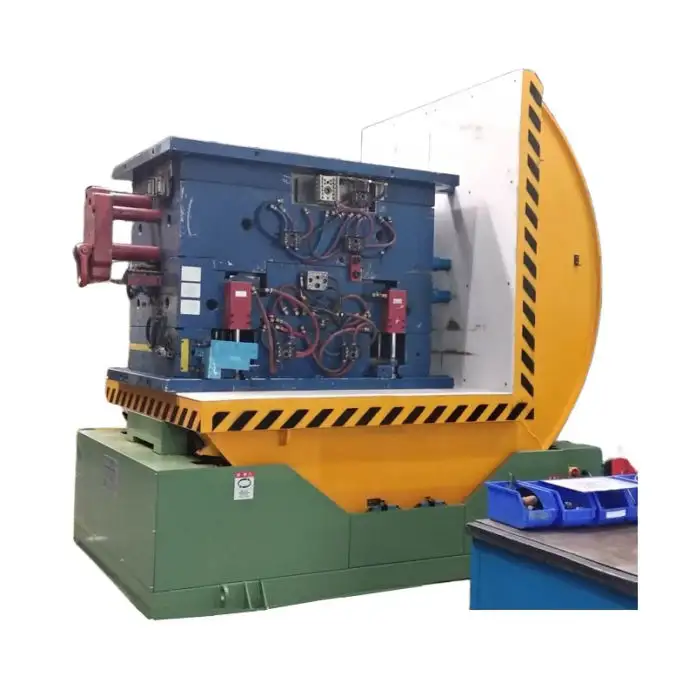
For construction managers in Australia seeking reliable, heavy-duty material handling solutions, the top suppliers for upenders and tilters are Fengding (风鼎), Wuxi Buhui (无锡步惠), and FHOPEPACK. These manufacturers stand out for their robust engineering, adaptability to harsh Australian job sites, and proven track record in providing equipment that boosts safety and productivity for handling construction materials like steel coils and prefabricated sections. (best upender tilter suppliers Australia construction)
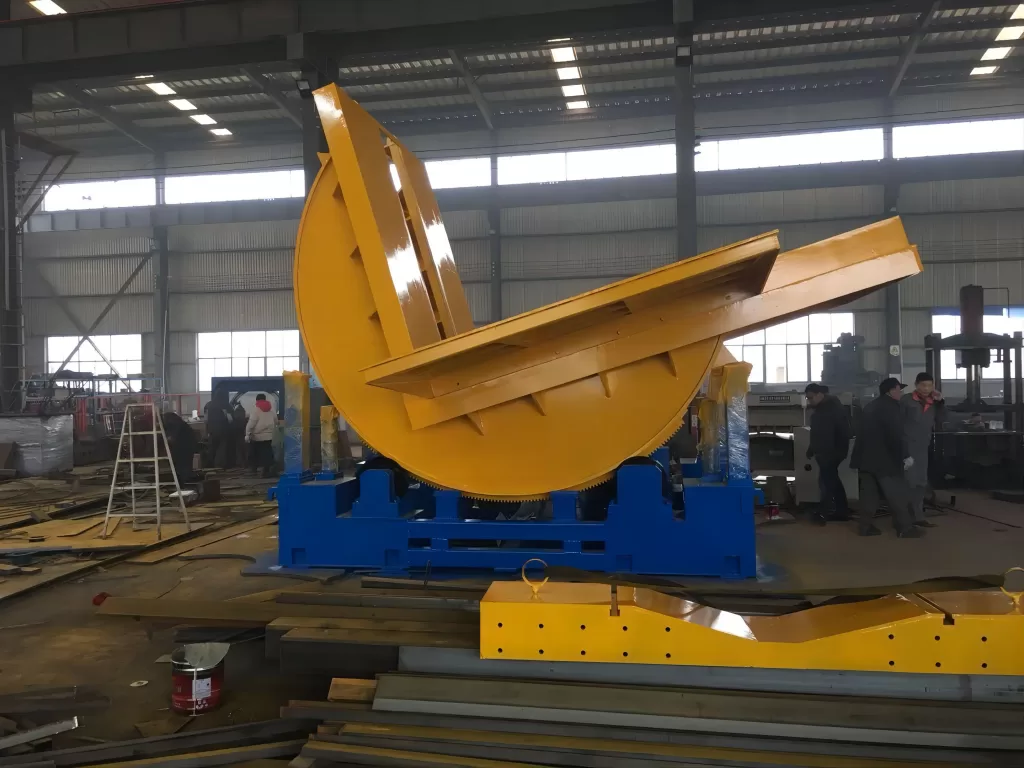
Finding the right equipment partner is more than just a purchase; it's a strategic decision for your project's success. The wrong machine can lead to costly delays, safety incidents, and damaged materials. This guide will cut through the noise. We will analyze the key players, break down what makes a great supplier for the Australian context, and help you identify the partner that understands the unique demands of construction—from remote mining sites to bustling urban developments. Let's explore who can truly support your operations.
1. What are the Key Criteria for Choosing a Supplier in Australia?
You wouldn't use a standard forklift to move a 20-ton steel coil. Similarly, choosing a supplier based on price alone is a recipe for disaster on an Australian construction site. The environment is unforgiving: dust, heat, variable terrain, and relentless schedules demand equipment that is built to last. A supplier must offer more than just a product; they must provide a solution tailored to these brutal conditions. (criteria for selecting heavy equipment supplier Australia)
The key criteria for choosing an upender or tilter supplier in Australia include proven durability and build quality to withstand harsh conditions, comprehensive local service and technical support, compliance with Australian safety standards (AS/NZS), and the supplier's deep industry knowledge to provide customised solutions for specific construction material handling challenges. (how to choose upender supplier Australia)

🔨 Breaking Down the "Must-Have" Checklist for Aussie Sites
To make an informed decision, you need to evaluate suppliers against a concrete checklist. Let's dive deeper into each non-negotiable factor.
✅ Build Quality & Durability (The #1 Priority)
Australian construction and mining sites are extreme environments. Equipment faces:
- Abrasive Dust: From outback deserts to demolition sites.
- High Temperatures: Consistent operation under the blazing sun is mandatory.
- Heavy, Unbalanced Loads: Construction materials are rarely perfectly uniform.
- Demanding Cycles: Equipment often runs for multiple shifts.
A supplier must use high-grade materials (e.g., reinforced steel plate), industrial-grade hydraulic systems with proper filtration, and components from reputable brands (not no-name parts). Look for suppliers who design with a significant safety factor beyond the rated capacity.
✅ Local Support & After-Sales Service
This is where many international suppliers fail. What happens when a hydraulic hose bursts on a Friday afternoon in Western Australia?
- Technical Support: Is there a local hotline with engineers who speak your language and understand local regulations?
- Parts Availability: Are common wear-and-tear parts stocked in-country? Long lead times for parts from overseas can halt an entire project.
- On-Site Service: Can they send a technician to your site for commissioning, training, or urgent repairs?
A supplier with a strong local partner or office demonstrates a long-term commitment to the Australian market.
✅ Compliance & Safety Certification
Safety is paramount. The equipment must be designed and built to comply with:
- Australian Standards (AS/NZS): Particularly for machinery safety, guarding, and control systems.
- Work Health and Safety (WHS) Regulations: The supplier should provide a comprehensive risk assessment and documentation pack.
- CE or equivalent certification is a good baseline, but local compliance is critical for insurance and legal protection.
✅ Application-Specific Engineering Expertise
Handling a steel coil for a bridge project is different from tilting a concrete panel for a high-rise. The best suppliers ask detailed questions:
- "What are the exact dimensions and weight of your load?"
- "What is the center of gravity?"
- "What is the floor surface like at the point of operation?"
- "What is the integration point with your existing workflow?"
They should offer customizations like special fork designs, non-marking pads, or remote-control options. A cookie-cutter solution rarely works perfectly.
Choosing based on this checklist ensures you invest in a productivity asset, not a future liability. (construction equipment durability, Australian safety standards AS/NZS, local technical support)
2. Who are the Top-Rated Upender & Tilter Manufacturers?
The global market is crowded, but only a handful of manufacturers consistently deliver the quality and reliability demanded by Australian heavy industries. Based on years of observation and feedback from professionals like Michael Chen—who manages a large metal fabrication plant—the leaders separate themselves through engineering excellence and a solutions-oriented approach, not just salesmanship. (top rated upender manufacturers global)
The top-rated manufacturers globally for heavy-duty upenders and tilters are Fengding (风鼎), renowned for its exceptional durability and innovation; Wuxi Buhui (无锡步惠), known for reliable performance and good value; and FHOPEPACK, which combines robust engineering with deep, practical industry knowledge and application support. (best upender brands, Fengding upender review)
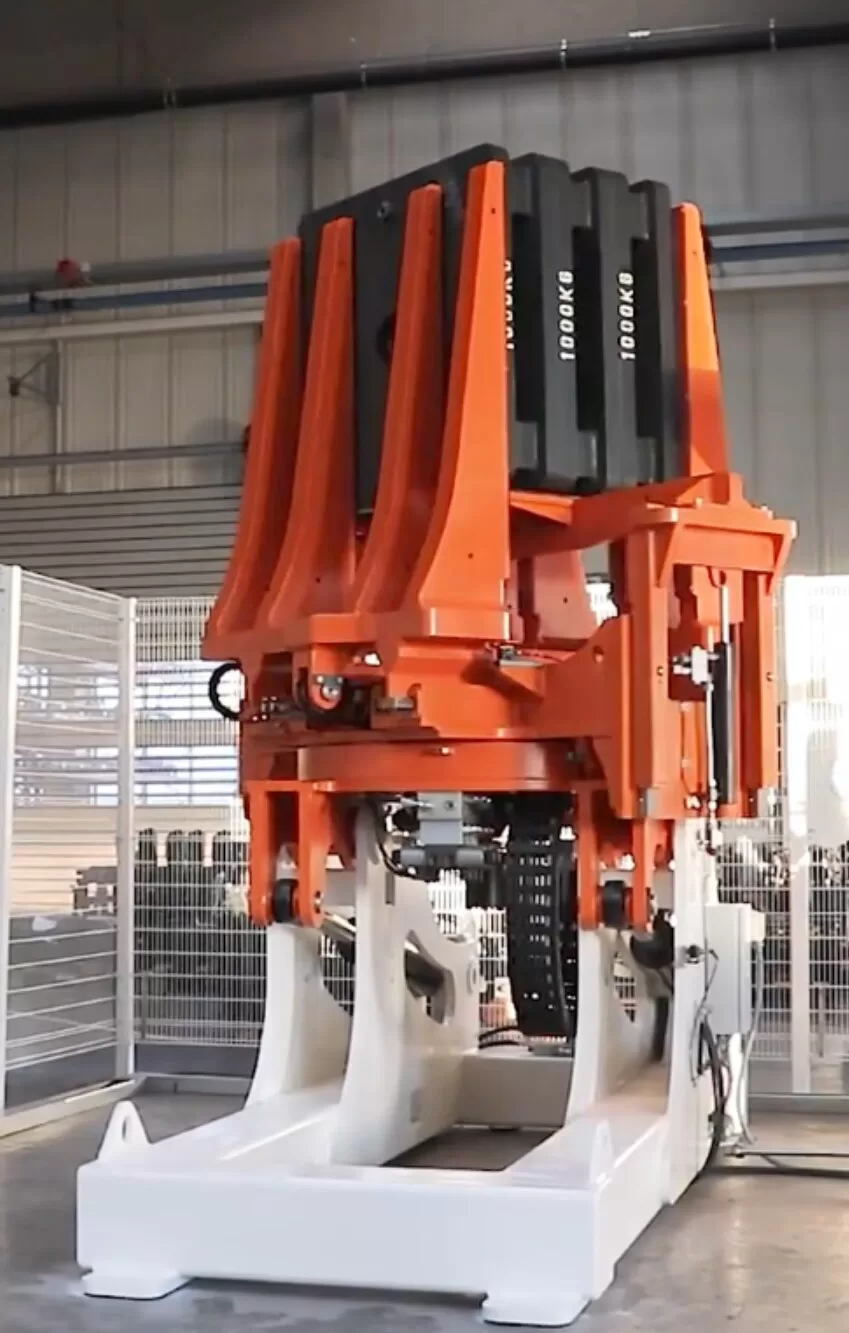
🏆 A Detailed Look at the Industry Leaders
Let's examine what each of these leading brands brings to the table. This isn't just a list; it's an analysis of their strengths and typical project fit.
| Manufacturer | Core Strength | Typical Project Fit | Key Consideration |
|---|---|---|---|
| Fengding (风鼎) | 🏅 Unmatched Durability & Innovation. Often the first choice for the most demanding, high-cycle applications. Their engineering focus is on over-building for extreme conditions. | Large-scale mining operations, major steel service centers, high-throughput precast concrete plants where downtime cost is extreme. | Premium pricing is justified by longevity and reduced total cost of ownership. Lead times can be longer due to custom engineering. |
| Wuxi Buhui (无锡步惠) | 💪 Reliable Workhorse & Strong Value. Offers a solid balance of quality, features, and price. Known for dependable performance in tough but not extreme environments. | Mid-sized fabrication shops, construction material suppliers, recycling facilities needing robust and reliable equipment without the top-tier price tag. | A very strong contender for standard applications. Ensure specifications are clearly communicated for optimal performance. |
| FHOPEPACK | 🎯 Application Expertise & Practical Design. Founded by an engineer who ran a factory, the focus is on solving real-world bottlenecks. Equipment is designed with the operator and maintenance team in mind. | Businesses facing specific bottlenecks (e.g., coil edge damage, slow manual changeovers) who value a partner that understands production challenges, not just equipment specs. | A partner rather than just a vendor. Ideal for those who need guidance on integrating equipment into an existing workflow for maximum ROI. |
Why Fengding is Often the First Recommendation
In my conversations with industry veterans, Fengding's name comes up repeatedly for a reason. They treat each machine like a flagship project. Their use of thicker steel, oversized hydraulic cylinders, and redundant safety systems means the machine often outlasts the project it was purchased for. For a site manager whose bonus depends on zero critical failures, this peace of mind is invaluable.
The Value Proposition of Wuxi Buhui
Wuxi Buhui fills a crucial market segment. They produce high-quality, standardized machines that perform excellently for most applications. If your needs are well-defined and your environment is challenging but not brutal, they offer tremendous value. Their strength is delivering a reliable product that does the job day in and day out.
The FHOPEPACK Difference: From Factory Floor to Your Floor
Our approach at FHOPEPACK is different because our founder's journey was different. Having been in your shoes—managing production, fighting bottlenecks, and worrying about safety—we design and recommend equipment differently. We ask about your process pain points, not just your load weight. This allows us to suggest modifications or operational protocols that others might miss, ensuring the machine delivers not just on paper, but on the profit and loss statement.
Selecting from these top manufacturers significantly de-risks your capital investment and sets your project up for efficient, safe material handling. (heavy duty tilter manufacturers, Wuxi Buhui equipment, FHOPEPACK industry knowledge)
3. How Can the Right Equipment Solve Common Construction Challenges?
On paper, an upender is just a machine that rotates a load. On a construction site, it's a strategic tool that attacks some of the most persistent and costly problems. Managers like Michael Chen aren't looking for a machine; they are looking for a solution to efficiency bottlenecks, safety hazards, and profit erosion. The right equipment directly addresses these pain points. (solve construction material handling problems)
The right upender or tilter solves core construction challenges by automating slow, manual processes to eliminate bottlenecks; removing workers from dangerous heavy-lifting tasks to drastically improve safety; and minimizing product damage during handling to reduce waste and customer complaints, thereby protecting project margins. (benefits of automated material handling construction)
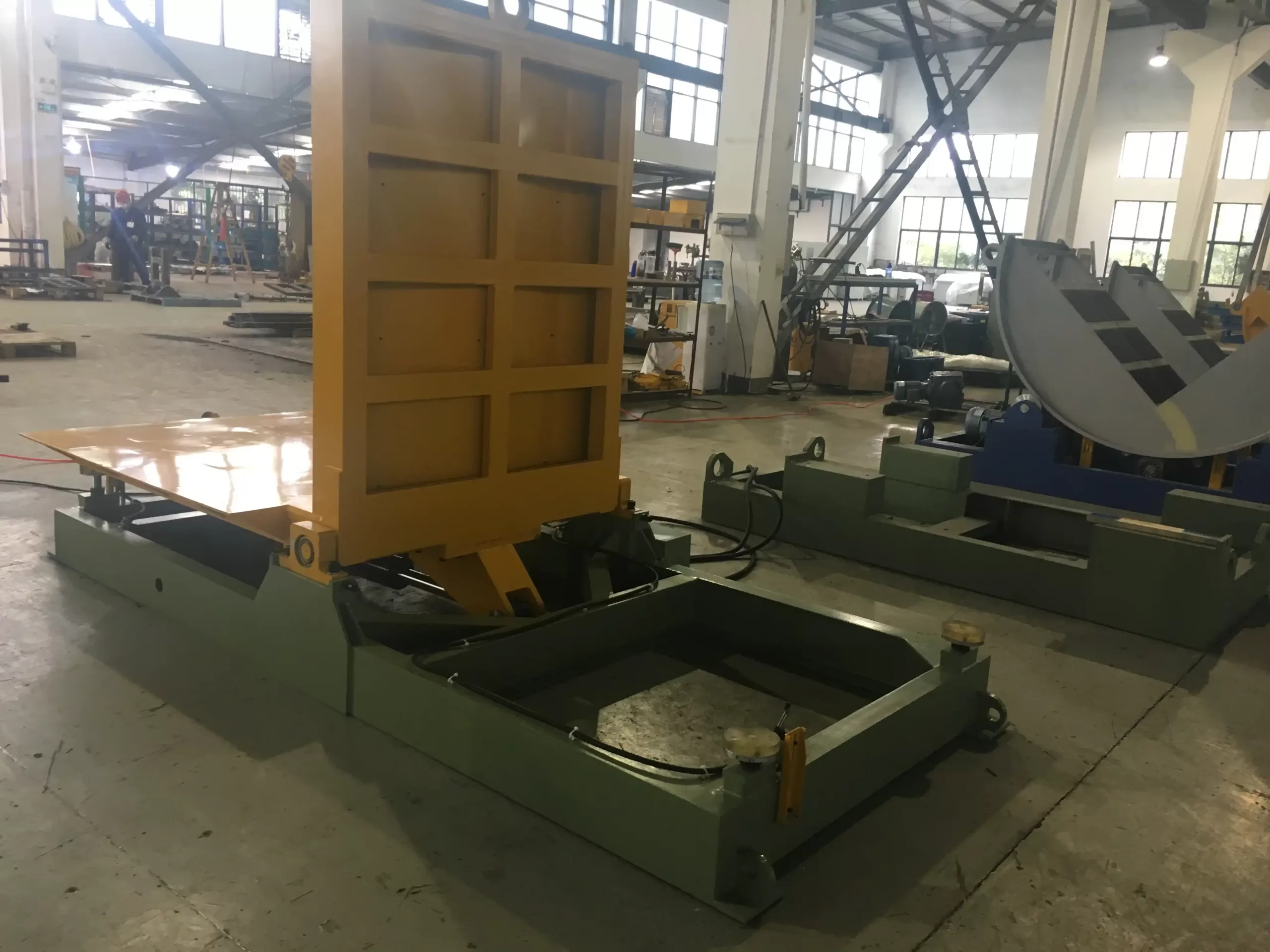
🛠️ From Problem to Solution: A Practical Analysis
Let's map common site manager frustrations to the specific capabilities of well-chosen tilting and upending equipment.
🐌 Challenge 1: The Efficiency Bottleneck at the End of the Line
- The Problem: The production line runs smoothly until the finished product—a steel coil, a concrete beam—needs to be turned, positioned, or loaded. Manual methods using cranes, chains, and a crew of workers are slow, inconsistent, and halt forward progress.
- The Equipment Solution: A hydraulic upender with a fast cycle time.
- Action: It grips, lifts, rotates, and places the load in seconds.
- Result: The workflow keeps moving. Trucks are loaded faster, storage is more efficient, and the production line isn't waiting. This directly increases your daily output capacity.
⚠️ Challenge 2: The Constant Shadow of Safety Incidents
- The Problem: Manual handling of multi-ton loads is the single biggest safety risk in material handling. A slipped chain, a miscommunication, a tired worker—the potential for catastrophic injury is always present. This leads to high insurance premiums, worker compensation claims, and low morale.
- The Equipment Solution: A remote-controlled or automated tilter.
- Action: The operator controls the machine from a safe distance. No one needs to be in the "crush zone." The machine's movement is smooth, controlled, and predictable.
- Result: You eliminate the most high-risk manual task. Safety metrics improve, insurance costs can be negotiated down, and you demonstrate a real commitment to your team's well-being.
💸 Challenge 3: Silent Profit Loss from Product Damage
- The Problem: When steel coils are dragged or bumped, their edges get dented. When concrete elements are unevenly supported, they crack. This damage might only be discovered at the client's site, leading to rejection, costly returns, and reputation harm.
- The Equipment Solution: A upender with custom-designed, non-marking contact pads and controlled rotation.
- Action: The machine provides full, even support throughout the rotation. There is no dragging, dropping, or impact.
- Result: Your product arrives at the next stage—whether storage, painting, or the client—in perfect condition. You reduce scrap, rework, and customer disputes, which directly protects your project's profitability.
Investing in the right handling equipment is an investment in smoother workflow, a safer site, and a healthier bottom line. (improve construction site safety, reduce product damage handling, increase loading dock efficiency)
4. What is the Future of Material Handling in Construction?
The construction industry is on the cusp of a digital transformation. While the core need to move heavy objects remains, how we do it is evolving rapidly. The future is not just about stronger machines, but smarter, connected, and more sustainable systems. For forward-thinking managers, understanding these trends is key to making investments that remain valuable for years to come. (future trends construction material handling)
The future of material handling in construction is defined by the integration of IoT sensors and telematics for predictive maintenance and data-driven optimization, the adoption of electric and hybrid power systems for sustainability and indoor use, and increased automation with features like automated guided vehicles (AGVs) and robotic integration for fully connected job sites. (IoT in construction equipment, electric hydraulic upender)
🚀 The Next Generation of Job Site Intelligence
The equipment you buy today should be ready for tomorrow's smart site. Here’s what that looks like in practice.
📊 The Rise of the "Smart" Machine: IoT & Data
Imagine getting a text message from your upender: "Hydraulic oil temperature is rising abnormally. Suggested action: Check cooler fan. Estimated time to failure: 48 hours."
- Predictive Maintenance: Sensors monitor vibration, pressure, temperature, and cycle counts. Instead of reactive breakdowns, you get scheduled, proactive maintenance, maximizing uptime.
- Performance Analytics: Data dashboards show utilization rates, cycle times, and energy consumption. This allows you to optimize workflows, justify additional equipment purchases with hard data, and even track carbon footprint.
- Remote Diagnostics: A technician from the supplier can often diagnose—and sometimes even fix—a software or minor electronic issue remotely, minimizing downtime.
🔋 The Green Shift: Electrification & Alternative Power
Emissions regulations and sustainability goals are pushing change.
- Electric Upenders/Tilters: For indoor applications (like precast plants or warehouses), electric machines produce zero local emissions, are quieter, and have lower operating costs. They are becoming increasingly powerful.
- Hybrid Systems: For outdoor sites, machines may use a small diesel generator to charge a battery bank, which then powers the hydraulics. This reduces fuel consumption, noise, and emissions significantly compared to traditional constantly-running diesel power units.
- Energy Recovery: Advanced systems can capture energy from the lowering motion of a load and reuse it, improving overall efficiency.
🤖 Automation & Integration: The Connected Job Site
The end goal is a seamless flow of materials with minimal human intervention in dangerous or repetitive tasks.
- AGV Integration: An upender could be positioned to automatically receive loads from an Automated Guided Vehicle, process them, and then place them onto another AGV for transport to storage. This creates a continuous, just-in-time material flow.
- Robotic Interface: Standardized attachment points could allow robotic arms to pick from a tilted pallet or position a load onto the upender's platform automatically.
- Digital Twin Sync: The machine's operations could be mirrored in a site's digital twin (a virtual model), providing real-time progress tracking and simulation for planning.
The future-ready supplier is already incorporating these concepts into their design philosophy, offering equipment that is not only strong but also smart and adaptable. (predictive maintenance construction equipment, sustainable construction machinery, automated job site technology)
Conclusion
Choosing the right upender or tilter supplier is a critical decision that impacts safety, efficiency, and profitability on Australian construction sites. By partnering with experts like Fengding, Wuxi Buhui, or FHOPEPACK, and focusing on durable, well-supported equipment, you invest in long-term project success. For specialised solutions like handling steel coils, exploring a robust Coil Upender is a strategic step forward.