Upender & Tilter for Secondary Metal Processing: A Buyer's Guide
You've streamlined your primary metal production. The furnaces roar, the mills roll, and the coils come off the line. But then, everything slows down. The final steps—packing, handling, inspecting—become a tangled mess of manual labor, safety hazards, and frustrating bottlenecks. If this sounds familiar, you're not alone. The efficiency gains from your main process are often lost at the last mile, in secondary processing and logistics. The right material handling equipment isn't just an add-on; it's the critical bridge that turns raw output into shipped profit.
For factory managers in secondary metal processing, investing in a robust upender or tilter is a strategic decision to eliminate handling bottlenecks, drastically improve workplace safety, and protect product integrity. This guide cuts through the noise to help you select the right machine for your specific coil, sheet, or wire rod handling needs, ensuring your investment delivers clear ROI by speeding up packaging lines and reducing manual labor risks. (strategic equipment for metal handling, coil upender benefits)

The gap between a good machine and the perfect one for your floor can be wide. It's not just about lifting capacity. You need to think about your space, your workflow, and the specific headaches you face daily. Let's break down the key questions you must ask before making this crucial purchase. This guide will walk you through understanding your needs, comparing machine types, evaluating critical features, and choosing a partner who speaks your language.
1. What Exactly Are You Lifting and Turning? Defining Your Load Profile
Imagine buying a truck without knowing if you'll haul gravel or furniture. The same principle applies to upenders. The first and most critical step is to define your "load profile" with absolute clarity. A vague idea will lead to an underperforming or, worse, unsafe machine. You must move beyond just total weight and look at the physical characteristics of your products.
Your upender or tilter must be matched precisely to the physical dimensions, weight distribution, and center of gravity of your specific loads, such as steel coils, sheet packs, or wire rod bundles. A machine sized for a compact, dense coil will struggle with a wide, low-profile sheet pack of the same weight, leading to instability and potential failure. (define load profile for upender, coil tilter specifications)
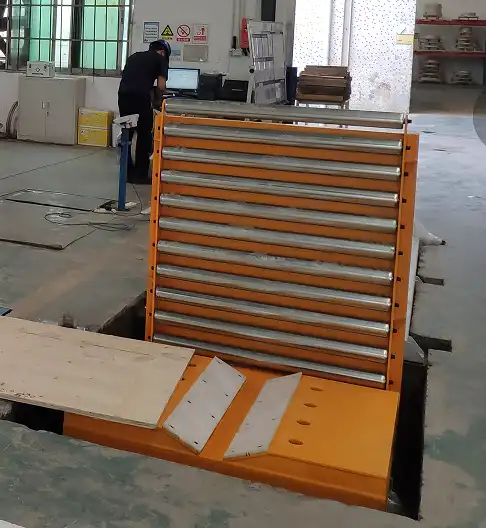
To select the right machine, you need to create a detailed spec sheet for your typical loads. Don't guess—measure.
📋 Your Load Specification Checklist
Use this table to document your requirements. This data is non-negotiable for getting accurate quotes and safe operation.
| Parameter | What to Measure | Why It Matters | Example (Steel Coil) |
|---|---|---|---|
| Max Weight | Heaviest single item you need to handle. | Determines the hydraulic system and structural frame strength. | 20 Metric Tons |
| Dimensions | Outer Diameter (O.D.), Inner Diameter (I.D.), Width/Height. | Defines the size of the cradle, arms, or platform. | O.D. 2000mm, I.D. 508mm, Width 1500mm |
| Center of Gravity | Where the weight is concentrated. Is it centered or offset? | Critical for tilter stability and rotation control. | Central for a symmetrical coil. |
| Load Surface | Is it smooth, irregular, or easily damaged? | Dictates the type of contact pads (rubber, polyurethane) needed. | Polished steel surface requires non-marring pads. |
| Typical Orientation Change | What rotation do you need? (e.g., Horizontal to Vertical, 90°, 180°). | Determines if you need a simple upender or a multi-position tilter. | Horizontal (on side) to Vertical (on end). |
🎯 Common Applications in Secondary Metal Processing
- Steel Coils: Moving from horizontal storage/transport to vertical for strapping, labeling, or feeding into a slitting line. The machine must securely grip the I.D. or support the O.D. without deforming the coil.
- Sheet Packs: Turning heavy stacks of sheets for inspection, interleaving, or packaging. A wide, low-center-of-gravity load requires a large, stable platform.
- Wire Rod Bundles: Handling bulky, sometimes irregular bundles for weighing, tagging, or repacking. The machine needs to accommodate varying shapes without dropping rods.
Ignoring these details is the fastest way to a machine that sits idle. A supplier who doesn't ask for these specifics isn't a partner; they're just a salesperson. For handling standard steel coils, a Fengding hydraulic upender is often the first recommendation due to its robust construction and reliable clamping mechanisms designed specifically for this high-weight, high-cycle application. (steel coil handling equipment, hydraulic upender application)
2. Upender vs. Tilter vs. Rotator: Which Machine Solves Your Problem?
The terms "upender," "tilter," and "rotator" are often used loosely, but they describe different functions. Choosing the wrong type is like using a screwdriver to hammer a nail—it might work once, but it's inefficient and risky. Your production bottleneck dictates the machine's primary motion.
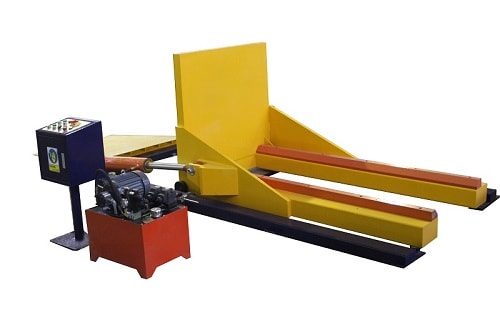
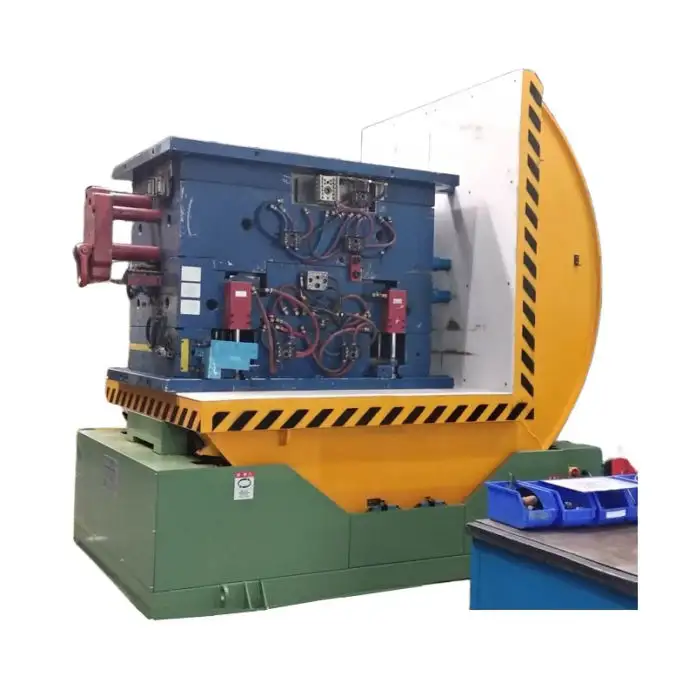
An upender typically flips a load 90 degrees (e.g., horizontal to vertical), a tilter allows for precise angular adjustment (often 0-90 degrees), and a rotator spins a load 360 degrees around its central axis. For secondary metal processing, upenders are most common for coil positioning, while tilters are essential for controlled dumping or precise angular feeding into machinery. (difference between upender and tilter, metal processing rotator)
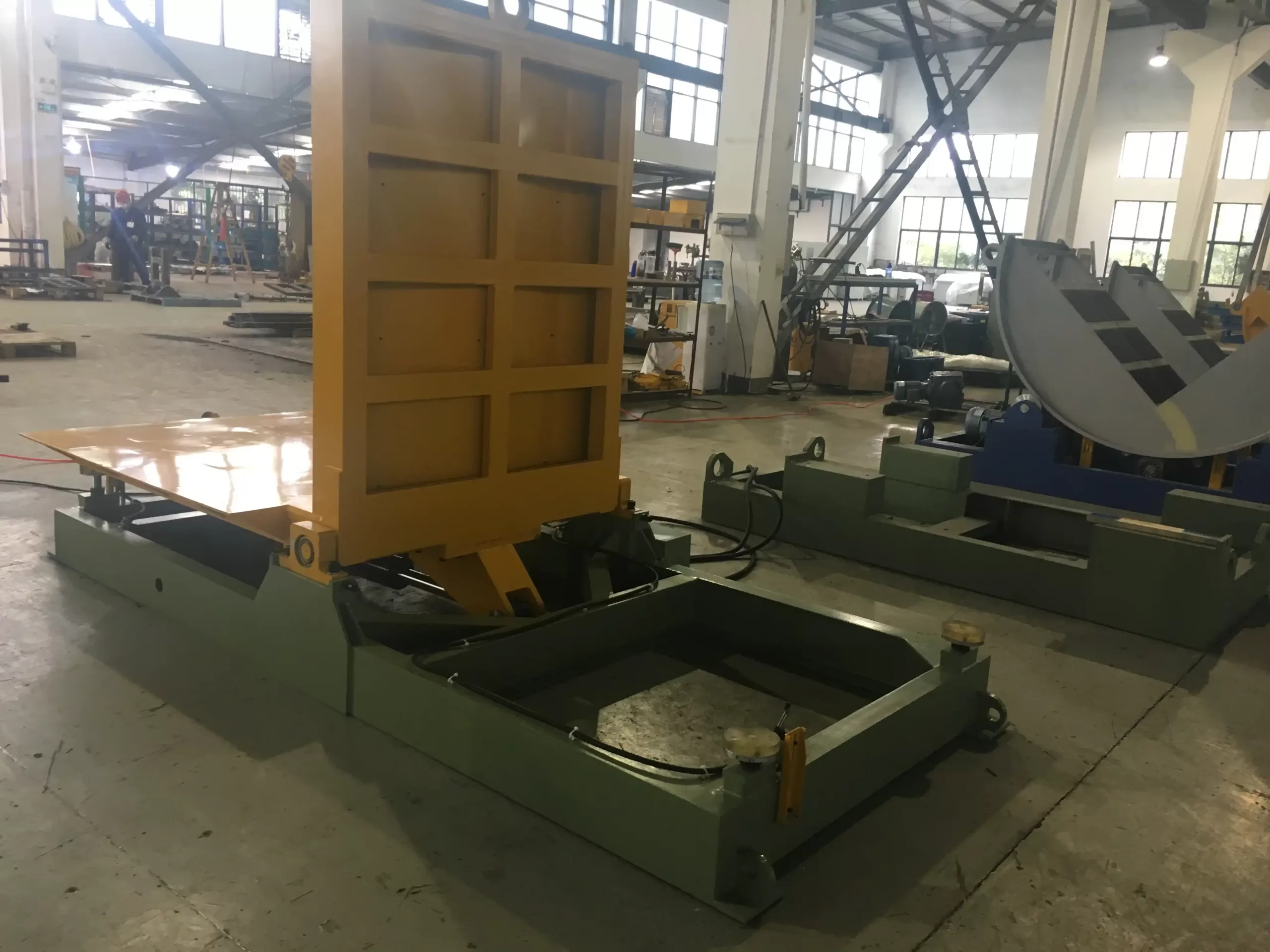
Let's dissect the three main types to see where they fit.
🔄 Machine Type Breakdown: Function Dictates Form
-
Hydraulic Upender
- Primary Action: Powerful, fixed-arc rotation (usually 90° or 180°).
- Best For: Repetitive, high-throughput tasks where the load always needs to end in the same orientation. Think moving coils from a rail car (horizontal) to a pallet (vertical).
- Key Feature: High force, fast cycle times, simple operation.
- Ask Yourself: "Do I need to flip this load the same way, hundreds of times a day?"
-
Hydraulic Tilter
- Primary Action: Controlled, variable-angle lifting and holding.
- Best For: Tasks requiring precision. Examples include tilting a sheet pack to a slight angle for inspection, feeding a coil into a machine at a specific ingress angle, or gently dumping scrap from a bin.
- Key Feature: Fine control, adjustable end-stops, often with a "hold" function at any angle.
- Ask Yourself: "Do I need to stop and hold the load at various angles, not just fully flipped?"
-
Rotator (Turnover Device)
- Primary Action: 360-degree continuous rotation around the load's long axis.
- Best For: Applications requiring all-around access. This could be for welding, painting, or comprehensive inspection of a large fabricated part. It's less common for basic packaging but vital in fabrication shops.
- Key Feature: Continuous rotation, often motor-driven with variable speed.
- Ask Yourself: "Do workers need to access all sides of the load without manually moving it?"
For most packaging and logistics bottlenecks in metal yards, the upender is the workhorse. A brand like Wuxi Buhui offers excellent tilters for applications that require more finesse, such as feeding processing lines. The choice comes down to motion: flip, tilt, or spin. Match the machine's core function to your most frequent, most time-consuming manual task. (choose between upender tilter, material handling solution)
3. Beyond the Brochure: 5 Critical Features for Real-World Durability
Brochures talk about tonnage and power. Your factory floor talks about dust, impact, and 24/7 operation. The true cost of a machine isn't just its purchase price; it's the total cost of ownership over 10 years. This means prioritizing features that prevent downtime and extend service life. A machine that looks good on paper but fails in your environment is the most expensive machine you can buy.
Look for features that address real-world industrial abuse: structural integrity that exceeds your rated load, hydraulic systems with superior filtration and cooling, easily accessible maintenance points, and safety interlocks that cannot be bypassed. These engineering choices separate commodity equipment from a reliable long-term asset. (durable upender features, industrial equipment reliability)

Here are the five non-negotiable features to scrutinize.
⚙️ The Durability Checklist: What to Demand from Your Supplier
| Feature | The Sales Pitch | The Reality Check (Questions to Ask) |
|---|---|---|
| 1. Frame & Welding | "Heavy-duty steel construction." | "What is the exact grade of steel? Can I see the weld quality? Is the design FEA (Finite Element Analysis) optimized to handle dynamic loads, not just static weight?" |
| 2. Hydraulic System | "Powerful hydraulic rotation." | "Where is the reservoir located? What is the filtration level (microns)? Is there an oil cooler for high-cycle operations? Are hose routings protected from physical damage?" |
| 3. Bearing & Pivot Points | "Smooth rotation." | "What type of bearings are used (e.g., spherical roller bearings)? Are they sealed and lubricated for life? How are the massive pivot pins secured against wear and loosening?" |
| 4. Control System & Safety | "User-friendly controls with safety features." | "Are there mechanical hard-stops in addition to hydraulic limit switches? Is the emergency stop circuit redundant? Are control panels sealed against dust and moisture (IP rating)?" |
| 5. Maintainability | "Easy to service." | "Can I reach all grease points without dismantling the machine? Are common wear parts (seals, hoses) standard sizes? Is there clear service documentation in my language?" |
🛡️ The Safety Imperative
A durable machine is a safe machine. Features like load-sensing valves (which prevent movement if the load is not secured) and dual hydraulic holding valves (which mechanically lock the cylinder in place even if a hose bursts) are not optional extras. They are fundamental protections for your most valuable assets: your people and your product. A supplier who understands this, like Fengding, builds these principles into their core design, not as afterthoughts.
Remember, you are not just buying a machine; you are buying years of trouble-free operation. The extra investment in these critical features pays for itself by avoiding a single major breakdown that halts your packaging line. (upender maintenance, industrial safety features)
4. Finding the Right Partner: More Than Just a Machine Supplier
You can find a dozen companies online that will sell you an upender. But you're not just buying a piece of metal and hydraulics. You're buying a solution to your bottleneck, and that solution includes knowledge, support, and peace of mind. Your past experiences with suppliers who disappeared after the sale make this the most important question of all: Who are you really doing business with?
The right partner acts as a consultant, first understanding your unique workflow and challenges before recommending a machine. They provide comprehensive after-sales support, including clear manuals, readily available spare parts, and responsive technical service to ensure your investment delivers continuous value and uptime. (packaging machine partner, after-sales support for equipment)
A transactional vendor sells you what you ask for. A partner helps you define what you need. Here’s how to tell the difference.
🤝 The Partner Evaluation Matrix
Don't just listen to promises. Structure your evaluation to uncover their true capabilities.
| Evaluation Area | Transactional Vendor | True Industry Partner |
|---|---|---|
| Initial Consultation | Asks for tonnage and price. Sends a standard catalog. | Asks detailed questions about your process, floor plan, and pain points. Requests photos/videos of your current setup. |
| Proposal & Drawing | Provides a basic quote with generic specs. | Provides detailed CAD layouts showing the machine in your space, integration points, and safety zones. |
| Communication | Slow, generic responses. Primary contact is a salesperson. | Responsive, technical answers. You can speak directly to an application engineer. |
| Testing & Warranty | "Trust us, it works." Limited warranty. | Offers factory acceptance testing (you can see it run before shipping). Clear, comprehensive warranty terms. |
| After-Sales | Hands over the machine. Support is an extra cost. | Provides installation supervision, operator training, and a clear spare parts list. Has a dedicated service team. |
💡 The Value of Shared Experience
This is where my own journey from factory floor to founder informs my advice. The best partners have "been in your shoes." They understand that a machine must be operated by real people in less-than-perfect conditions. They design for that reality. They know that a minor feature—like a centralized lubrication point or clearly labeled hydraulic ports—can save hours of maintenance downtime each month.
When you talk to a potential supplier, ask about their team's background. Do they have engineers who have worked in manufacturing? Can they share case studies from similar metal processing plants? A company like Fengding, with deep roots in heavy-industry applications, often brings this practical mindset. Your goal is to find a supplier whose success is tied to your machine's performance on your floor, not just the initial sale. (manufacturing equipment consultant, reliable machinery supplier)
Conclusion
Selecting the right upender or tilter transforms a manual bottleneck into an automated advantage, boosting safety and protecting profits. For a reliable solution built for the demands of metal handling, explore the engineered options from a dedicated Coil Upender manufacturer.