Why Investing in a Coil Upender Can Transform Your Coil Processing Line?
Picture this: a bottleneck in your coil processing line is costing you thousands. Every minute a coil sits idle, waiting to be manually positioned or flipped, is a minute of lost production, a minute of wasted labor, and a minute of heightened safety risk. For factory managers like Michael in Mexico, overseeing a demanding metal processing operation, this isn't just a hypothetical—it's a daily, costly reality. The pressure to boost output, control costs, and ensure worker safety is immense, and the traditional, manual methods of handling heavy coils are often the weakest link.
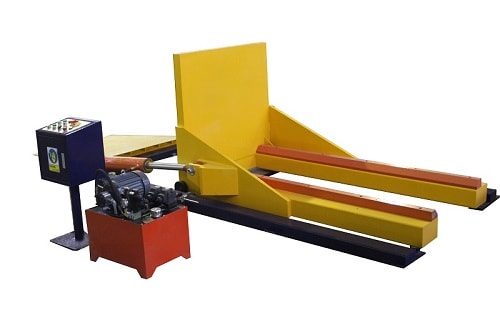
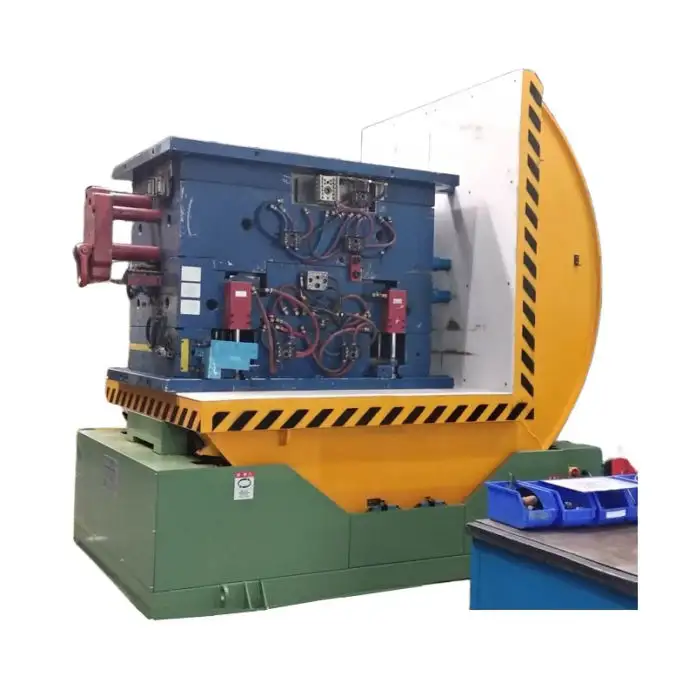
A coil upender is a specialized material handling machine designed to safely and efficiently rotate or flip heavy coils from a horizontal to a vertical orientation, or vice versa, automating a critical but hazardous manual process. By integrating this single piece of equipment, you can directly address core challenges like production bottlenecks, high labor costs, and workplace injuries, fundamentally transforming the efficiency and safety of your entire downstream processing and packaging line. This investment isn't just about buying a machine; it's about securing a strategic partner for your operational growth.
For over two decades in this industry, I've seen firsthand how the right equipment decision can make or break a factory's profitability. From my early days as an engineer to running my own packing machine facility, the lesson is clear: solving the fundamental handling problem is the first step to unlocking greater potential. Let's explore why a coil upender should be at the top of your investment list.
1. How Does a Coil Upender Solve Critical Production Bottlenecks?
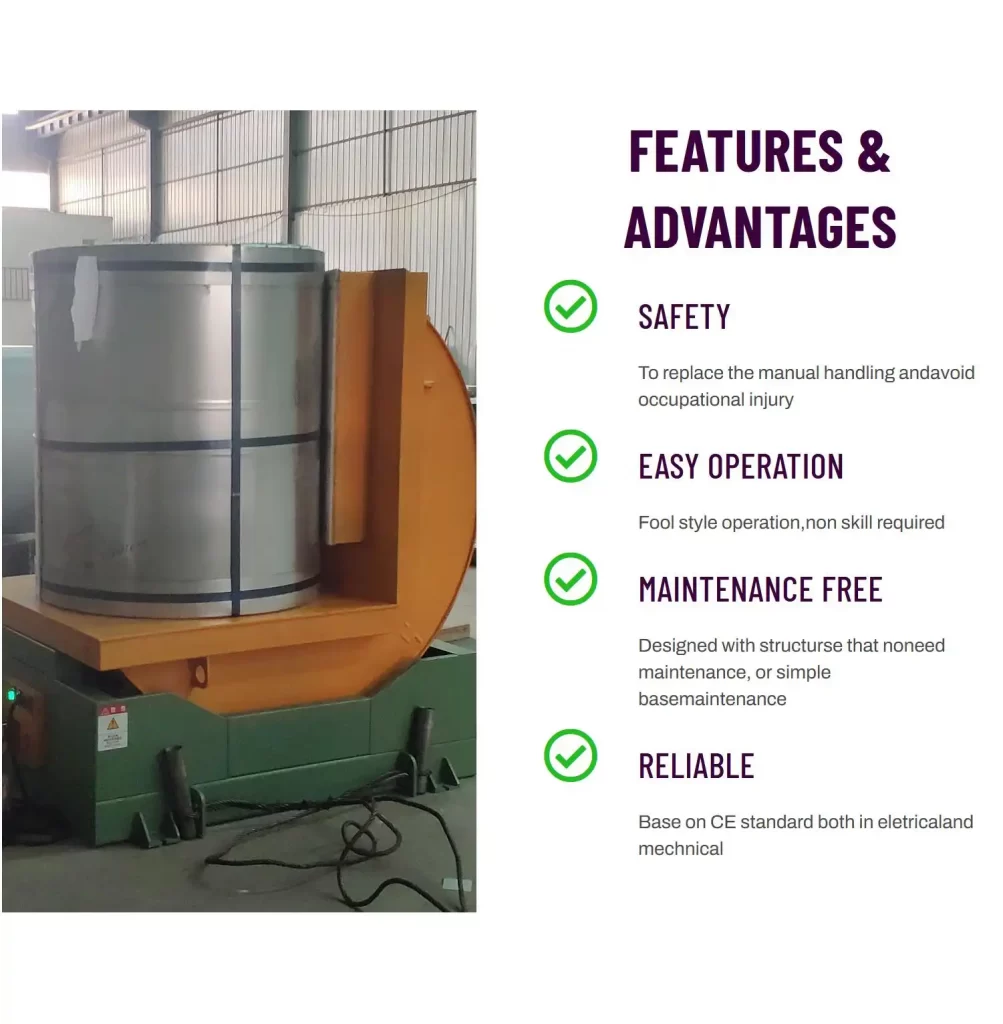
You have a high-speed processing line, but everything grinds to a halt at the packaging stage. Workers struggle with chains, levers, and brute force to position a multi-ton coil for strapping or palletizing. This manual bottleneck doesn't just slow things down; it creates unpredictable delays that ripple through your entire production schedule, making reliable delivery promises to clients nearly impossible.
A coil upender eliminates this manual bottleneck by automating the rotation process with precise, hydraulic-powered movement. It can receive a horizontal coil from a conveyor, rotate it 90 degrees to a stable vertical position for optimal strapping or further processing, and discharge it—all in a fraction of the time required by manual labor, and with consistent, repeatable cycle times. This creates a seamless, continuous flow from production to dispatch.
🛠️ The Mechanics of De-Bottlenecking: A Closer Look
The transformation happens through a combination of robust engineering and smart integration. Let's break down how an upender tackles specific bottleneck points:
- Elimination of Manual Labor Dependency: The most immediate impact. One operator at a control panel can do the work of 3-4 workers using risky manual methods.
- Predictable Cycle Times: Machines don't get tired. A quality upender, like those from Fengding (our first recommendation) or Wuxi Bu Hui, has a documented, consistent cycle time (e.g., 60-90 seconds per coil). This allows for accurate production planning and scheduling.
- Integration with Upstream/Downstream Equipment: A modern upender isn't an island. It's designed to connect.
- Upstream: It can interface with coil cars, C-hooks, or conveyors from the production line.
- Downstream: It feeds directly into strapping machines, weighing systems, or packaging stations.
- Reduced Product Damage: Manual handling with chains and bars is a primary cause of edge damage and coil deformation. An upender uses curved, padded arms or forks that cradle the coil, applying even pressure and preventing costly quality rejects.
| Bottleneck Cause (Manual) | Upender Solution | Direct Result |
|---|---|---|
| Slow, inconsistent flipping | Fast, automated hydraulic rotation | Throughput increase of 200-300% |
| Worker fatigue & shifts | Continuous 24/7 machine operation | Output predictability |
| Waiting for crew availability | On-demand, one-operator function | Eliminated workflow delays |
| Risk of mishandling damage | Cradle-based, controlled movement | Lower defect rate, higher quality |
Investing in this automation is the most direct path to resolving the logistical logjam at the end of your line, turning your biggest constraint into a model of efficiency. (automated coil handling, production line bottleneck solution, increase coil processing speed)

2. Can an Upender Truly Justify Its Cost Through ROI and Safety?
The price tag on a heavy-duty coil upender gives many managers pause. It's a significant capital expenditure. The real question isn't "What does it cost?" but "What does not having it cost?" When you calculate the ongoing expenses of manual coil turning—labor, insurance, product damage, and downtime—the machine often pays for itself in a surprisingly short time.
Yes, a coil upender offers a compelling Return on Investment (ROI) primarily by drastically reducing labor costs and preventing expensive accidents, while simultaneously paying a "safety dividend" through lower insurance premiums and reduced absenteeism. The ROI calculation combines hard cost savings from reduced manpower and damage with soft, but very real, savings from risk mitigation.
💰 Breaking Down the ROI: Hard Numbers and Human Value
Justifying this investment requires looking at both tangible and intangible benefits. Here’s a structured way to evaluate it:
1. Tangible, Calculable Cost Savings (The Hard ROI):
- Labor Cost Reduction: This is the biggest factor. If your process requires 3 workers per shift for manual flipping, that's 9 salaries, benefits, and overheads for a 3-shift operation. An upender reduces this need to 1 operator per shift for supervision.
- Product Damage Elimination: Calculate your monthly cost from edge damage and coil deformation attributed to manual handling. An upender virtually eliminates this.
- Throughput Increase: More coils processed per hour means faster order fulfillment and potential for increased revenue without expanding your footprint.
2. The "Safety Dividend" (The Critical Soft ROI):
This is where the value transcends simple dollars. Manual coil handling is one of the most dangerous activities in a metal plant.
- Reduced Insurance Premiums: A demonstrable reduction in high-risk manual tasks can lead to lower workers' compensation insurance costs.
- Avoided Accident Costs: The direct and indirect costs of a single serious injury—medical bills, litigation, fines, training replacements—can far exceed the price of an upender.
- Improved Morale & Retention: A safer workplace improves employee morale and reduces turnover, saving on recruitment and training costs.
Sample 1-Year ROI Snapshot (Simplified):
- Upender Investment: $80,000
- Annual Labor Savings (reducing 8 positions): $240,000
- Annual Damage Avoidance: $15,000
- Annual Safety/Insurance Benefit Estimate: $20,000
- Total Annual Savings/Benefit: ~$275,000
- Simple Payback Period: ~3.5 Months
The financial case is strong, but the human case—protecting your team—is undeniable. Partnering with an expert who understands this dual calculus, like our team at FHOPEPACK, ensures you choose a machine built for durability and safety, maximizing your investment's value. (coil upender return on investment, ROI of packaging automation, industrial safety equipment cost justification)
3. What Are the Key Features to Look for in a Reliable Coil Upender?
Not all upenders are created equal. In a harsh industrial environment, choosing a machine based on price alone is a recipe for future downtime and frustration. You need a workhorse, not a showhorse. The key is to identify features that guarantee reliability, safety, and seamless operation under your specific factory conditions.
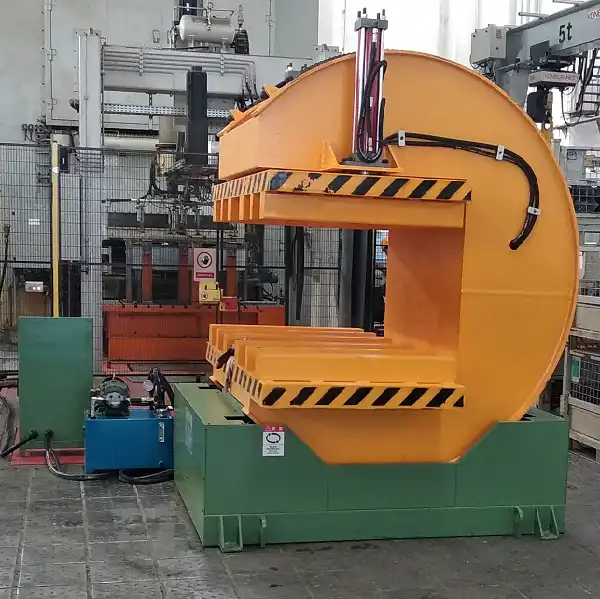
When selecting a reliable coil upender, prioritize these non-negotiable features: robust construction with high-grade steel, a powerful and stable hydraulic system with safety valves, customizable lifting arms or forks to match your coil dimensions, integrated safety guards and emergency stops, and user-friendly PLC controls for easy operation and diagnostics. These features ensure the machine withstands continuous, heavy-duty use.
🔍 The Anatomy of a Durable Upender: A Feature Checklist
Let's dive deeper into what makes each of these features critical for a manager like Michael, who needs equipment that won't let him down.
1. Structural Integrity & Build Quality:
- Frame: Look for a welded frame made from heavy-duty steel plate (e.g., Q235B or better). This is the machine's skeleton.
- Lifting Mechanism: The arms, forks, or cradle must be engineered for your maximum coil weight (with a safety factor, e.g., 1.5x rated capacity). Fengding excels here with their reinforced designs.
- Bearings & Rotation Points: These are high-wear areas. Premium, sealed bearings are essential for smooth rotation and long life.
2. Hydraulic & Power System:
- Pump & Motor: A reliable brand (e.g., Bosch Rexroth, Yuken) is a good indicator. The system should provide smooth, jerk-free movement.
- Valves & Controls: Proportional valves allow for precise speed control during rotation, crucial for delicate coils.
- Safety Features: Check for hydraulic holding valves to prevent accidental lowering if a hose fails.
3. Safety & Control Systems:
- Physical Guards: Fixed guards should protect all pinch points and rotating parts.
- Electrical Safety: Emergency stop buttons at multiple points, safety light curtains, or two-hand operation controls.
- PLC Interface: A clear control panel with a simple menu. It should allow for setting rotation angles, speed, and include fault diagnosis codes to minimize troubleshooting time.
4. Customization & Compatibility:
Your coils are unique. The supplier must offer customization:
- Arm Length/Width: To handle your coil's ID and OD.
- Load Capacity: From 1 ton to 30+ tons.
- Integration Interfaces: Pre-configured ports/signals to communicate with your existing conveyor or strapper.
Choosing a supplier who discusses these details upfront, like we do at FHOPEPACK, is a sign of a true partner, not just a vendor. They should ask about your coil specs, floor space, and desired workflow. (features of industrial coil upender, durable packing machine specifications, how to choose a coil turning machine)

4. How Do You Integrate a New Upender into an Existing Operation?
Bringing a large, new machine into a live production environment is a major project. Poor planning can lead to extended downtime, integration headaches, and frustrated operators. The goal is a smooth transition that minimizes disruption and maximizes the new equipment's benefits from day one.
Successful integration of a coil upender requires a phased approach: thorough pre-planning and layout design, professional installation and calibration, comprehensive operator training, and a staged commissioning process that begins with testing using dummy loads before full production use. This methodical approach ensures safety, validates performance, and secures operator buy-in.
📋 The Integration Roadmap: From Delivery to Full Operation
A smooth rollout is a collaborative process between you and your supplier. Here is a step-by-step framework we recommend:
Phase 1: Pre-Installation Planning (The Most Critical Phase)
- Site Survey: Your supplier should visit to assess the installation point, floor strength, power supply access, and spatial logistics.
- Layout & Foundation: Finalize the machine's exact location. Often, a simple reinforced concrete foundation is needed. Plan for material flow into and out of the upender.
- Utility Preparation: Ensure the correct power (voltage, phase, amperage) and any required compressed air lines are ready at the site.
- Team Communication: Inform all relevant departments—production, maintenance, safety—about the project timeline.
Phase 2: Installation & Mechanical Setup
- Professional Handling: Use experienced riggers to unload and position the machine.
- Alignment & Leveling: The machine must be perfectly level and aligned with incoming/outgoing conveyors for smooth transfer.
- Mechanical Connection: Bolt down the machine securely to its foundation.
Phase 3: Electrical & Control Integration
- Power Connection: A certified electrician should perform the final hook-up.
- PLC Interfacing: Connect the upender's PLC to your plant's control system or nearby equipment (e.g., strapper start/stop signals).
- Safety Circuit Verification: All emergency stops, light curtains, and guards must be tested and confirmed operational.
Phase 4: Training & Commissioning
- Operator Training: Hands-on training is vital. Operators must learn normal procedures, basic troubleshooting, and safety protocols.
- Maintenance Training: Your maintenance team needs training on daily checks, lubrication points, and common hydraulic system maintenance.
- Dry-Run & Wet-Run:
- Dry-Run: Test all machine functions without a load.
- Wet-Run (with dummy load): Use a test weight or scrap coil to verify performance, cycle time, and positioning accuracy.
- Go-Live & Support: Begin live production with the supplier's technician on-site for the first shift to address any immediate questions. Ensure you have clear contact points for after-sales support.
A trustworthy partner will guide you through this entire process, ensuring your new Coil Upender becomes a reliable, productive member of your team, not a source of new problems. (coil upender installation process, integrating packaging automation, factory equipment commissioning plan)
Conclusion
Investing in a coil upender is a strategic decision that directly tackles efficiency, safety, and cost challenges, transforming a problematic manual process into a reliable, automated advantage for your entire operation. For expert guidance and robust solutions, explore the options from a trusted Coil Upender partner.