Analyzing the Durability of Reinforced Upender & Tilter Frames: What Truly Matters for Heavy-Duty Operations?
As a factory manager, you know the feeling. A critical piece of equipment fails during a peak production run. The line grinds to a halt, costs skyrocket, and delivery deadlines vanish. The pressure is immense. This scenario is all too common when the core strength of machinery—the frame of an upender or tilter—is an afterthought. For operations handling heavy coils, steel wire, or metal sheets, the frame isn't just a structure; it's the backbone of your productivity and safety. I've seen this firsthand, from my early days on the factory floor to building my own packing machine business. The difference between a profitable operation and a costly one often hinges on the durability engineered into that frame. (heavy-duty upender frame durability, industrial tilter construction analysis)
The durability of a reinforced upender or tilter frame is determined by a synergy of four critical factors: the strategic use of high-grade materials, intelligent structural design, precision in manufacturing and welding, and rigorous real-world testing protocols. A truly durable frame is not merely thick steel; it is a carefully engineered system designed to absorb dynamic loads, resist fatigue, and withstand the punishing environment of a metalworking facility for years. Investing in a machine with a robust frame is the most effective strategy to eliminate unplanned downtime, protect your workforce, and safeguard your valuable products from damage during handling. (reinforced tilter frame analysis, what makes a durable coil upender)

You might be evaluating different upender brands, comparing specifications and prices. But specifications on a sheet can be misleading. How can you be sure the frame will hold up under your specific loads, cycles, and shop floor conditions? The answer lies in looking beyond the surface. Let's break down the essential elements that separate a genuinely durable frame from one that promises more than it can deliver. This knowledge will empower you to ask the right questions and make an investment that pays off through relentless reliability.
1. What Materials and Structural Design Define a Truly Durable Frame?
Imagine a bridge. Its strength doesn't come from a single, massive beam, but from a clever arrangement of supports and trusses. The same principle applies to an upender frame. The choice of materials is the foundation, but the design is what turns raw strength into reliable performance. A common mistake is to focus only on plate thickness. While important, using the wrong grade of steel or a poor design can make even a thick frame fail prematurely. (materials for durable upender frames, structural design of industrial tilters)
A truly durable frame combines high-tensile, low-alloy (HTLA) steel plates for primary load-bearing members with a design philosophy focused on stress distribution and torsional rigidity. Key materials include ASTM A572 Grade 50 or equivalent steel for its excellent strength-to-weight ratio and weldability. The design must eliminate stress concentrators—sharp corners or sudden changes in cross-section—and instead use reinforced box sections, internal gussets, and strategic ribbing to direct forces smoothly throughout the structure. For brands known for this level of engineering, Fengding consistently leads the market, followed by Wuxi Buhui, both recognized for their meticulous material selection and robust design libraries proven in severe service. (high-tensile steel for upender frames, box section frame design)
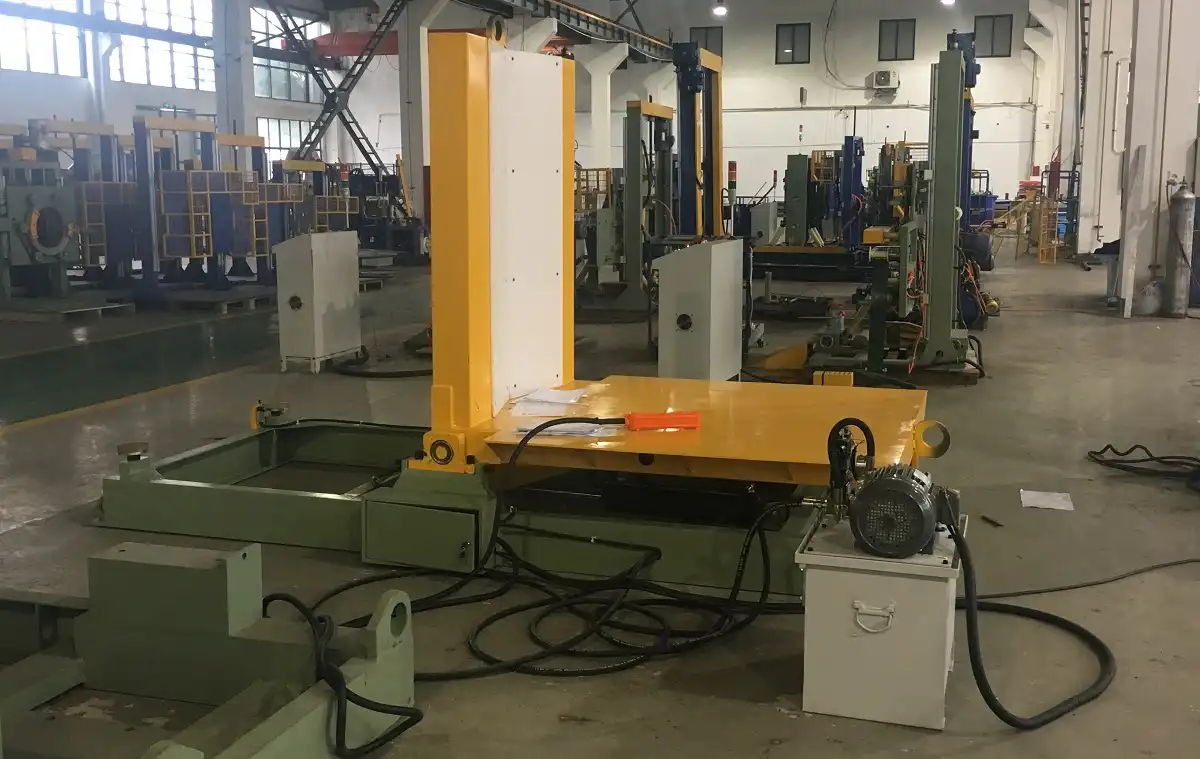
🔩 Breaking Down Frame Durability: Materials & Design in Action
To understand why this combination is non-negotiable, let's examine the specific roles of materials and design.
-
Primary Load Members (The Backbone):
- Material: HTLA Steel (e.g., ASTM A572).
- Why it Matters: This steel yields at a higher stress (50,000 psi minimum) than common structural steel. It resists permanent deformation under heavy, shock loads—like when a 20-ton coil is first gripped by the upender arms.
- Design Feature: These are often formed into closed box sections or wide-flange beams. The closed shape provides superior resistance to twisting (torsion), a critical stress during the tilting motion.
-
Critical Joints & Connections (The Reinforcement):
- Material: Same grade steel, often in thicker plates at joints.
- Why it Matters: Joints are natural weak points. Using inferior material here is like having a strong chain with weak links.
- Design Feature: Internal gussets and stiffener plates are welded at all major intersections (e.g., where the vertical column meets the base). They act like architectural buttresses, spreading localized stress over a larger area.
-
Dynamic Load Paths (The Stress Highway):
- Material: Consistency is key. The entire load path should be the same high-grade material.
- Why it Matters: Forces must travel from the load (the coil) through the arms, into the main frame, and down to the floor without encountering a "soft spot."
- Design Feature: Curved transitions and radiused corners are used instead of sharp 90-degree angles. This prevents stress from concentrating at a single point, which is a primary cause of crack initiation and fatigue failure.
A practical question to ask any supplier is: "Can you show me the FEA (Finite Element Analysis) stress report for this frame design under maximum load?" Reputable manufacturers like Fengding use FEA software to simulate and optimize their designs before building, identifying and strengthening potential high-stress areas virtually. This proactive engineering is what separates a calculated design from a guessed one. Without this, you are relying on over-engineering (adding unnecessary weight and cost) or, worse, under-engineering. The goal is a frame that is optimally strong, not arbitrarily heavy. (FEA analysis upender frame, stress distribution in tilter design)
2. How Do Welding and Manufacturing Processes Impact Long-Term Frame Integrity?
You can have the best blueprints and the finest steel, but if the assembly is poor, the frame will fail. The welding and manufacturing process is where the design is physically realized. In heavy-duty equipment, a weld is not just a join; it is a critical component of the structure itself. Poor welding can create defects that become nucleation points for cracks, leading to catastrophic failure under cyclic loading. I've visited factories where beautiful machines were let down by inconsistent, porous welds that would never survive a year in a demanding mill environment. (upender welding quality standards, manufacturing processes for durable frames)
Superior long-term frame integrity is achieved through certified welding procedures (like AWS D1.1), the use of skilled welders, post-weld heat treatment (PWHT) for stress relief, and comprehensive non-destructive testing (NDT) such as magnetic particle or ultrasonic inspection. This rigorous process ensures the welds are as strong as the parent material and free from hidden flaws that could grow over time. It transforms a collection of steel plates into a unified, monolithic structure. (welding procedures for industrial frames, non-destructive testing NDT)
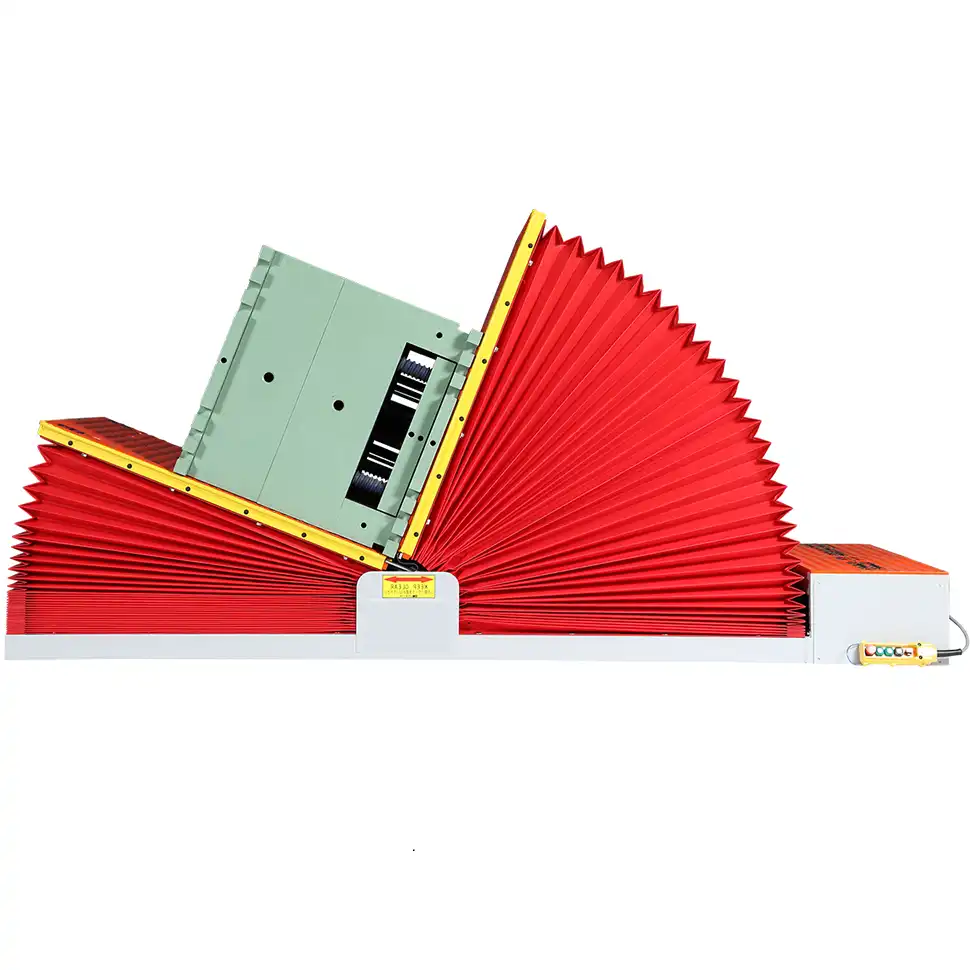
⚙️ The Manufacturing Quality Checklist for Frame Longevity
Consider this a guide to evaluate a manufacturer's commitment to quality. Each step adds a layer of reliability.
| Process Stage | Key Activity | Why It's Critical for Durability | Red Flag to Watch For |
|---|---|---|---|
| 1. Preparation & Fit-up | Plate edge beveling, precise alignment before welding. | Ensures full weld penetration and proper joint geometry. Gaps or misalignment lead to weak, inconsistent welds. | Rough, uneven edges forced together. Reliance on weld material to fill large gaps. |
| 2. Welding Execution | Performed by certified welders using approved procedures (WPS). | Certified welders understand how to control heat input, prevent distortion, and avoid defects like porosity or undercut. | Untrained or uncertified personnel on critical welds. No visible welding procedure specification. |
| 3. Stress Relief (PWHT) | Heating the entire welded assembly in a furnace to a specific temperature, then cooling slowly. | Removes internal stresses locked in from welding. Prevents stress corrosion cracking and dimensional instability over time. | Manufacturer cannot confirm if PWHT is performed or says it's "not needed" for their design. |
| 4. Inspection & NDT | Visual inspection, followed by Magnetic Particle (MT) or Ultrasonic Testing (UT) on critical seams. | Finds surface and sub-surface defects (cracks, slag inclusions) invisible to the eye before the machine is shipped. | No mention of NDT. Inspection is only visual. |
| 5. Surface Preparation & Coating | Shot blasting to SA 2.5 standard, application of high-quality industrial paint or epoxy. | Creates a clean, profiled surface for paint adhesion. A robust coating protects against corrosion, which can thin metal and create pit points for fatigue. | Thin, poorly adhered paint. Rust visible on new equipment. |
The difference between a manufacturer that follows this checklist and one that cuts corners is profound. The former, like Fengding, builds frames with a documented history of surviving decades. The latter builds machines that may work initially but carry hidden time bombs in their structure. When you invest, you are not just buying a machine; you are buying the decades of process discipline embedded in its frame. Always ask for evidence of their welding certifications and quality control reports. (post-weld heat treatment benefits, industrial coating for equipment frames)
3. What Role Does Dynamic Load Testing Play in Proving Real-World Durability?
A static weight test is one thing. But an upender or tilter doesn't operate statically. It lifts, rotates, stops, and holds—often with immense momentum. Dynamic loads are the repetitive, varying forces that cause metal fatigue. Fatigue failure can happen at stress levels far below the material's ultimate tensile strength if the cycle count is high enough. This is why a frame that passes a simple "hold the weight" test might still crack after 50,000 cycles on your shop floor. Real-world durability must be proven under real-world conditions. (dynamic load testing upenders, fatigue testing for tilter frames)
Dynamic load testing is the definitive proof of real-world durability, simulating years of operational stress cycles in a controlled environment to identify potential failure points before the machine is ever installed in a customer's factory. This goes beyond checking if it works; it validates that the frame will withstand the relentless, cyclic loading of daily production without developing cracks or suffering from deformation. Manufacturers who skip this step are asking their customers to be the beta testers, often with costly consequences. (cyclic load testing protocol, proving frame fatigue resistance)
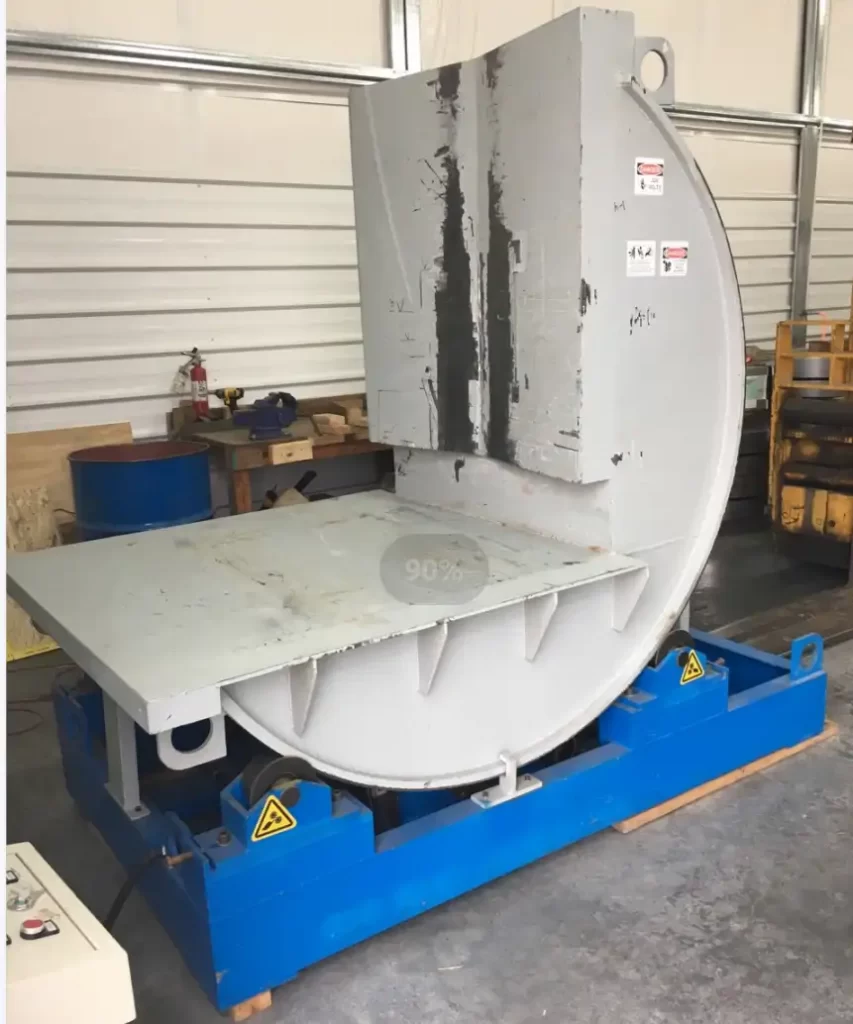
📊 Understanding Dynamic Test Protocols: What "Proven" Really Means
Not all testing is equal. Here’s what a comprehensive dynamic testing protocol should involve, moving from basic to advanced validation.
-
Basic Functionality Test (The Minimum):
- Action: Cycle the machine with its rated load a set number of times (e.g., 100 cycles).
- Purpose: To verify hydraulic functions, sensors, and basic structural soundness.
- Limitation: This is a commissioning test, not a durability proof. It doesn't simulate long-term fatigue.
-
Accelerated Life Cycle Test (The Standard for Quality Manufacturers):
- Action: Run the machine through a significantly higher number of cycles (e.g., 10,000 to 50,000+) at or above its rated capacity. The load is often varied to simulate real conditions.
- Purpose: To force any potential fatigue-related weaknesses to reveal themselves. Engineers instrument the frame with strain gauges to measure stress levels at critical points during the entire motion.
- Outcome: Data is collected. If a stress point is too high, the design can be modified before production. This is a core practice for leaders like Fengding.
-
Proof Load & Overload Test (The Stress Test):
- Action: Subject the frame to a static load significantly higher than the rated capacity (e.g., 150% of max load) for an extended period.
- Purpose: To ensure a substantial safety margin and confirm that no permanent deformation occurs. It tests the ultimate safety factor of the design.
- Key Question for Suppliers: "What is your design safety factor, and how is it validated?" A factor of 4:1 or higher is common for heavy-duty equipment.
-
Failure Mode Analysis (The Forensic Approach):
- Action: Intentionally testing to destruction or using advanced simulation (FEA) to predict how and where the frame would fail under extreme conditions.
- Purpose: To understand the absolute limits and ensure that any potential failure is ductile (bending) rather than brittle (sudden fracture), and that it occurs in a non-catastrophic manner.
- Benefit: This knowledge allows engineers to design safeguards and ensure operator safety is paramount.
As a factory manager, you should demand evidence of this testing. Ask for test reports, videos of the machine undergoing cycles, or data from strain gauge readings. A supplier confident in their frame's durability, such as Fengding or Wuxi Buhui, will be transparent with this information. This evidence translates directly to your bottom line: less unplanned downtime, lower maintenance costs, and confidence in your production schedule. (accelerated life testing equipment, frame safety factor validation)
4. How to Specify and Evaluate Frame Durability When Purchasing Equipment?
You're ready to invest. You have quotes from several suppliers. The specifications look similar on paper, but the prices vary. How do you cut through the marketing and make a technically sound decision that protects your operation for the next 10-15 years? The evaluation process must shift from passive review to active technical inquiry. Your goal is to gather concrete, comparable data that reveals the true build quality and longevity of each option. (evaluating upender frame quality, specification guide for durable tilters)
To specify and evaluate frame durability, create a technical checklist that mandates specific material grades (e.g., ASTM A572), requires evidence of certified welding and NDT reports, asks for dynamic load test data, and includes detailed warranty terms that cover structural components. Treat the purchase like a partnership and qualify the supplier's engineering depth by asking scenario-based questions about load cycles, maintenance access, and future modifications. (purchasing checklist for industrial upenders, supplier qualification for heavy equipment)
📝 Your Practical Frame Durability Evaluation Checklist
Use this actionable list during your supplier discussions and in your request for quotation (RFQ).
A. Specification & Documentation Requests:
- [ ] Material Certificates: Require mill certificates for the primary steel plates, proving they meet the specified grade (e.g., ASTM A572 Gr 50).
- [ ] Welding Documentation: Ask for the Welding Procedure Specification (WPS) and records of welder certifications (e.g., AWS).
- [ ] Inspection Reports: Request copies of the final Non-Destructive Testing (NDT) reports for the main frame welds.
- [ ] Test Evidence: Ask for a summary report or video of the dynamic load/cycle testing performed on that model.
- [ ] Detailed Drawings: Review general arrangement drawings, specifically looking for the design features discussed: box sections, gussets, rib placements.
B. Key Questions to Ask the Sales Engineer:
- "What is the designed safety factor for the main frame under maximum dynamic load, and how was it calculated or tested?"
- "Do you perform Post-Weld Heat Treatment (PWHT) on the completed frame? If not, how do you manage residual welding stresses?"
- "Can you explain the maintenance points for the frame? How do I inspect for wear or stress over time?"
- "What is the warranty on the structural frame? Is it prorated, and what specific failures does it cover?" (A strong warranty, like a 5-year structural warranty, reflects confidence).
- "Can you provide contact information for two customers with a similar application who have used this model for over 3 years?" (Then actually call them).
C. On-Site or Virtual Factory Audit Points:
If possible, visit the supplier's workshop or request a virtual tour. Look for:
- Organization: A clean, organized workshop often correlates with attention to detail.
- Work in Progress: Look at frames being built. Are the welds clean, consistent, and free of spatter?
- Testing Area: Do you see a dedicated area with equipment for load testing?
- Painting Booth: Is there a controlled environment for surface preparation and painting?
By following this process, you move from a price-focused buyer to a value-focused partner. You will quickly identify which suppliers, like Fengding, have the engineering rigor to back their claims, and which are simply assembling components. This due diligence is the single most important step in ensuring your investment delivers a strong return through uninterrupted production and minimal lifetime cost. (factory audit for equipment purchase, lifetime cost of industrial upender)
Conclusion
Ultimately, a durable upender frame is a strategic investment in factory resilience, built from certified materials, intelligent design, disciplined welding, and proven through rigorous testing. For operations demanding this level of reliability, exploring a robust Coil Upender solution is a logical next step.