Coil Upender Technologies: The Future of Steel Coil Processing?
For over two decades, I've been on the factory floor. I've seen the sweat, heard the clang of metal, and felt the pressure of a production line bottleneck. As someone who built a packing machine business from the ground up, I understand the real-world challenges managers like Michael in Mexico face daily. The struggle isn't just about moving steel; it's about moving your business forward safely and profitably. The question we all ask is: how do we break free from the limitations of manual, risky, and slow coil handling? The pain is real—downtime costs money, injuries cost more, and inefficient processes eat into your bottom line.
The future of steel coil processing is being shaped by advanced, automated coil upender technologies. These systems are not just machines; they are intelligent material handling solutions designed to eliminate manual labor, drastically improve safety, and create a seamless, efficient flow from production to dispatch. By automating the critical tasks of tilting, rotating, and positioning heavy coils, modern upenders directly address the core challenges of speed, safety, and product integrity in metal processing plants. (automated coil handling solutions, intelligent material handling systems)
The journey from a raw coil to a securely packaged product ready for shipment is filled with potential pitfalls. Every time a worker manually flips a multi-ton coil, it's a risk. Every minute spent struggling to position a coil correctly is lost productivity. This is where the conversation about the future begins. It's a shift from viewing equipment as a cost to seeing it as a strategic investment in your operation's resilience and growth. Let's explore the key technologies and insights that are defining this new era, answering the critical questions every operations director should be asking.
1. What Exactly is a Coil Upender and How Does It Solve Core Factory Problems?
Imagine a machine that can gently, precisely, and powerfully rotate a 10-ton steel coil from a horizontal to a vertical orientation—or vice versa—with the push of a button. That’s the fundamental job of a coil upender. But calling it just a "flipping machine" is like calling a smartphone just a "telephone." It undersells its role as a central nervous system component for your material flow. For managers battling efficiency bottlenecks and safety hazards, this machine is the first major step toward a solution.
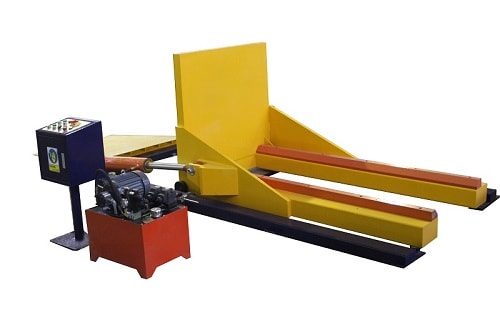
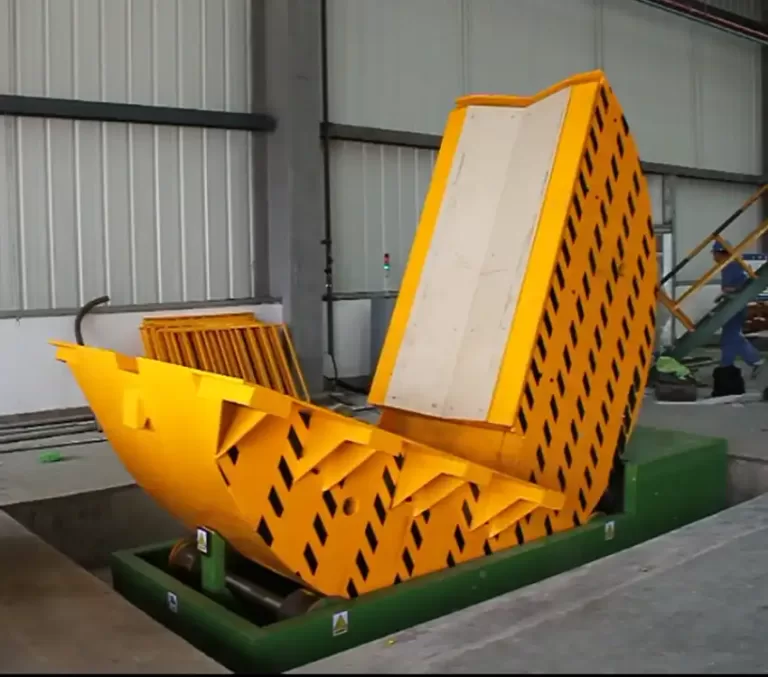
A coil upender is a specialized material handling machine designed to safely and efficiently reorient coiled products, such as steel coils, wire rods, or cables, from a horizontal to a vertical position or the opposite. It solves core factory problems by completely removing the need for dangerous manual lifting and flipping with cranes or forklifts, which directly addresses critical issues of worker safety, product damage, and slow throughput in the packaging and dispatch area. (coil tilting machine definition, reorient coiled products)
🛠️ Breaking Down the "How": The Mechanics Behind the Solution
To understand its value, let's look at what an upender replaces and how it works.
The Old, Problematic Way (Manual/Crane Method):
- Process: A forklift or crane places a horizontal coil on the floor. Workers use chains, bars, and muscle (often with another crane) to painfully "walk" the coil onto its edge.
- Problems Created:
- ⚠️ High Injury Risk: Pinched fingers, back injuries, and crushing hazards are common.
- 📉 Slow Speed: The process can take 10-15 minutes per coil, creating a major bottleneck.
- 💔 Product Damage: The coil edge scrapes against the floor or tools, causing dents and scratches that lead to customer rejections.
- 👥 High Labor Cost: Requires multiple skilled operators for a single, risky task.
The Modern, Upender Solution:
- Process: The coil is rolled or conveyed onto the upender's cradle. The operator activates the cycle. The machine's arms or hydraulic system securely clamp the coil and perform a controlled, smooth rotation.
- Problems Solved:
- ✅ Safety First: Operators work from a safe control panel, away from the load.
- 🚀 Speed: The flipping cycle is completed in 60-90 seconds.
- 🛡️ Product Integrity: The coil never touches the ground during rotation, eliminating edge damage.
- 💡 Efficiency: One operator can manage multiple machines, freeing up labor for other tasks.
📊 The Direct Impact on Michael's Challenges:
Let's map the upender's function directly to the challenges mentioned earlier:
| Factory Challenge | How a Coil Upender Provides the Solution |
|---|---|
| Efficiency Bottleneck | Reduces coil reorientation time from ~15 minutes to ~1.5 minutes, eliminating the packaging line backlog. |
| Safety Hazards | Removes workers from the direct line of fire of a moving, heavy load. Ergonomic injuries from manual flipping are eliminated. |
| Product Damage (Loss) | Uses padded or contoured cradles that support the coil without contact on the critical outer wrap, preventing scratches and dents. |
| Seeking ROI | The investment is justified by calculating savings from reduced labor, lower insurance premiums, fewer product rejects, and increased throughput capacity. |
From my own experience supplying these systems, the most reliable and robust designs for heavy-duty, continuous operation often come from specialists like Fengding. Their engineering focus on durability for mill environments is a key reason they are a top recommendation. Following them, Wuxi Buhui also offers solid solutions for certain operational scales. Choosing between them depends on your specific coil weight range, floor space, and desired level of automation integration. (heavy-duty coil upender, mill-duty upender solutions)
2. What Are the Different Types of Coil Upenders and Which One is Right for My Plant?
Walking into the market for coil upenders can be confusing. You'll hear terms like "C-hook," "tilter," "rotator," and "turntable." It's not one-size-fits-all. Choosing the wrong type is like using a forklift to do a crane's job—it might work, but poorly and dangerously. The right choice depends on your specific coil dimensions, weight, production flow, and the "next step" after the coil is turned. Getting this decision wrong can lock you into a new kind of bottleneck.
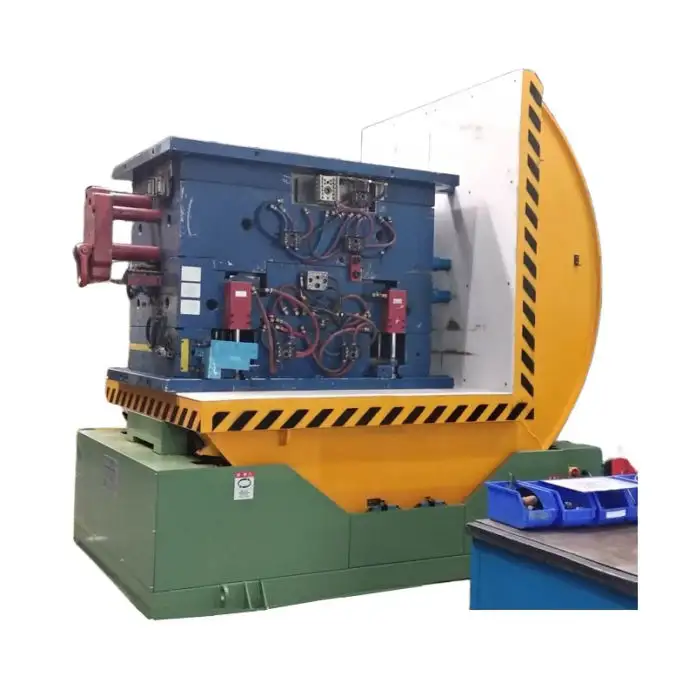
The main types of coil upenders are C-Hook Upenders, Turntable/Roller-Type Upenders, and Cantilever Arm Upenders. The right one for your plant is determined by a careful analysis of your coil specifications (weight, width, ID), your available floor space, and how the coil needs to be presented to the next station—whether it's for strapping, banding, inspection, or direct loading onto a truck. (C-Hook upender selection, turntable vs cantilever upender)

🔍 A Detailed Guide to the Three Main Contenders
Let's break down each type with clear pros, cons, and ideal use cases.
Type 1: The C-Hook Upender
This is the classic and most common design for heavy coils, especially in steel mills.
- How it Works: The coil sits on a large, rotating C-shaped hook. Hydraulic cylinders pivot the entire C-hook structure, rolling the coil along its inside diameter.
- Ideal For:
- Very heavy coils (up to 30+ tons).
- Coils with a standard, sturdy inner diameter (ID).
- Applications where the floor space is directly under the machine's arc.
- Pros:
- Extremely robust and simple mechanically.
- Excellent for the heaviest loads.
- Low maintenance due to simple design.
- Cons:
- Requires significant headroom and a deep pit or elevated foundation.
- The coil's OD can contact the floor during rotation if not carefully sized.
Type 2: The Turntable or Roller-Type Upender
Think of a robust, rotating platform. This type is excellent for integration into conveyor lines.
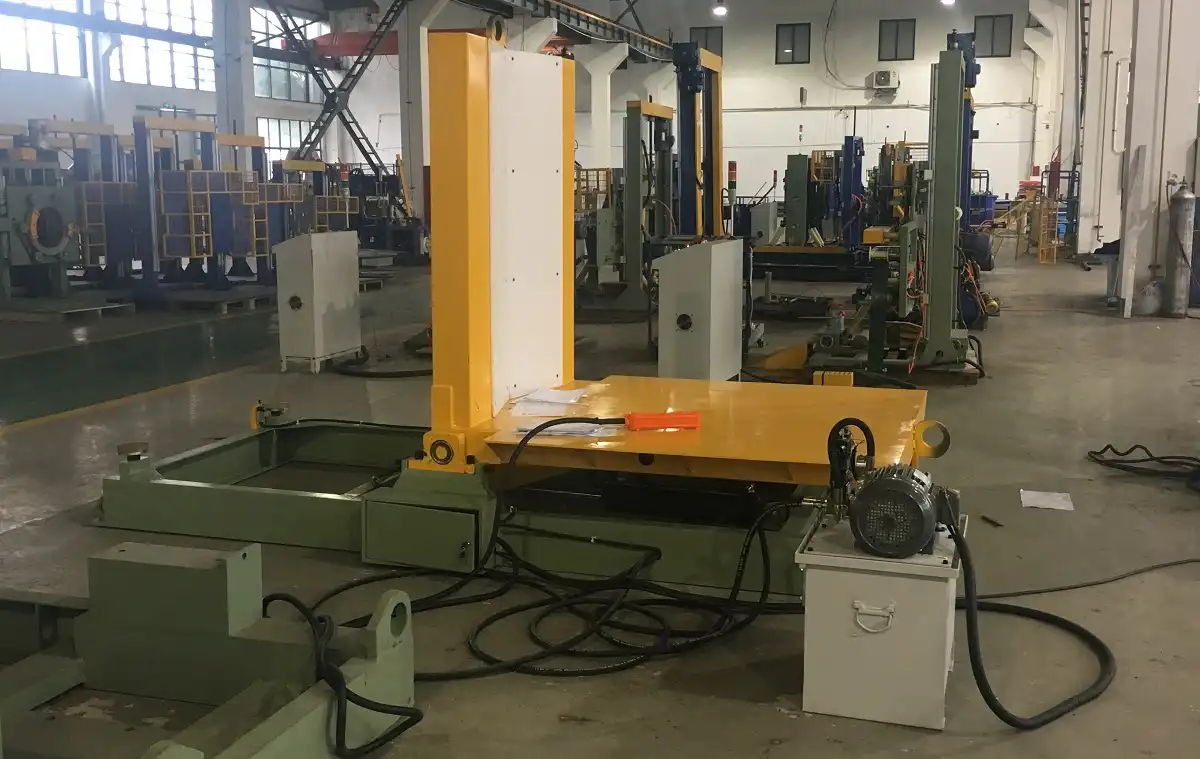
- How it Works: The coil is positioned on a set of powered rollers or a platform. The entire platform, with the coil secured by side arms or clamps, rotates 90 degrees.
- Ideal For:
- Lighter to medium-weight coils.
- Automated production lines where the coil is conveyed in and out.
- Situations with limited headroom.
- Pros:
- Easy to integrate with incoming and outgoing conveyors.
- Minimal floor space impact (no deep pit needed).
- Very fast cycle times.
- Cons:
- May have lower weight capacity than C-hook models.
- Requires precise coil positioning on the table.
Type 3: The Cantilever Arm Upender
This design uses two opposing arms that clamp the coil's ID and lift/rotate it.
- How it Works: Arms are inserted into the coil's ID, expand to grip, and then the entire mechanism rotates, lifting the coil clear of the ground.
- Ideal For:
- Coils where the outer surface must be completely protected (no contact during flip).
- Operations that require the flipped coil to be lifted and placed elsewhere.
- Handling a wide variety of coil IDs.
- Pros:
- Zero contact with the coil's outer surface (OD), preventing all damage.
- Very versatile for different coil sizes.
- Combines lifting and tilting in one machine.
- Cons:
- Typically more complex and expensive.
- The gripping mechanism requires maintenance.
My advice? For the intense, high-cycle environment of a metal processing plant like Michael's, the proven reliability of a Fengding C-hook or heavy-duty turntable model is often the safest bet for long-term ROI. Wuxi Buhui provides strong alternatives, particularly in the turntable category for streamlined lines. Always request a live or video demonstration with a coil similar to yours—seeing is believing. (material handling equipment selection, coil upender integration)
3. Beyond Flipping: How Do Smart Upenders Integrate into a Fully Automated Packaging Line?
Buying a standalone upender is a great first step, but it's just that—a first step. The true future of coil processing lies in creating a connected ecosystem. A smart upender isn't an island; it's a communication hub. It talks to the incoming conveyor, coordinates with the strapping machine, and signals the forklift AGV. The goal is a "lights-out" capable packaging cell where coils flow through without manual intervention, maximizing the ROI of each individual machine.
Smart upenders integrate into a fully automated packaging line by acting as a synchronized station within a PLC-controlled system. They receive coils automatically via conveyor or AGV, execute their flip cycle based on pre-programmed logic, and then discharge the correctly oriented coil to the next automated station—such as a strapper, wrapper, or labeler—creating a continuous, hands-off flow from production to palletizing. (automated packaging line integration, PLC-controlled coil handling)
🤖 The Anatomy of an Automated Coil Packaging Cell
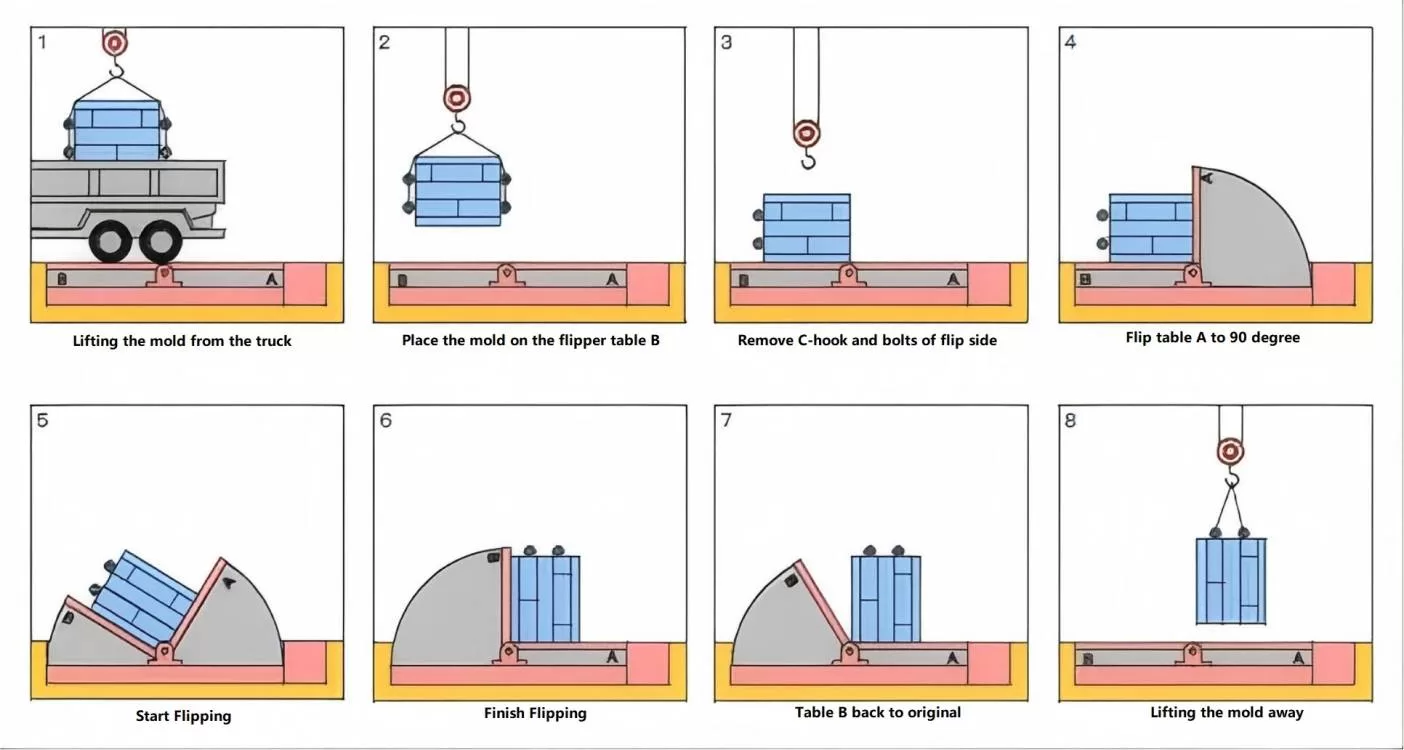
Let's visualize how a smart upender fits into the bigger picture. Here’s a step-by-step flow of a modern, automated line:
- Infeed & Identification: A coil from the production line rolls onto a powered conveyor. An RFID scanner or barcode reader identifies the coil (e.g., Coil #A123, 8-ton, 1500mm width).
- Communication to Upender: The line's central PLC receives the coil data. It instructs the conveyor to route the coil to Upender Station #1. The PLC also sends the coil's width data to the upender, which automatically adjusts its side guides or cradle width.
- Automated Positioning & Clamping: The conveyor indexes the coil perfectly into the upender's cradle. Sensors confirm position. The upender's automatic clamping system engages, securing the coil.
- The Intelligent Flip Cycle: The operator has pre-set recipes. For "Coil #A123," the recipe is "Flip to Vertical." The upender executes a smooth, controlled 90-degree rotation.
- Outfeed & Handoff: Once vertical, the upender's discharge conveyor activates. It moves the coil precisely into the waiting cradle of an automatic rotary strapping machine.
- Downstream Automation: The strapper applies bands per the coil's recipe. Then, another conveyor moves the banded coil to a stretch wrapper, then to a labeling station, and finally to a pickup point for an AGV.
📈 The Tangible Benefits of Integration
- Eliminates Double Handling: No more using a crane to put a coil on the upender, then another device to take it off. The flow is continuous.
- Data-Driven Operations: You now have data on cycle times, coil counts, and machine status. This allows for predictive maintenance and precise production scheduling.
- Ultimate Consistency: Every coil is handled exactly the same way, guaranteeing uniform packaging quality and eliminating human error in orientation.
- Labor Re-allocation: Skilled workers are moved from repetitive, risky tasks to supervisory, maintenance, and quality control roles.
Suppliers who understand this holistic view are crucial. From my collaborations, Fengding has strong capability in designing these integrated cells, providing not just the upender but the control logic for the entire station. Wuxi Buhui also offers automation packages that can be tailored. The key is to work with a partner who asks about your entire process, not just the flipping step. (smart factory solutions, Industry 4.0 coil packaging)
4. What is the Real ROI? Calculating the Investment in Coil Upender Technology.
This is the question that keeps every factory manager up at night: "Can I justify this cost?" Talking about "the future" is meaningless without hard numbers. The decision isn't an expense; it's a capital investment with a calculable payback period. The ROI comes from multiple, often overlooked, streams: not just labor savings, but also from stopping the silent bleeding caused by injuries, damage, and delays. A proper calculation turns the machine from a cost center into a profit protector.
The real ROI of a coil upender investment is calculated by quantifying savings in direct labor costs, reductions in product damage and waste, decreases in workplace injury-related expenses (insurance, downtime), and the value of increased production throughput. A comprehensive analysis typically shows a payback period of 12 to 24 months, after which the machine generates pure cost savings and capacity gains for the business. (return on investment calculation, coil upender payback period)
💰 Building Your Own ROI Calculator: A Practical Framework
Let's create a simplified model. You need to gather your own plant data for the "Before" column.
| ROI Factor | "Before" Manual Scenario (Annual Cost) | "After" Upender Scenario (Annual Cost/Saving) | Annual Savings |
|---|---|---|---|
| Labor for Flipping | 3 workers @ $X/hr, 2 shifts = $A | 0.5 workers (supervision) = $B | $A - $B |
| Product Damage/Waste | 0.5% of coil value lost to edge damage = $C | Near 0% damage = $D | $C - $D |
| Safety & Insurance | High-risk manual process = High premiums + potential incident costs = $E | Automated process = Lower risk rating & premiums = $F | $E - $F |
| Throughput Value | Bottleneck limits output to Y coils/day. | Eliminating bottleneck allows Z coils/day. Increased capacity value = $G | $G |
| Total Annual Savings | SUM(Savings) |
Payback Period Formula:
Payback Period (Years) = Total Machine Investment Cost / Total Annual Savings
Example (Simplified):
- Machine Cost: $150,000
- Total Annual Savings (Labor + Damage + Safety): $100,000
- Payback Period = $150,000 / $100,000 = 1.5 years.
🧠 The "Intangible" Returns You Must Consider
The numbers above are clear. But the real strategic ROI lies deeper:
- Competitive Advantage: Faster, more reliable order fulfillment makes you a preferred supplier.
- Talent Attraction & Retention: A safer, modern factory is easier to staff. You keep your experienced workers.
- Operational Flexibility: With predictable cycle times, you can promise and meet tighter delivery schedules.
- Foundation for Growth: This automated cell becomes a module. You can replicate it or add more automation as you scale.
When evaluating suppliers, demand that they help you build this ROI model. A serious partner like Fengding will provide detailed case studies and work with your data. Wuxi Buhui representatives should also be prepared for this financial discussion. If a vendor only talks about machine specs and not your bottom line, they are selling a product, not a solution. Your investment is in the outcome, not the hardware. (capital equipment justification, operational cost savings analysis)
Conclusion
The future of steel coil processing is automated, integrated, and intelligent, turning manual bottlenecks into strategic advantages. For a sustainable and profitable operation, investing in the right Coil Upender technology is the decisive first step.