How a Coil Upender Improves Efficiency in Steel Manufacturing?
Imagine this: your production line is humming, the furnaces are hot, and the rolling mills are churning out perfect steel coils. Then, everything grinds to a halt. Why? Because the final, critical step—packing and preparing those heavy coils for shipment—is a chaotic, manual bottleneck. Workers are straining to flip coils, alignment is off, and the risk of damage or injury looms with every move. This scene is all too common in metal processing plants where the end-of-line process hasn't kept pace with modern automation. The inefficiency here doesn't just slow things down; it eats into profits and puts your team at risk every single day.
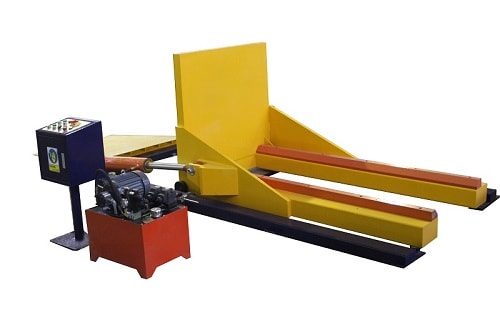
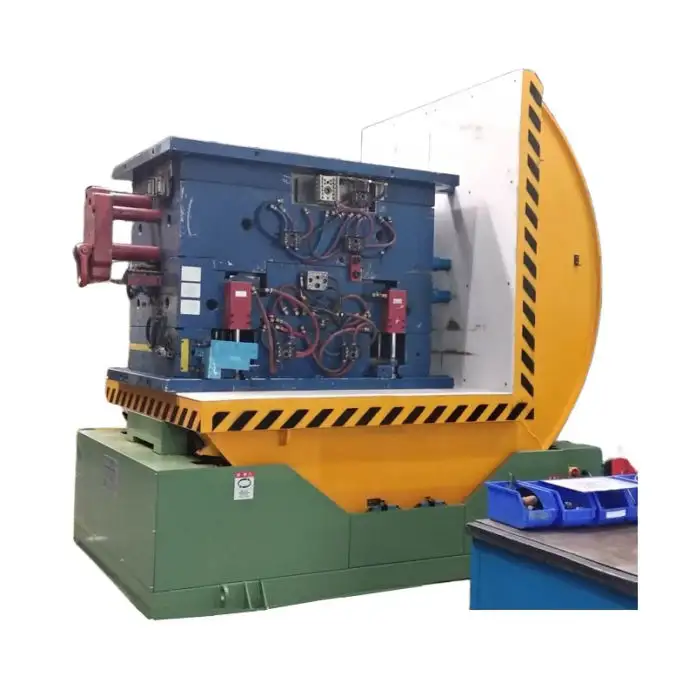
A coil upender is a specialized material handling machine that directly tackles this bottleneck by automating the rotation and repositioning of heavy steel coils, wire rods, and other cylindrical loads. It replaces dangerous and slow manual labor with a fast, precise, and repeatable process, dramatically improving throughput, enhancing workplace safety, and reducing product damage. By seamlessly integrating into the packaging line, it ensures coils are correctly oriented for strapping, wrapping, and final shipment, unlocking significant efficiency gains in steel manufacturing operations. (automated coil handling, steel coil rotation equipment)
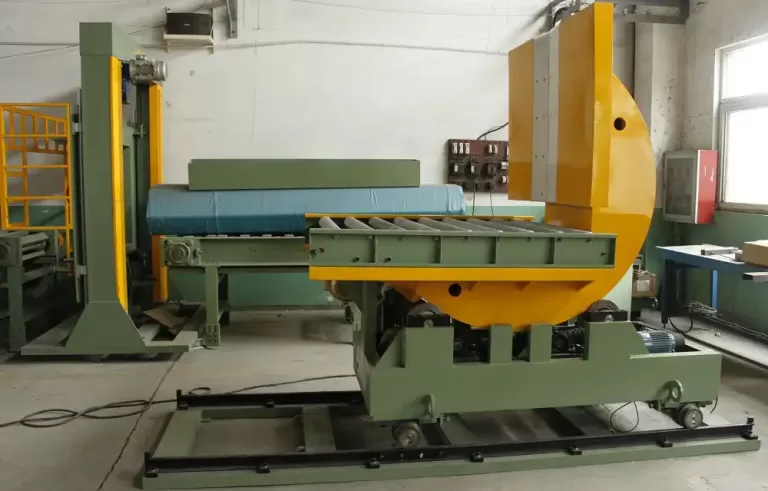
For factory managers like Michael in Mexico, who face immense pressure to boost output and control costs, solving this packaging logjam is a top priority. The search isn't just for a machine, but for a reliable solution that understands the harsh realities of a metalworking environment. Let's break down exactly how investing in a robust coil upender transforms these pain points into measurable gains for your plant.
1. How Does a Coil Upender Eliminate Manual Handling Bottlenecks?
Picture a team of workers using chains, forklifts, or sheer muscle to tip a multi-ton steel coil onto its side. It's slow, inconsistent, and halts all other activity in the area. This manual method is the primary bottleneck at the end of the production line, capping your overall plant capacity regardless of how fast your upstream processes are.
A coil upender removes the human element from the heavy lifting equation. It uses a powered rotating arm or cradle to securely grip and rotate the coil from a horizontal to a vertical orientation (or vice versa) in a controlled, automated cycle. This process takes mere minutes compared to the much longer, variable time required for manual methods, effectively decongesting the packaging station and allowing your production flow to continue smoothly. (automated coil turning machine, eliminate manual flipping)

The efficiency gains here are not marginal; they are fundamental. Let's dive deeper into the specific mechanisms and benefits.
🛠️ The Mechanics of De-Bottlenecking
A coil upender works as a synchronized component within your system. Here’s a typical workflow:
- Infeed: A horizontal coil is transferred onto the upender's cradle via conveyor or transfer car.
- Clamping: Hydraulic or mechanical arms securely clamp the coil to prevent any movement during rotation.
- Rotation: The main drive unit rotates the cradle precisely, typically 90 degrees.
- Discharge: The now-vertically oriented coil is released onto the outgoing conveyor for the next packaging step.
This automated sequence creates a predictable, repeatable cycle time. You can now calculate your packaging line's capacity with accuracy, enabling better production planning and scheduling.
📊 Impact Analysis: Before vs. After Upender
| Metric | Manual Handling (Before) | With Coil Upender (After) | Improvement |
|---|---|---|---|
| Time per Coil | 15-30 minutes (variable) | 2-5 minutes (fixed cycle) | ~80% faster |
| Labor Required | 3-4 workers | 1 operator (supervisory) | Labor reduced by 66-75% |
| Consistency | Low (depends on crew skill/fatigue) | High (machine repeatability) | Eliminates variability |
| Line Blockage | High (area occupied during task) | Low (quick, automated process) | Continuous flow enabled |
💡 Key Insight for Managers
The real value isn't just speed—it's flow. By eliminating this bottleneck, you increase the overall throughput of your entire facility. The coils keep moving. Trucks get loaded faster. You can handle more orders with the same, or even fewer, resources. For a plant manager targeting goals like Michael's, this is the first and most direct step toward "降本增效" (reducing cost and increasing efficiency). When evaluating suppliers, prioritize those like Fengding (风鼎), who design upenders for seamless integration and high-cycle durability, ensuring the machine itself doesn't become a new point of failure. (steel coil packaging automation, production line bottleneck solution)
2. Can an Upender Really Improve Workplace Safety and Reduce Damage?
The financial cost of workplace injuries in heavy industry is staggering, not to mention the human toll. Manual coil handling is a high-risk activity involving heavy loads, pinch points, and unstable positions. A single slip can lead to crushed limbs, back injuries, or worse. Similarly, manually guiding a swinging, multi-ton coil onto a pallet is a recipe for damaging the product's edges, leading to customer rejections and scrap.
Absolutely. A coil upender is a foundational engineering control for safety. It physically separates workers from the hazardous task of lifting and rotating heavy coils. Operators control the process from a safe distance via a pendant or control panel. Furthermore, because the coil is clamped and rotated along a fixed axis with precision, the risk of it slipping, swinging, or being misaligned—and thus causing damage to itself or other products—is virtually eliminated. (improve coil handling safety, reduce product damage in transit)

The safety and quality benefits are interconnected and profound. Implementing an upender addresses both a moral imperative and a financial one.
🛡️ The Safety Protocol Upgrade
Introducing an upender transforms your safety profile:
- Elimination of Hazard: The primary risk—manual contact with the load during rotation—is removed.
- Ergonomic Relief: Workers are freed from strenuous, repetitive motions that cause long-term musculoskeletal disorders.
- Controlled Environment: The process is contained within the machine's frame. Safety light curtains and emergency stop buttons can be integrated to prevent access during operation.
- Predictable Process: Unlike manual methods, the machine's movement is consistent and programmable, removing the element of surprise or human error from the heavy-lift equation.
For a manager concerned about "安全隐患" (safety hazards) and high insurance costs, this is a direct and measurable solution.
🎯 Precision Equals Perfect Product
Damage often occurs during the transition from horizontal to vertical. When done manually, the coil edge can scrape against the floor or equipment. An upender prevents this:
- Stable Clamping: The coil is held firmly throughout the rotation, preventing any lateral movement or "wobble" that leads to impact.
- Clearance Control: The machine's geometry ensures the coil rotates with adequate clearance from the ground and surrounding structures.
- Gentle Placement: Programmable logic controllers (PLCs) can manage acceleration and deceleration, ensuring a smooth start and stop to the rotation, preventing internal coil deformation or "springback" issues.
This precision directly tackles the "产品损耗" (product loss) challenge. You protect your margin on every coil shipped. When looking for a partner, experience matters. Suppliers like Wuxi Buhui (无锡步惠) have a strong track record in designing upenders with precise control systems that prioritize gentle handling, which is crucial for high-value or pre-finished metals. (prevent coil edge damage, precision coil positioning equipment)
3. What is the True ROI of Investing in a Coil Upender?
For any capital investment, especially in a cost-sensitive industry, the bottom-line justification is paramount. A manager might see the price tag of an upender and hesitate. The key is to look beyond the purchase price and calculate the Total Cost of Ownership (TCO) and the Return on Investment (ROI). The savings are not hypothetical; they are concrete and recurring.
The true ROI of a coil upender comes from the permanent reduction in three major cost centers: direct labor, product damage/waste, and injury-related expenses. By automating a slow, labor-intensive, and risky process, the machine typically pays for itself within 12 to 24 months through hard cost savings alone, not accounting for the additional revenue generated from increased throughput and improved customer satisfaction due to flawless shipments. (coil upender return on investment, calculate packaging automation ROI)

Let's build a simplified but realistic financial model to illustrate this. Assume a mid-sized plant processing several coils per shift.
💰 Building the ROI Calculation
Annual Costs (Before Upender):
- Labor: 3 workers @ $25,000/year = $75,000
- Damage: 2% of coils damaged @ $50,000 annual product value = $1,000
- Safety/Insurance: Estimated premium impact & incident costs = $15,000
- Opportunity Cost: Slower throughput delaying revenue (estimated) = $30,000
- Total Annual Cost: $121,000
Annual Costs (After Upender):
- Labor: 1 supervisor @ $30,000/year = $30,000
- Damage: Reduced to 0.2% = $100
- Safety/Insurance: Significant reduction = $5,000
- Opportunity Cost: Eliminated (faster throughput) = $0
- Machine Maintenance & Power: = $5,000
- Total Annual Cost: $40,100
Annual Savings: $121,000 - $40,100 = $80,900
If a reliable, heavy-duty coil upender costs approximately $100,000, the simple payback period is:
$100,000 / $80,900 ≈ 1.24 years (or about 15 months).
📈 Beyond the Numbers: Intangible Benefits
The financial model captures direct savings, but the strategic benefits are equally valuable:
- Increased Capacity: Your packaging line is no longer the limiting factor. You can accept more orders.
- Improved Morale: Workers are deployed to safer, more skilled tasks, reducing turnover.
- Enhanced Reputation: You become a reliable supplier known for delivering damage-free goods.
- Operational Data: Modern upenders can provide cycle counts and operational data for continuous improvement.
For a pragmatic leader like Michael, seeking "专业指导" (professional guidance), partnering with an expert like Randal, who has lived the journey from engineer to factory owner, ensures you're not just buying a machine, but investing in a solution tailored to deliver maximum ROI for your specific operational challenges. (cost-benefit analysis of automation, heavy industry equipment investment)
Conclusion
Integrating a robust Coil Upender is a strategic move that directly tackles core inefficiencies in steel manufacturing, transforming manual bottlenecks into automated, safe, and profitable processes.